
- Commercial Greenhouse
- Film Greenhouse
- PC Greenhouse
- Glass Greenhouse
- Tunnel Greenhouse
- Scientific Research Greenhouse
- Vegetable Greenhouse
- Flower Greenhouse
- Multi-span Greenhouse
- Sawtooth Greenhouse
- Greenhouse Equipments
- Greenhouse Accessories
- Hot Dip Galvanized Pipe
- Irrigation System
- Hydroponics System
- Planting Tools
- Planting technology
Tel: +86 191 5068 3942
Fax:
Mobile: +86 191 5068 3942
Contact: Alina
E-mail: sales@cngreenhouses.com
SKYPE:


Greenhouse Plastic Sheeting - Fitting in Cold Weather
Greenhouse plastic sheeting at 6 mil, 0.15 or 0.12 mm: how a flexible film follows an arch without cutting and fits in cold weather without creasing.
.
TEL:+86 191 5068 3942
- Features


A cover film is asked to hold light, hold weather and follow the frame. The third is what decides how a sheet behaves on the fitting day and in the weeks after, and it is the one most often left out of a specification. This page is about flexibility in a polyethylene cover: what it changes on the frame, what it means when the film goes on in cold weather, and what happens to the folds the sheet arrives with.
The covering described here is standard clear greenhouse film at 6 mil, at a covering material thickness of 0.15 mm or 0.12 mm, run as a single layer or as two, and held with aluminum clips. On this model it is listed against a frame of hot dip galvanized steel pipe under an arch roof, with spans of 6.4, 8, 9.6 or 10 metres, a total structure height of 4.3 to 6.5 metres and a design wind load of 0.35 kN/m2, and the covering is intended to prevent heat loss and cold air intrusion.
This page stays on the sheet itself: what flexibility is, where the frame needs it, how cold changes a fitting day and how a fold line behaves. Thickness as a load decision, ultraviolet ageing, and how a cover is run out and tensioned each have a page of their own.

What Flexibility Means in a Cover Film
Flexibility in a film is not softness. A cover has to stretch slightly over the arch without going slack between fixings, take wind movement without splitting at the clip line, and drape well enough to follow a curve that differs between crown and eaves. A sheet that is too stiff fights the frame and loads the clips; one that is too soft sags between clips and slaps in a gust.
The cover this model is listed with is clear polyethylene between 0.12 mm and 0.15 mm thick, which is the range in which a sheet still behaves like cloth on a warm day. That is what the word flexibility is doing in a specification: it describes how far the material will move before it tears, not how it feels in the hand.
Why a Flexible Sheet Covers an Arch Without Cutting
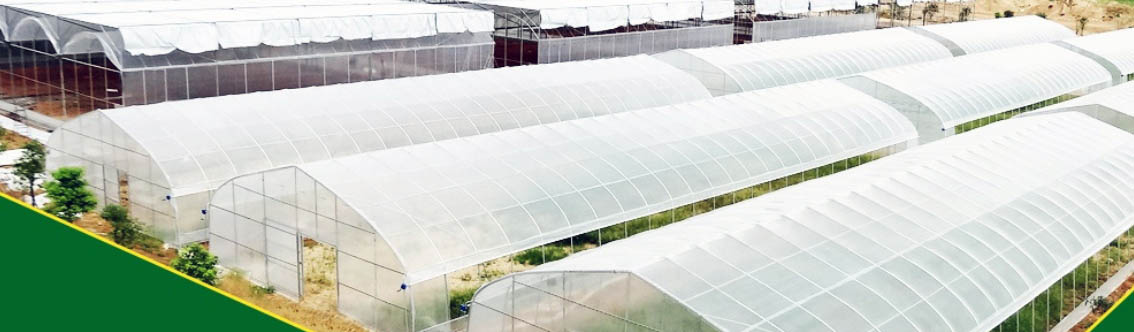
An arch house is one of the few structures where a single sheet can run from one side to the other without a seam, because the profile is one continuous curve. A film that drapes makes that possible: it follows the arch into the channel on both sides rather than being cut to fit it. The covering here may only be polyethylene held with aluminum clips, so the sheet carries no fixings beyond the clip line.
Fewer joints is the practical gain. Every lap or seam is a line where water can work in and where the sheet can lift in wind, so each one avoided by a film that conforms is a joint that never has to be watched, and the same property lets one roll cover the bays of a long house instead of being pieced across it. Houses of this type, in both the arch and tunnel forms, are shown under tunnel and poly tunnel houses.

Cold-Weather Installation: Working With a Stiffened Film
Polyethylene stiffens as it cools, well before freezing. A sheet that drapes on a mild afternoon is much harder to work at dawn in winter, and forcing a cold film damages covers before they are ever in service: pulled hard over a tight radius it creases instead of following the curve, and a crease pressed in cold is the one that stays.
The response is scheduling rather than technique. Fit the cover in the warmest hours of the day, when the sheet has some give; keep the roll closed until the moment it is needed; and do not pull the film drum-tight while it is cold, because tension that is right at ten degrees is too much at zero. A cover fitted tight in winter is tighter still in summer, and that load sits on the clips all season.
Two smaller habits belong with it. Unroll the film on a surface clear of ice, gravel and stubble, because a cold sheet scores easily and a score becomes a tear; and handle the roll by its core rather than dragging it across the ground. Where a house is being covered in a cold month, it is also worth knowing how much heat the finished house is expected to hold, which is set out in the note on heating needs in a greenhouse.

Fold Marks From the Roll: What Opens Out and What Stays
A new roll arrives wound, so the sheet carries folds from packing and transport, and a fitted cover collects more where the film is turned back at the channel and the end walls. What a fold does next depends on how hard it was pressed and at what temperature.
Folds taken in warmth and held under mild tension mostly open out on their own, leaving a faint line that fades over the first days on the house. A crease that was set cold, at a tight radius, or by pulling the sheet hard against the channel is different: it leaves a permanent line in the material. On the house that line is a mark rather than a hole, but it is thinner than the film around it, and it is where a split will begin if the cover is ever loaded hard.
That is why a cold fitting day deserves the care described above. Where a fold has to be accepted, it is better at the low end wall than over the crown, and better under low tension than high. Film that has been judged by its physical indicators rather than by its appearance, and what those indicators are, is covered in the note on the four indicators of a plastic film.
Six Mil at Low Temperature: What Thickness Does and Does Not Fix
This model is listed with standard clear greenhouse film at 6 mil, a build thicker than the 4 mil film normally sold for light garden use. What that extra thickness does at low temperature is often overstated. It does not make the sheet flexible; a thicker sheet of the same formulation is slightly stiffer when cold.
What it does is leave more material around any mark. A fold line, a nick at a clip or a graze from a branch is surrounded by more film on a 6 mil sheet than on a thin one, so a local fault is less likely to run. That is the value of the 6 mil build in a cold climate, and it works alongside the two covering thicknesses listed here, 0.15 mm and 0.12 mm.

Cover, Frame and Systems Data for a Cold-Site Build
The covering this page describes is standard clear greenhouse film at 6 mil, at a covering material thickness of 0.15 mm or 0.12 mm, run as a single layer or as a double layer, and it may only be held by aluminum clips on the frame channel. The frame is hot dip galvanized steel pipe under an arch roof, with spans of 6.4, 8, 9.6 and 10 metres and a total structure height of 4.3 metres to 6.5 metres, and ventilation is manually or electrically operated. The covering is intended to prevent heat loss and cold air intrusion, and the structure is drawn for a design wind load of 0.35 kN/m2. The pipe is specified at 70 to 85 micrometres of zinc under BS EN ISO 1461 and assessed to BS EN ISO 14713-1, so the frame's working life follows the corrosivity class of the site: class C2 (clean), C3 (urban), C4 (industrial) or C5 (coastal).
Crops grown under it are vegetables, fruit, flowers and seed nursery stock, and sizes are quoted to the customer's own drawing rather than a fixed footprint. The systems added on request are cooling and heating, irrigation, ventilation, fertilisation, shading and benches, so a house intended for a cold site can be ordered with the heating and insulation side filled in at the same time as the covering. What a film's working life looks like from the outside is set out in the note on extending the life of a cover film.


Ordering a Cover for a Cold Climate, Samples and Support
The company behind this covering is a manufacturer rather than a trading house, and the greenhouse items it sells are produced in its own works, which allows quality control and competitive pricing on the same order. The structure has been manufactured for above 35 years in the company's own frame factory.
A quotation is built from the quantity of houses required and the crops they will carry, and for a cold-climate order it is worth adding two figures: the lowest expected site temperature and the average wind speed. Temperature decides how much give the film will have on the intended fitting day, and wind decides the design pressure the frame is quoted against. Samples of the greenhouse products, including covering film components, are supplied free of charge, with sample freight borne by the customer. After the order, an after sales engineer provides layout drawings and the standard installation manual, and can travel to the customer's country where on site supervision is wanted. A house leaves the works in three groups, metal structures, covering system and install accessories, and the covering group is the part that arrives as a roll. Technical reporting on protected cropping through a winter season is published by HortWeek, and standards and guidance for the growers who build these houses come from bodies such as the NGMA.
If you need a cover specified for a house that will be fitted in cold weather, call us on +86 191 5068 3942 or send an e-mail to sales@cngreenhouses.com. Tell us the fitting month, the site temperature and the span you are covering, and the film, the thickness and the fixing can be settled for that job. The wider range this covering belongs to is shown under film greenhouse covers we build.


Frequently Asked Questions
Q: How does cold weather change the day a cover film is fitted?
Polyethylene stiffens as it cools, so a sheet that drapes well on a mild afternoon is much harder to work with on a frosty morning, and forcing it over a tight radius creases the film instead of letting it follow the curve. The practical answer is to fit in the warmest hours, keep the roll closed until it is needed, and avoid pulling the film drum-tight while it is cold, since tension that is right at ten degrees is too much at zero.
Polyethylene stiffens as it cools, so a sheet that drapes well on a mild afternoon is much harder to work with on a frosty morning, and forcing it over a tight radius creases the film instead of letting it follow the curve. The practical answer is to fit in the warmest hours, keep the roll closed until it is needed, and avoid pulling the film drum-tight while it is cold, since tension that is right at ten degrees is too much at zero.
Q: What is flexibility actually for in a greenhouse cover?
It is what lets one sheet follow the whole arch profile without being cut to fit, and what lets the film move with the frame instead of fighting it. A cover that is too stiff concentrates load at the clips and the channel; one that is too soft sags between clips and slaps. On this model the covering is clear polyethylene between 0.12 mm and 0.15 mm thick, held by aluminum clips, the range in which the sheet still drapes like cloth in mild weather.
It is what lets one sheet follow the whole arch profile without being cut to fit, and what lets the film move with the frame instead of fighting it. A cover that is too stiff concentrates load at the clips and the channel; one that is too soft sags between clips and slaps. On this model the covering is clear polyethylene between 0.12 mm and 0.15 mm thick, held by aluminum clips, the range in which the sheet still drapes like cloth in mild weather.
Q: Do the fold marks in a new roll come out on the house?
Mostly, if they were taken in warmth. A fold that was rolled or handled in mild conditions opens out under light tension and leaves only a faint line that fades over the first days. A crease set cold, at a tight radius or by pulling the sheet hard against the channel, leaves a permanent line, and that line is thinner than the surrounding film, which is where a split will start later.
Mostly, if they were taken in warmth. A fold that was rolled or handled in mild conditions opens out under light tension and leaves only a faint line that fades over the first days. A crease set cold, at a tight radius or by pulling the sheet hard against the channel, leaves a permanent line, and that line is thinner than the surrounding film, which is where a split will start later.
Q: Does a thicker film stay more flexible in the cold?
No. The 6 mil build this model is listed with does not make the sheet more flexible than a thinner one; a thicker sheet of the same formulation is slightly stiffer when cold. What it does is leave more material around a mark, so a fold line or a nick is surrounded by more film and is less likely to run. The covering is listed at 0.15 mm or 0.12 mm, run as a single layer or as two.
No. The 6 mil build this model is listed with does not make the sheet more flexible than a thinner one; a thicker sheet of the same formulation is slightly stiffer when cold. What it does is leave more material around a mark, so a fold line or a nick is surrounded by more film and is less likely to run. The covering is listed at 0.15 mm or 0.12 mm, run as a single layer or as two.
Q: What figures should be given when ordering a cover for a cold site?
The quantity of houses and the crops they will carry, plus the lowest temperature the site is expected to reach and the average wind speed there. Temperature indicates how much give the film will have on the intended fitting day, and wind sets the design pressure the frame is quoted against, which for this structure is a wind load of 0.35 kN/m2. Spans of 6.4, 8, 9.6 or 10 metres and a total height of 4.3 to 6.5 metres are quoted against the customer's own drawing.
The quantity of houses and the crops they will carry, plus the lowest temperature the site is expected to reach and the average wind speed there. Temperature indicates how much give the film will have on the intended fitting day, and wind sets the design pressure the frame is quoted against, which for this structure is a wind load of 0.35 kN/m2. Spans of 6.4, 8, 9.6 or 10 metres and a total height of 4.3 to 6.5 metres are quoted against the customer's own drawing.
Q: Are samples free, and who pays the freight?
Samples of the greenhouse products, including covering film components, are supplied free of charge, with the freight on a sample delivery borne by the customer. For a covering order, the quotation is built from the quantity of houses and the crops grown in them, and after the order an after sales engineer provides the layout drawings and the installation manual.
Samples of the greenhouse products, including covering film components, are supplied free of charge, with the freight on a sample delivery borne by the customer. For a covering order, the quotation is built from the quantity of houses and the crops grown in them, and after the order an after sales engineer provides the layout drawings and the installation manual.
Note: If you're interested in the product, please submit your requirements and contacts and then we will contact you in two days. We promise that all your informations won't be leaked to anyone.
 Deutsch
 Español
 Français
 Italiano
 Português
 日本の
 한국어
 العربية
 български
 hrvatski
 česky
 Dansk
 Nederlands
 suomi
 Ελληνικά
 हिन्दी
 norsk
 Polski
 Română
 русский
 Svenska