- Commercial Greenhouse
- Film Greenhouse
- PC Greenhouse
- Glass Greenhouse
- Tunnel Greenhouse
- Scientific Research Greenhouse
- Vegetable Greenhouse
- Flower Greenhouse
- Multi-span Greenhouse
- Sawtooth Greenhouse
- Greenhouse Equipments
- Greenhouse Accessories
- Hot Dip Galvanized Pipe
- Irrigation System
- Hydroponics System
- Planting Tools
- Planting technology
Tel: +86 191 5068 3942
Fax:
Mobile: +86 191 5068 3942
Contact: Alina
E-mail: sales@cngreenhouses.com
SKYPE:


- Features


Description
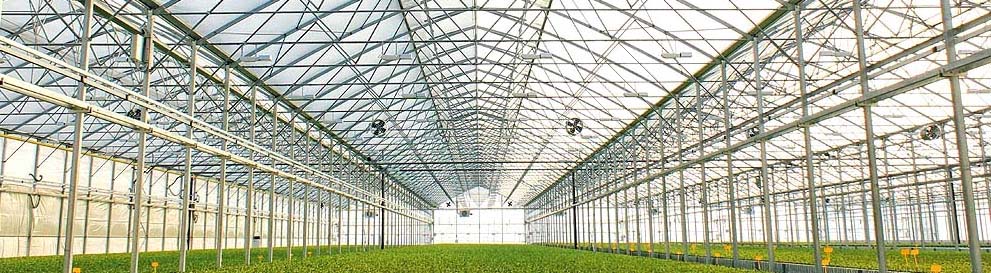
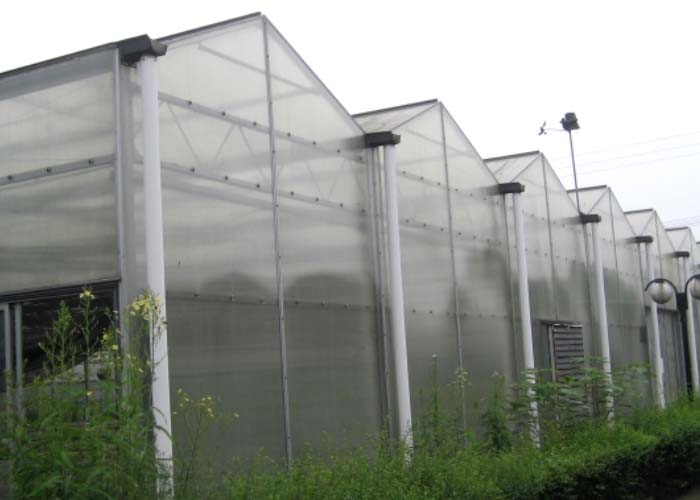
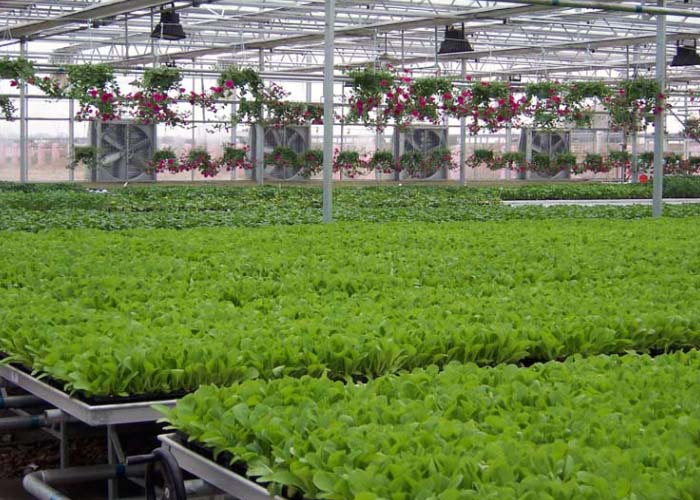
A vegetable greenhouse range built with a PC structure frame has excellent thermal insulation, so in-season vegetables can be eaten for a longer part of the year. Vegetable greenhouses usually use a steel skeleton, and the top is covered with one or several layers of insulation PC sheet, forming a closed growing space. The covering is drained well so condensate does not drip onto the crops.
Once the frame and covering are fixed, daily productivity depends on what the plan usually leaves until last: how the beds and the working space around them are arranged. Bed type, tier count, aisle width and irrigation route should all be settled before the door position is frozen. The PC sheet greenhouses we build share one platform, so the logic below applies to soil crops, bench greens and stacked seedlings alike.
Bed Type and Working Height: Match the Bed to the Crop and the Posture
Ground beds. Ground beds grow directly in the floor soil. They suit tall, long-season trellised crops such as tomato, cucumber, pepper and melon, and root crops such as radish and carrot, which need depth rather than a shallow root volume. The cost is posture: harvesting and pruning mean bending or kneeling, so the least frequently worked crop is the best candidate.
Raised benches. Benches lift the growing surface to the worker. A bench near hip height lets a picker stand and use both hands without bending, which is why lettuce, leafy greens, herbs and strawberry, all picked repeatedly by hand, are the classic bench crops. Fix the height by posture rather than by a catalogue figure: set the top so the most frequent task is done with the forearm roughly level.
Multi-layer benches. Tiers are stacked to multiply the growing surface per unit of floor. They belong to short-cycle, tolerant-light crops: seedlings waiting to transplant, microgreens and propagation plugs. They are the wrong place for a tall or light-hungry fruiting crop, because the tiers above steal light and head space.
A practical test is to list every operation the crop needs and note the posture. If most touches happen at or above knee level, a raised or stacked bed wins; if the crop is tall and touched a handful of times, a ground bed is simpler and just as productive. Our accessory range follows the same logic: the multi-layer rolling benches for stacked production, and the translational nursery beds where one aisle serves many benches.
Multi-Layer Benches: Output per Square Metre against Shading
Stacking raises output per square metre, but the gain is neither free nor unlimited. Every tier added above the first intercepts light that would otherwise reach the tier below, and blocks the air movement that carries heat and moisture out of the canopy, so the lower tiers end up dimmer and more humid than the top.
The comparison that settles the tier count is the extra harvest each tier brings against the extra light and air the tier below needs to reach the same quality: two or three tiers of a short-cycle crop usually pay back, because the crop finishes before the penalty matters.
Three principles reduce the penalty. Keep the stack low and each tier shallow, since a shallow tier shades less of the tier below than a deep one. Run the tiers in line with the ridge and the midday sun so the rows shade each other as little as possible. Put the light-demanding stage on top or on a single-tier bench and move only tolerant stages into the shaded tiers.
Aisle Width and Harvest Route
The aisle produces nothing, which is why it is so often made too narrow and then regretted for the life of the house. A working aisle must serve three users, and it should be sized for the widest rather than the average: a worker carrying a full crate, a hand cart or trolley, and the irrigation hose or a ladder. Size for the widest of the three, then add clearance for passing and turning.
Keep two aisle types apart. A main crossing aisle running the length of the house should let two people, or a person and a cart, pass each other. The aisle between bed rows can be far narrower, and in a rolling or translational bench system it can be almost eliminated, because the benches move aside to open one wide service aisle.
Lay the harvest route as a one-way loop: the picker enters at the headland, works along a row and leaves at the far headland, so full crates always travel forward and never back against the direction of work. Add cross aisles so changing rows never means walking the full length of the house.
Benches with Irrigation, and Access for Small Machinery
Bed layout and irrigation layout are one decision. Raised and stacked benches grow in containers or trays, so they pair with drip lines or flood and drain, while ground beds pair with drip tape and sub-irrigation from below. Route the main line along the aisle with the valves at the headland, never across the beds where they snag a crate. On a stacked bench each tier needs its own dripper or tray with its own valve; if the tiers share one line, the top takes the pressure and the lower tiers run dry.
Where a small tractor or powered cart moves substrate, crates or compost, the aisle stops being a footpath and becomes a road. Two clearances then govern the layout: the clear width of the door and main aisle, matched to the widest machine at its loaded width, and the turning space, which is the one most often forgotten. A machine has to turn at the headland without reversing over a bed.
For the reference standards behind protected cultivation and water management, see the United States Department of Agriculture (USDA). Practical reporting on how growers lay out beds and working space appears on Hortidaily.
Our company has supplied greenhouse structures and equipment for above 35 years, and steel frames are protected against corrosion according to the ISO 9223 and BS EN ISO 14713-1 exposure classes, from C2 up to C5. If you want to know more about greenhouse, please send an E-mail to sales@cngreenhouses.com or call +86 191 5068 3942.
Frequently Asked Questions
Q1: How do I decide between ground beds and raised benches?
Decide by contact frequency and posture. Tall crops touched a few times per season, such as trellised tomato and melon, or crops needing soil depth, such as radish, suit ground beds; crops picked repeatedly by hand, such as lettuce, suit raised benches.
Q2: How many tiers of multi-layer benches are practical?
No fixed number is reliable. The test is whether the lower tiers still reach marketable quality: short-cycle seedlings and plug holding tolerate two or three tiers, while a light-demanding fruiting crop does not tolerate shading at all.
Q3: How wide should the working aisle be?
Size it for the widest user, not the average: a worker with a full crate, a cart, or a ladder and hose. Take the widest, then add clearance so a person can pass and a cart can turn. In a rolling bench system the between-row aisle can be reduced further because the benches move aside.
Q4: Can a small tractor be driven inside the greenhouse?
Yes, if the aisle is planned as a road from the start. The door and main aisle must match the widest machine at its loaded width, the path must stay clear from door to far end, and the headland must be deep enough to turn without driving over a bed.
Q5: How are benches connected to irrigation?
Run the main line along the aisle with the valves at the headland, so nothing crosses the bed where it could snag during harvest. Each tier of a stacked bench needs its own dripper or tray with its own valve, otherwise the top tier takes the pressure and the lower tiers run dry.
Q6: Does a PC greenhouse need supplemental lighting for bench crops?
It depends on what the bench holds. A single-tier bench of a light-demanding crop normally relies on natural light, while stacked tiers are where supplemental lighting becomes part of the layout rather than an accessory, because upper tiers shade lower ones.
 Deutsch
 Español
 Français
 Italiano
 Português
 日本の
日本の
 한국어
한국어
 العربية
 български
 hrvatski
 česky
česky
 Dansk
Dansk
 Nederlands
 suomi
suomi
 Ελληνικά
 हिन्दी
 norsk
norsk
 Polski
 Română
 русский
 Svenska