- Commercial Greenhouse
- Film Greenhouse
- PC Greenhouse
- Glass Greenhouse
- Tunnel Greenhouse
- Scientific Research Greenhouse
- Vegetable Greenhouse
- Flower Greenhouse
- Multi-span Greenhouse
- Sawtooth Greenhouse
- Greenhouse Equipments
- Greenhouse Accessories
- Hot Dip Galvanized Pipe
- Irrigation System
- Hydroponics System
- Planting Tools
- Planting technology
Tel: +86 191 5068 3942
Fax:
Mobile: +86 191 5068 3942
Contact: Alina
E-mail: sales@cngreenhouses.com
SKYPE:

You are here: China Greenhouse Manufacturers > Commercial Greenhouse > Scientific Research Greenhouse


Scientific Research Greenhouse - Controlled Environment
Scientific research greenhouse with uniform light, temperature and humidity: insulated glazing, ventilation and compartment layout.
.
TEL:+86 191 5068 3942
- Features


What Makes a Research House Different:
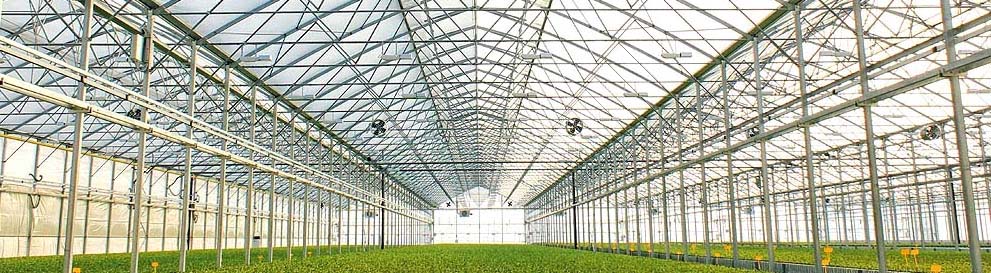
A research greenhouse is not a production house with a different name on it. A production house is judged on yield per square metre; a research house is judged on whether two beds given different treatments are really being grown under the same conditions, and whether the same trial run next season gives the same answer. That single difference drives everything else in the design: the environment has to be uniform across the floor, the compartments have to be separable so that trials do not contaminate each other, and the equipment has to be able to hold a set point rather than merely keep the crop alive. The second photo above shows a house in that role, with a crop under a glazed roof and the air handling visible overhead.Uniform Conditions: Light, Temperature and Humidity:
Uniformity is the thing to spend on. Light has to be even across the whole floor, not bright in the middle and dim at the gable ends, which is why a research house is usually built with glazing on the walls as well as the roof and with a frame that casts as little shadow as possible. Temperature has to be even in the horizontal plane and, as far as the design allows, vertically - a house with hot air trapped at the ridge and cold air at crop level will produce a gradient that hides the treatment effect you are trying to measure. Humidity is the hardest of the three to hold, because it moves with temperature and with the transpiration of the crop itself; screening and a properly sized ventilation and cooling system are what keep it inside a band rather than swinging through the day. Where the work needs it, supplementary lighting and CO2 enrichment are specified with the structure so that the services are planned rather than retrofitted.Compartments and Repeatable Trials:
Most research houses are built as compartments rather than one open floor, and the compartment layout is the decision that is hardest to change later. Each compartment needs its own climate control, its own irrigation zone and its own way in, so that a trial in one bay cannot be affected by what is happening next door. Within a compartment, the working width and the bench layout are set so that a bed can be treated as a unit - which usually means planning for more path space than a production house would accept, because the people doing the recording need to reach every plant. We build the compartment walls, doors and zones to the layout you need, and the greenhouse irrigation to match, so each zone can be run and metered independently.Cover, Glazing and Air Handling:
The cover follows the same logic. Glass gives the highest light transmission and the clearest view into the house, which matters both for the crop and for anybody observing a trial; where heat retention matters more than peak light, a PC sheet greenhouse on the same span is the better answer. Roof and side vents on a rack and pinion drive let a long house be aired from a few control points, and where a set point has to be held through a hot afternoon, wet curtain and fan cooling and internal or external screening are specified with the frame. All of the services - vents, screening, cooling, heating, lighting and irrigation - are planned at the drawing stage, because a research house that has to be drilled and re-plumbed after it is built is a house that has lost a season.Sizing, Delivery and Ordering:
Tell us the trials you plan to run, the number of compartments and the size of each, the set points you need to hold and your site conditions. From that we set the span, the height, the glazing, the zoning and the equipment schedule, and quote the glass greenhouse models that suit the work together with the wider commercial greenhouse range they are built from. Normal shipping time is 4 to 6 weeks after receipt of order, plus transit from the factory; 30% of the basic greenhouse price is charged on receipt of order and the balance before shipment. Read more about our greenhouse factory, call +86 191 5068 3942 or send an E-mail to sales@cngreenhouses.com.
Frequently Asked Questions:
Q: How is a research greenhouse different from a production greenhouse?
A: It is judged on repeatability rather than yield. The environment has to be uniform across the floor, compartments have to be separable so trials do not affect each other, and the equipment has to hold a set point rather than just keep the crop alive.
Q: Which is more important - temperature, humidity or light?
A: Uniformity matters more than any single one. Light has to be even to the gable ends, temperature even across and up the house, and humidity is the hardest to hold because it moves with temperature and with the crop's own transpiration.
Q: Why build compartments rather than one open floor?
A: So that a trial in one bay cannot be affected by what is happening next door. Each compartment gets its own climate control, its own irrigation zone and its own access. The compartment layout is the decision that is hardest to change later, so it is worth getting right at the drawing stage.
Q: Can supplementary lighting and CO2 be added?
A: Yes, and they should be specified with the structure rather than retrofitted. Planning lighting, CO2, screening, cooling and irrigation at the drawing stage is what keeps a research house from losing a season to re-work.
Q: Glass or PC sheet for a research house?
A: Glass gives the highest light transmission and the clearest view into the house, which matters for observation as well as for the crop. Where heat retention matters more than peak light, a PC sheet house on the same span is the better answer and we will say so.
Q: What do you need from me to quote?
A: The trials you plan to run, the number and size of compartments, the set points you need to hold and your site conditions. From that we set the span, height, glazing, zoning and equipment schedule.
Note: If you're interested in the product, please submit your requirements and contacts and then we will contact you in two days. We promise that all your informations won't be leaked to anyone.
 Deutsch
 Español
 Français
 Italiano
 Português
 日本の
 한국어
 العربية
 български
 hrvatski
 česky
 Dansk
 Nederlands
 suomi
 Ελληνικά
 हिन्दी
 norsk
 Polski
 Română
 русский
 Svenska