
- Commercial Greenhouse
- Film Greenhouse
- PC Greenhouse
- Glass Greenhouse
- Tunnel Greenhouse
- Scientific Research Greenhouse
- Vegetable Greenhouse
- Flower Greenhouse
- Multi-span Greenhouse
- Sawtooth Greenhouse
- Greenhouse Equipments
- Greenhouse Accessories
- Hot Dip Galvanized Pipe
- Irrigation System
- Hydroponics System
- Planting Tools
- Planting technology
Tel: +86 191 5068 3942
Fax:
Mobile: +86 191 5068 3942
Contact: Alina
E-mail: sales@cngreenhouses.com
SKYPE:


Greenhouse Ventilation Layout: Roof Vents, Louvres, Fans
Greenhouse ventilation by layout: ridge and roof vents at the peak, side louvre vents at crop level, roll-up film for tunnels, and fans for still days.
.
TEL:+86 191 5068 3942
- Features


Ventilation is the part of a greenhouse that decides whether the air inside still belongs to the crop by four in the afternoon. This page deals with the equipment that does the job and the way it is placed around the house: the openings, the drives that move them, the fans, and the order in which all of it goes together. The sensing and control side has pages of its own and is not repeated here, and the cooling figures of the wet curtain stay on the wet curtain page - on this page the pad set appears only as one member of the ventilation set.
The hardware side matters because ventilation is the one facility in a greenhouse that cannot be checked by looking at it. A house can be fitted with a large roof vent, a side wall full of louvres and two extract fans, and still hold stale air in the crop zone, because the openings are in the wrong places relative to each other. The sections below go through the pieces one at a time, then come back to the layout rules that decide whether the pieces work together.
Two Jobs for Ventilation, and Two Families of Equipment
Air in a closed house fails in two separate ways. The first is heat. Radiation that comes through the cover is trapped inside, so the air temperature climbs well above the outside air, and a crop that is held above its comfortable band stops growing and starts aborting flowers or bolting. The second is moisture. Every plant in the house is transpiring all day, and in a closed house that water vapour has nowhere to go: it reaches the dew point on the coldest surface it can find, which is the inside of the cover, and comes back down as condensation on the leaves. Leaf wetness under a still, humid head of air is what fungal disease is made of, and no amount of spraying replaces an air change.
The equipment that answers those two problems falls into two families. Openings - sash windows, louvre vents, rolled film - are natural ventilation: they work on the difference in density between warm and cool air, and on whatever wind the site gives, and they cost nothing to run. Fans are mechanical ventilation: they move a known quantity of air whether the day is still or not, and they cost power whenever they turn. The working rule is natural first, because it is free wherever it will do the job, and fans where the natural set cannot reach - a long multi-span house with a deep air path down the middle, a site with a hot still summer, or a house that has to hold a temperature through the afternoon rather than drift up with it.
Where the Openings Go: High Outlet, Low Inlet
Natural ventilation works on a height difference, so the two openings have to sit at two levels. The outlet goes as high as the structure allows, which on a multi-span house means a roof vent along the ridge of every bay, because the warmest and most humid air in the house collects up there. The inlet goes low, at or just above the crop line, so the replacement air arrives where the plants are rather than washing across the roof space and straight back out.
On the walls, the opening is usually a sash window or a louvre vent. A louvre vent is a stacked set of horizontal blades in a frame: the blades turn together, so the opening can be cracked part open on a mild day or run fully open at midday, and because the blades overlap in the closed position the wall stays weatherproof and the rain is kept out. That makes louvre vents a common choice on a side wall in a wet or windy climate, where a plain hinged sash would be slammed or would let the rain in. Louvre vents also take insect netting more easily than a sash, which matters where the crop has to be protected from aphid or whitefly pressure as well as kept cool.
What decides the performance is the pairing, not the size of either opening on its own. A house with a generous roof vent and no low inlet has an outlet but no inlet, so the air that leaves is replaced through the door gaps; the air in the crop zone hardly moves, and the house is no cooler than the same house with the roof vent closed.
Film and Tunnel Houses: Ventilation Without Windows
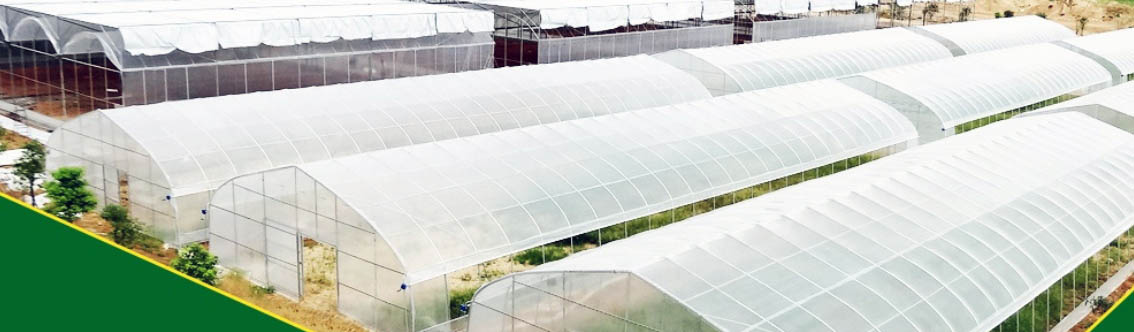
A film house has no sash to open, so the opening is made by rolling the cover itself. On the arch and tunnel houses the film is rolled up along the base, on one side or both, which is exactly the arrangement at the top of this page: the skirt is lifted and the crop behind it is open to the outside air across the full length of the house. The height the film is rolled to is the opening area, so the same house can be run almost closed on a cold morning and wide open by midday, and the wound roll also catches the wind and holds the film against the frame instead of letting it flap.
Some houses add a ridge roll-up as well, which gives the film house the same high outlet and low inlet pair that a windowed house has. Our own range is built in three modes, which are set out on the natural ventilation system page: volume ventilation, film ventilation, and rack and pinion sash windows. Where a film house is airtight enough that roll-up sides alone will not hold the crop, the next step is not a bigger opening but an extract fan in an end wall, because at that point the house is asking for forced air rather than more natural opening.
The Drive: Rack and Pinion, Hand or Motor
Sash windows and louvre vents are moved by a rack and pinion drive, and the drive can be turned by hand or by motor. The hand crank is the right answer on a small house, on a site with no power at that wall, or where the grower wants the openings moved by a person each morning and each evening. The motorised version is what makes a long house practical: one drive line serves a run of windows, so a house a hundred metres long can be opened from a few control points instead of being walked window by window. Rolled film is moved by a film winder instead, hand turned or electric, and the same logic applies - the electric winder is chosen where the house is long or where the sides have to come down quickly when the weather turns.
Louvre Shutters, Extract Fans and the Pad Set

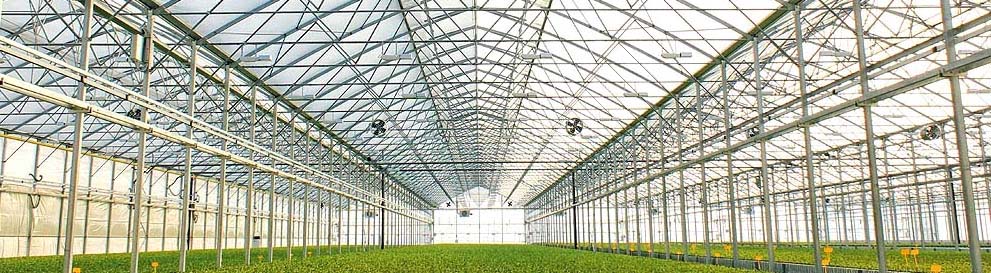
Mechanical ventilation starts with the extract fan. The fan is set into a wall - an end wall or a gable, as in the photograph above - and carries a louvre shutter on its outside face that hangs closed when the fan stops and is pushed open by the air stream when it runs, so the house is not left with an open hole in the wall overnight. Fans earn their place on the days when natural ventilation fails: a still afternoon with no wind and no density difference to work with, a long house whose middle bays are far from any opening, and a high summer peak where the crop cannot be allowed to drift up with the outside temperature.
Where an extract fan on its own is still not enough, the fan is matched to a wet curtain and the two are ordered as one set: the pad goes along one end wall, the fans in the opposite one, and the air is then drawn the length of the house through the wetted pad and cooled on the way in. The cooling performance of that set - how many degrees it takes out of the house and how the pad area and the water circuit are worked out - belongs to the wet curtain cooling set page and is not repeated here. What belongs on this page is the position of the pad set inside the ventilation plan: it is the forced member of the set, it is quoted with the fans rather than bought apart, and it only performs if the rest of the openings are shut while it runs, for the reason given in the layout rules below.
Circulation Fans Are Not Ventilation
The fans that hang inside the house and blow along the crop are a separate item with a separate job, and it is worth keeping the two apart when a set is specified. A circulation fan does not exchange the air in the house with the outside; it moves the air that is already there. That is exactly what is wanted when the house is deliberately closed - a winter night with the heating on, or a sealed house running on enriched carbon dioxide - because the layers of warm air under the roof, cool air at the floor and a film of damp air against the leaves are evened out into one body of air, and the crop dries off after watering. It is not what is wanted on a hot afternoon, because no amount of stirring will cool air that has nowhere to go.
So the two are specified together rather than one instead of the other. The circulation fans in our range are built on moisture proof motors with adjustable air volume and blade speed, and that page sets out how they are built and where they are used. The ventilation openings and the extract fans do the exchanging; the circulation fans do the evening out.
How Much Ventilation, and Where the Figure Comes From
Ventilation quantity is expressed as air changes per hour: the whole air volume of the house is moved out and replaced, and the question is how many times that has to happen in an hour on the worst afternoon of the year. The volume itself is the span multiplied by the length multiplied by the average height of the house, so a wide long house asks for a great deal more moving air than a narrow one of the same floor area, and the target rate is set by how hot and how humid the local summer gets and by what the crop will tolerate.
We do not print a single air change figure and offer it for every greenhouse, because the figure that holds a leafy crop on a hot dry afternoon is not the figure a cool coastal site needs, and oversizing a fan set wastes power every day of the year while undersizing it fails on the two days that matter. Give us the span, the length, the average height, the crop and the local summer peak, and the vent area and the fan capacity are worked out for that house rather than copied from a catalogue.
The Layout Rules That Decide the Result
Five points cover most of the ventilation faults we are asked to correct on houses that already have the equipment fitted.
Outlet above the inlet, never the other way round. The high opening is the exhaust and the low opening is the supply. Two openings at the same height, or an outlet below an inlet, give a house that looks ventilated and is not.
Keep the air path clear along its whole length. A tall crop, a stack of trays or a parked machine standing against the inlet wall starves every bay downstream of it. The opening is only as good as the route the air takes away from it.
Every bay needs its own outlet. On a multi-span house a bay with no roof vent of its own sits in the lee of the next one and turns into a dead zone, whatever the total vent area of the house says.
Do not leave the natural openings open while the extract fans or the pad set are running. The fans then take their air from the nearest opening at the top of the house instead of pulling it along the crop, and the air in the crop zone barely moves even though the fans are doing full work. Shut the vents and let the air come in the way the set was designed to take it.
Check the house for leaks before blaming the equipment. A door frame that does not seal, an unsealed end wall panel or a torn film skirt lets air in where it is not wanted, and the openings then have to be bigger than the house should need. Sealing the house costs almost nothing and is the part most often skipped.
Hand, Motor, and One Control Point
Every moving part described above can be worked by hand, and on a small house that is often the right answer: the grower walks the house and opens what the morning needs. Once a house is long, or is run by someone who is not always on site, the drives and the fans are wired to a control unit instead, so that the openings, the film roll-up and the fans respond to the same set of readings rather than to a person walking the length of the house with a crank. Sensors, control units and the way the loop is set up are a subject of their own: they are covered on the automatic control page and on the control ventilation system page. What matters here is only that the equipment on this page is built to be driven that way when the buyer wants it, and that the drives and the fans are ordered with the control unit in mind rather than added to it afterwards.
What the Set Contains, and What to Send Us
A ventilation set put together from this page reads as follows: roof or ridge vents on every bay, side louvre vents or sash windows at crop level, roll-up film sides on the film houses, a rack and pinion drive to each run of openings, hand or motor turned, extract fans with louvre shutters in the end walls where forced air is wanted, a wet curtain set to match them where cooling is wanted as well, circulation fans inside the house, and insect netting over the openings where it is specified.
To have a set quoted, send the span and the length of the house, the average height, the crop and the stage it is grown to, the hottest and most humid month where you are and what the temperature reaches in it, the coldest night you have to hold, whether there is power at the site, and whether the openings should be hand or motor driven. Tell us as well whether this is a new house or one already standing, because ventilation is much easier to place while the frame is still being detailed, and a house that is already up can usually still take louvre vents, roll-up sides and wall fans - the frame, the wall panel and the power supply are checked first.
Factory, Service and How to Order
The equipment on this page is made in our own factory, which has been building greenhouses and the fittings that go into them for above 35 years, so the ventilation set, the frame it is bolted to and the irrigation that runs beside it come from one source rather than from three. What a buyer gets with an order is the service behind it: a reply to an enquiry within 24 hours and 14 hours of online service each day, the technical support and the solution worked out by our chief engineer rather than by a sales desk, a quality control system and team behind every run, and OEM or ODM work where the buyer wants the set to his own drawing. A sample order can be taken before the mass order, and enquiries are handled in English, Spanish, French, Portuguese and Japanese among other languages.
Alongside the greenhouse range the factory makes irrigation and garden fittings - sprinklers, gardening hand tools, water nozzles, recoil hoses and other hose end accessories - so a house can be fitted out from the one supplier. Notes on protected cropping and greenhouse climate are published by organisations such as the NGMA, and international horticultural trade news is reported by HortWeek; both are useful starting points for a grower working out what his own house needs.
To have a ventilation set priced and laid out for your house, call +86 191 5068 3942 or write to sales@cngreenhouses.com with the span, the length, the crop and your summer peak, and the openings, the drives and the fans will come back as one specification rather than as a list of parts.
Frequently Asked Questions
Q: Do I need roof vents, side vents, or both?
A: Both, and they do opposite jobs. The roof vent along the ridge is the outlet, because that is where the warmest and dampest air sits, and the side vent or louvre at crop level is the inlet, because the replacement air should arrive where the plants are. A house fitted with high openings only has an outlet and no supply, so the air in the crop zone hardly moves and the house is barely cooler than one with the vents shut.
A: Both, and they do opposite jobs. The roof vent along the ridge is the outlet, because that is where the warmest and dampest air sits, and the side vent or louvre at crop level is the inlet, because the replacement air should arrive where the plants are. A house fitted with high openings only has an outlet and no supply, so the air in the crop zone hardly moves and the house is barely cooler than one with the vents shut.
Q: How do you ventilate a film tunnel that has no windows at all?
A: By rolling the film. The skirt is wound up along the base, on one side or both, which opens the crop to the outside air over the full length of the house, and some houses add a ridge roll-up to give the same high outlet and low inlet pair a windowed house has. The height the film is rolled to is the opening, so the same house can run nearly closed in the morning and wide open at midday. Where roll-up sides are not enough, the next step is an extract fan in an end wall rather than a taller opening.
A: By rolling the film. The skirt is wound up along the base, on one side or both, which opens the crop to the outside air over the full length of the house, and some houses add a ridge roll-up to give the same high outlet and low inlet pair a windowed house has. The height the film is rolled to is the opening, so the same house can run nearly closed in the morning and wide open at midday. Where roll-up sides are not enough, the next step is an extract fan in an end wall rather than a taller opening.
Q: How much ventilation does my house actually need?
A: The quantity is expressed in air changes per hour, worked out from the volume of the house - span times length times average height - together with the local summer peak and what the crop tolerates. We do not print one figure and apply it to every greenhouse, because the rate that holds a crop on a hot dry afternoon would waste power every day on a cool coast. Send the span, the length, the average height, the crop and your summer peak, and the vent area and fan capacity are worked out for that house.
A: The quantity is expressed in air changes per hour, worked out from the volume of the house - span times length times average height - together with the local summer peak and what the crop tolerates. We do not print one figure and apply it to every greenhouse, because the rate that holds a crop on a hot dry afternoon would waste power every day on a cool coast. Send the span, the length, the average height, the crop and your summer peak, and the vent area and fan capacity are worked out for that house.
Q: Can the openings be worked by hand, or do they have to be motorised?
A: Both are supplied. Sash windows and louvre vents run on a rack and pinion drive that can be turned by a hand crank or by a motor, and rolled film is moved by a hand turned or an electric film winder. Hand operation suits a small house or a site with no power at that wall; the motorised drive is what makes a long house practical, because one drive line serves a run of windows and the house can be opened from a few control points instead of being walked window by window.
A: Both are supplied. Sash windows and louvre vents run on a rack and pinion drive that can be turned by a hand crank or by a motor, and rolled film is moved by a hand turned or an electric film winder. Hand operation suits a small house or a site with no power at that wall; the motorised drive is what makes a long house practical, because one drive line serves a run of windows and the house can be opened from a few control points instead of being walked window by window.
Q: Should the vents stay open while the extract fans or the wet curtain are running?
A: No. With the natural openings left open the fans take their air from the nearest opening at the top of the house instead of pulling it along the crop, so the fans run at full work and the air in the crop zone hardly moves. Shut the vents while the forced system runs, and let the replacement air come in through the wet pad the way the set was designed to take it.
A: No. With the natural openings left open the fans take their air from the nearest opening at the top of the house instead of pulling it along the crop, so the fans run at full work and the air in the crop zone hardly moves. Shut the vents while the forced system runs, and let the replacement air come in through the wet pad the way the set was designed to take it.
Q: Can ventilation be fitted to a house we already have standing?
A: Usually it can, and louvre vents, roll-up film sides and wall fans are all fitted to existing houses. What has to be checked first is whether the frame will carry the drive brackets and the fan openings, whether the wall panel is strong enough to take the fan, and whether there is power at the house. Send the span, a few photographs of the frame and the end walls, and the crop, and we will say what the frame will take.
A: Usually it can, and louvre vents, roll-up film sides and wall fans are all fitted to existing houses. What has to be checked first is whether the frame will carry the drive brackets and the fan openings, whether the wall panel is strong enough to take the fan, and whether there is power at the house. Send the span, a few photographs of the frame and the end walls, and the crop, and we will say what the frame will take.
Note: If you're interested in the product, please submit your requirements and contacts and then we will contact you in two days. We promise that all your informations won't be leaked to anyone.
 Deutsch
 Español
 Français
 Italiano
 Português
 日本の
 한국어
 العربية
 български
 hrvatski
 česky
 Dansk
 Nederlands
 suomi
 Ελληνικά
 हिन्दी
 norsk
 Polski
 Română
 русский
 Svenska