
- Commercial Greenhouse
- Film Greenhouse
- PC Greenhouse
- Glass Greenhouse
- Tunnel Greenhouse
- Scientific Research Greenhouse
- Vegetable Greenhouse
- Flower Greenhouse
- Multi-span Greenhouse
- Sawtooth Greenhouse
- Greenhouse Equipments
- Greenhouse Accessories
- Hot Dip Galvanized Pipe
- Irrigation System
- Hydroponics System
- Planting Tools
- Planting technology
Tel: +86 191 5068 3942
Fax:
Mobile: +86 191 5068 3942
Contact: Alina
E-mail: sales@cngreenhouses.com
SKYPE:


- Features


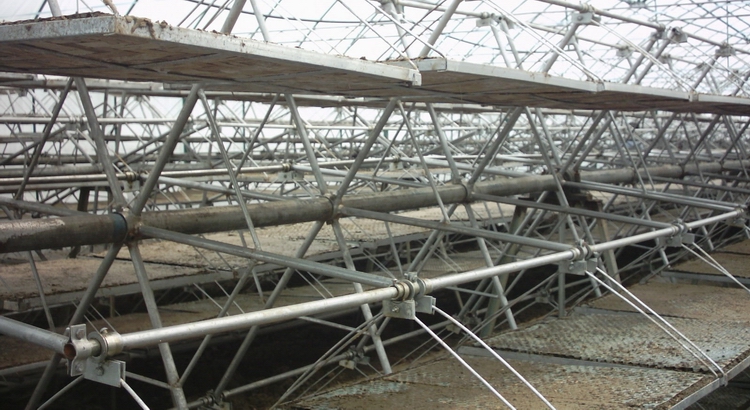
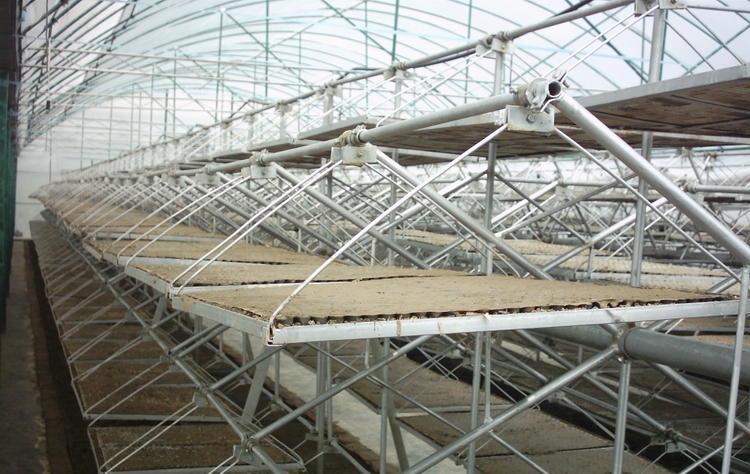
A rotating nursery bed solves a problem that every seedling house has: the trays nearest the wall get more light and dry faster than the trays in the middle of the block, so a batch raised in fixed positions is never quite even. The photo above shows the kind of steelwork involved. This page covers how the rotation works, what the structure is made of, and the specifications that decide whether a house can use it.
Why the trays are rotated
Light and water are not evenly distributed inside a greenhouse. Trays at the outer edge of a block receive more light and lose water faster than trays in the interior, and the difference shows up as uneven seedlings: taller plants at the edges, smaller ones in the middle, and a batch that has to be graded before it can be sold as one lot.
The traditional answer is to move the trays by hand, which costs labour through the whole raising period and is done inconsistently. A rotating bed takes that task over mechanically. The trays are carried on a rotating bracket driven by power, so that every tray spends time in the outer positions and in the inner ones, in continuous exchange. Over a full cycle each seedling receives a comparable share of the light and of the water, which is the whole point of the system.
The mechanism and the tray positions
The trays are hung from the rotating bracket rather than standing on a static frame, and the bracket is driven so that the positions change continuously. Because the trays travel on the same carriage, the exchange is automatic and identical for every tray: there is no sequence for an operator to get wrong, and none of the batch is left in a single position.
The same structure carries the trays on several levels. The installation is arranged in upper, middle and lower tiers so that the house is used in three dimensions rather than as a single layer of benches, which is what allows a given floor area to hold far more trays than a ground-level layout.
The drive is the part that wears, so access to it belongs in the layout. Chain or gear cases, bearings and the fixings that hold each tray bracket are the items that need checking on a routine, and because the frame is assembled from formed fasteners and standard parts, a damaged holder or bracket is replaced on site rather than cut out of a welded frame.
Structure, clearances and tray holders
The frame is an all-steel structure, assembled from formed fasteners and standard parts rather than from welded sections, which is what allows it to be erected and adjusted on site and to be repaired part by part later.
The clearances are fixed by the specification. The minimum ground clearance under the tray line is 300 to 500 mm, which leaves room for drainage below, for air to move under the trays, and for an operator to work along the row. The tray holder is 620 by 650 mm, which sets the size of the tray that locates positively in the bracket and therefore sets how many positions a given run contains. Getting those two figures right at the ordering stage is what decides the capacity of the whole installation.
Control and the exchange interval
The position exchange is controlled automatically, with the interval set by the user. The working range is 10 to 60 minutes between exchanges, and the appropriate setting is not a constant: a young batch under weak winter light benefits from a shorter interval than a hardened batch in bright spring conditions, and the interval is also the main lever on how much the drive actually runs.
Because the exchange is automatic, the bed does not need an operator standing in the house all day, which is the second thing it buys besides evenness. The routine work reduces to watching the mechanism, cleaning the drive and checking that the trays still locate properly in their holders.
What it changes, and how it compares
The effect claimed for the system is a better use of the greenhouse itself: the effective utilisation rate is given as 1.5 times that of a conventional greenhouse, which follows from carrying trays on three levels and from keeping the whole volume in production rather than concentrating the batch at one height.
It is one of several ways to use a house more intensively, and the choice depends on what the grower is short of. A translational bench slides sideways to reduce the aisle space and is the simplest of the group; a multi-layer bench with hand-wound or power-driven positions gains height without gaining uniformity; a rotating bed gains both, at the cost of a drive and of a mechanism to maintain. Where the crop is raised for sale as one uniform lot, that is usually the argument that decides it. Where the batch is graded anyway, the simpler bench will do.
To have a rotating bench specified against the house and the tray you use, write to sales@cngreenhouses.com or call +86 191 5068 3942. With above 35 years in greenhouse engineering we supply greenhouse equipment systems with the house, and keep reference material on the other bench arrangements: the multi-layer bench in multi-layer rolling bench design, the power driven version in power driven tray systems, and the simplest option in translational seedling beds.
Independent guidance on protected cultivation is published by the FAO, and current commercial reporting by Greenhouse Grower.
Frequently Asked Questions about rotating nursery beds
Q1: What problem does a rotating nursery bed actually solve?
Uneven seedlings. Trays at the edge of a block receive more light and dry faster than trays in the middle, so a batch in fixed positions has to be graded. Rotating the trays continuously gives every tray a comparable share of both, so the batch comes out even.
Q2: How often should the trays exchange position?
The interval is user set, with a working range of 10 to 60 minutes. The right setting follows the light and the stage of the batch rather than staying fixed: a young crop under weak winter light gains from a shorter interval than a hardened batch in bright spring conditions.
Q3: What are the key dimensions to order against?
The minimum ground clearance of 300 to 500 mm and the tray holder of 620 by 650 mm. The clearance provides drainage, airflow and working space beneath the trays, and the holder size sets both the tray that locates in it and the number of positions a run contains.
Q4: How many levels can the trays be carried on?
The installation is arranged in three tiers, upper, middle and lower, so the house is used in three dimensions instead of a single layer of benches. That is where the gain in usable capacity per square metre of floor comes from.
Q5: Does the bed need an operator during the day?
No. Position exchange runs on the automatic control at the interval set, so it does not need someone in the house through the raising period. The routine work is watching the mechanism, cleaning the drive and checking that trays still seat properly in their holders.
Q6: How does it compare with a translational or multi-layer bench?
A translational bench slides sideways and simply reduces aisle space; a multi-layer bench adds height without adding uniformity; a rotating bed gains both height and evenness, at the cost of a drive and a mechanism to maintain. The choice is usually decided by whether the crop is sold as one uniform lot.
 Deutsch
 Español
 Français
 Italiano
 Português
 日本の
日本の
 한국어
한국어
 العربية
 български
 hrvatski
 česky
česky
 Dansk
Dansk
 Nederlands
 suomi
suomi
 Ελληνικά
 हिन्दी
 norsk
norsk
 Polski
 Română
 русский
 Svenska