
- Commercial Greenhouse
- Film Greenhouse
- PC Greenhouse
- Glass Greenhouse
- Tunnel Greenhouse
- Scientific Research Greenhouse
- Vegetable Greenhouse
- Flower Greenhouse
- Multi-span Greenhouse
- Sawtooth Greenhouse
- Greenhouse Equipments
- Greenhouse Accessories
- Hot Dip Galvanized Pipe
- Irrigation System
- Hydroponics System
- Planting Tools
- Planting technology
Tel: +86 191 5068 3942
Fax:
Mobile: +86 191 5068 3942
Contact: Alina
E-mail: sales@cngreenhouses.com
SKYPE:


Sawtooth Greenhouse Plastic Film: Choice, Fixing, Tension
How the plastic covering is chosen and hung on a sawtooth greenhouse: 0.12 or 0.15 mm film, grooved channel and aluminum clips, roll-up side curtains.
.
TEL:+86 191 5068 3942
- Features


A sawtooth house is not a barrel, so its covering is not one long sheet either. The roof is a row of teeth, and the film has to follow that row: it runs over the sloping faces, stops at the frames that carry the opening faces, and on the side wall it does not stay fixed at all, because there it is a curtain that rolls up. This page is about the covering and nothing else - which film the house is quoted with, how it is held and tensioned over the teeth, where the film has to stop so that the vents and the side curtains still work, and what arrives on site with the rolls. How the teeth take light and clear heat, and the frame and span table, are set out on the other sawtooth pages and are not repeated here.
What the Sheet Fixes About the Covering
Two things about the cover are settled on the specification sheet and are worth reading before anything else, because they decide how the whole job is done. The first is the material: this house is covered with polyethylene film held with aluminum clips. It is not offered as a glass house with a film option, and it is not offered as a rigid sheet house. A film cover is light, it arrives in rolls, and it is fixed by trapping an edge in a frame member instead of by glazing bars, gaskets and beading. The second is the thickness: the covering material is quoted at 0.15 mm or 0.12 mm, and those are the two figures the order is placed against.
One more line on the same sheet decides the rest of this page. The frame carries a special grooved channel for the cover, and the stated purpose of that channel is to keep the film reinforced against wind and weather. In other words the fixing is not an accessory bolted on at the end of the build; it is part of how the house stands up to the weather. Everything below follows from those three facts.
0.12 mm or 0.15 mm: What the Number Changes
Both thicknesses are the same material, both are quoted for this house, and the choice is really a question about what the film has to survive on your site. The heavier sheet, 0.15 mm, has more material in the roll and in the run. That is worth having where the wind is strong or where the site is open, because it resists tearing where the film meets the frame, it flaps less when the wind gets under an edge, and it puts a little more between the crop and a cold night. A heavier film also tolerates more handling: covering a sawtooth roof means the film is pulled over frames, walked along and pulled again, and thin film is the film that suffers on that route.
The lighter sheet, 0.12 mm, weighs less in the run, so it goes on more easily and loads the frame less; for a given transparency it also takes away slightly less light, which matters in a house that is already trading light against heat. The honest answer to which one to order is that it depends on the exposure of the site and on how often you are willing to re-cover, and both figures are quoted so that the decision can be made against your own conditions rather than by default. If you want to see how the same thicknesses are described as covering products, our greenhouse plastic sheeting and UV stabilised greenhouse film pages set out the rolls we supply.
There is a third decision that is easy to forget and expensive to get wrong: the grade of the film, not just its gauge. The covering is described on the sheet as anti-PEP film, and the additives in the film are what decide how it behaves in sunlight and how it behaves when the house is closed at night. The general background on protected cultivation and on how a covering changes the climate inside a structure is published by bodies such as the USDA, and it is worth a look before you settle the grade. Before ordering, tell us the job the film has to do on your site - stabilised against ultraviolet, treated against condensation drip onto the crop, or a combination - and the roll is made to suit it rather than being taken off the shelf.
The Grooved Channel and the Aluminum Clips
The fixing on this house is a grooved channel running along the frame and a clip that presses the film into the groove. The film edge is pushed into the channel, the clip - a sprung wire that follows the same groove - is snapped over it, and the film is held along its whole edge by friction and spring pressure rather than by anything driven through it. Nothing pierces the cover, so there is no line of holes to tear from and no sealing compound to fail.
Two practical consequences follow. The first is that tension can be corrected later. Opening the clips along a run, pulling the film a little further into the channel and clipping it down again is a job for two people with a ladder, not a re-cover; on a roof made of repeated teeth, where the film has to turn at every tooth, that ability to correct an individual run is what keeps the house looking tight instead of patchy. The second is that the clip line is the strong line of the cover. Because the sheet is held mechanically along the channel, the wind load on the cover is passed into the frame at that line, which is exactly what the grooved channel is there for. A film that is only draped over the frame and tied down at the ends has no such line: it works loose, it saws against whatever it touches, and the first tear always appears at a tie.
Covering a Roof Made of Teeth: the Order of Work
On a film tunnel the covering is one continuous barrel and the sheet can be pulled on in one movement. A sawtooth roof does not allow that, because each tooth presents two surfaces with two different jobs: the sloping face is the surface that is covered and takes the light, and the near vertical face at the top is the surface that opens. The principle behind that split is covered on our sawtooth light and heat page, and the covering consequence is simple - the film is worked in runs from one gable end to the other, and no run is allowed to bridge across an opening face.
Within a run the order of work is the same every time, and getting it wrong is what produces a loose cover. The film is laid over the run with its surplus hanging at both ends, the two ends are hooked into the channel first so that the sheet cannot slide, and only then are the clips run along the channel. Tension is applied while clipping, from the middle of the run outwards, so that the slack is pushed out to the ends where it can still be pulled away. Pulling the whole sheet tight first and then trying to clip it is the usual mistake: the film fights the channel, the clips distort the film at the corners, and the run ends up with a fold that never comes out.
A covered sawtooth roof is a working roof, not a finished one. The vents at the top of each tooth have to open and close under their own frames, so the film run is finished short of the opening frame with enough clearance that the frame never touches the film, and the last clip on each run is set where the cover can be checked by hand from the walkway or from a ladder. Where the cover has to pass a corner, the film is worked round the corner in small steps with a clip after each step rather than being stretched across it in one pull.
Where the Film Stops: Side Curtains and Insect Net
On the side walls of this house the film does a different job, and it is quoted differently: ventilation is by sidewall openings covered with insect nets and roll-up curtains, manually or electrically operated. That means the side film is not a fixed cover at all. It is a curtain held on a roll-up tube, opened and closed by hand or by a motor, with the insect net taking the place of the film when the curtain is up. Reading the two sides of the house together is what fixes the film list for an order: fixed film on the sloping roof faces, roll-up film on the side walls, net where the side opening is.
The covering detail that this creates is worth knowing because it decides how the side film is fixed. A curtain that has to roll must be fixed along one edge only; the top edge goes into the channel and is clipped, and the rest of the sheet has to hang free so that it can be gathered onto the roll. If a curtain is clipped down both sides it will not roll, and if it is clipped down one side only without a proper channel at the top it will be pulled off the frame the first time the wind gets behind it. The insect net is set in its own frame behind the curtain, so the curtain rubs on the frame and not on the net.
Tension, Slack and Wind
A film cover is judged by how it behaves in wind, and the failure that matters is slack. Film that is not held taut lifts in a gust, drops back, and lifts again; every one of those movements rubs the sheet against the frame and against its own folds, and the wear shows first at the clip line and at the corners. Slack also collects water, and standing water on a film cover is weight on the frame, dirt on the cover, and less light reaching the crop until it drains or is pushed off.
The test on site is a hand pressed flat against the middle of a run. The film should give a little and come back with the shape of the roof, not ripple and not drum. Two habits keep it that way: check the cover after the first windy week, when the film has taken its final set and a few clips can be re-set; and re-tension before winter rather than after, because a film cover is easiest to work in mild weather and least forgiving in the cold, when the sheet stiffens and the risk of tearing at a clip goes up. Cut or torn film is repaired with a patch and the run re-clipped; the covering is a service item on the house and is meant to be dealt with in that way.
Warmth: What a Film Cover Does and Does Not Do
One of the advantages listed for this type is that it is good at keeping warm, and it is worth being precise about where that warmth comes from. A film cover works first as a wind break: it takes the moving air off the crop and holds a layer of still air around it, and still air is the simplest insulation there is. The second part is sealing. Most of the gain that a grower notices between a film house and the open field comes from being able to close the house - roof vents shut, side curtains down, doors closed - rather than from the gauge of the film.
So the thickness decision and the warmth question are separate. Going from 0.12 mm to 0.15 mm does help, but the far larger effect comes from a cover that is tight, from curtains that actually close along their whole length, and from closing the openings at the right hour in the afternoon rather than at dusk. The trade press, such as HortiDaily, carries growers' own accounts of how much difference covering and closing practice makes from one site to the next. Where night temperature is the real limit on the crop, the answer is not a heavier sheet: it is the cooling and heating system that is quoted as an add-on for this house, and the film job is only to keep that heat where the system put it.
Film Width, Span and Where Runs Join
Film is supplied in rolls of fixed width, so the width of a run is a decision made at the drawing stage and not on the roof. The span of this house is quoted at 6.4, 8, 9.6 or 10 metres with a total structure height of 4.3 metres to 6.5 metres, and a run on a sloping face is measured against that span; the aim is always to cover the face with as few joins as possible, because every join is a place where water can get in and where the film can lift. Where a join cannot be avoided, it belongs over a frame member and inside a channel rather than in the middle of a face, and it should be kept off the face that takes the worst of the prevailing wind.
The same thinking applies to spare film. Ordering a little extra width and length at the same time as the house is the tidy way to keep a spare run in store; ordering a single replacement roll later means paying for a roll on its own shipment, and matching it to a cover that has already weathered is never exact. The spans and the height range are given in full on the sawtooth specification page, so they are only repeated here for the one purpose they serve on this page, which is setting the film runs.
Systems Under the Cover
The house is quoted with a list of systems that can be added to the same frame: a cooling and heating system, an irrigation system, a ventilation system, a fertilization system, a shading system and benches. Every one of them touches the covering, so the covering order and the system order are best placed together. A cooling pad needs a solid end wall to stand against, shading needs structure above the roof so that the film is not carrying it, irrigation and fertilization need pipes through the side wall and that means the film is cut and sealed at a known place rather than at a place somebody picks on site later.
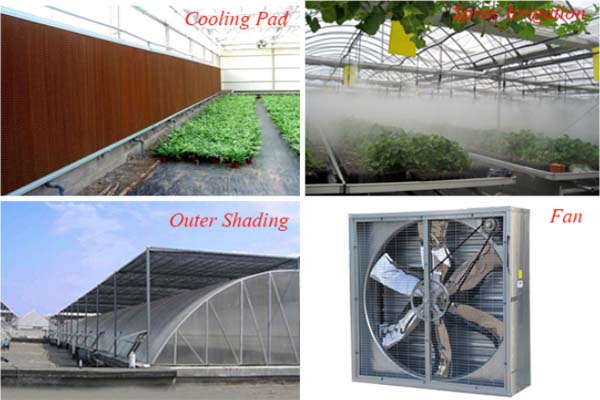
The photograph below is the equipment side of the same house: the cooling pad wall with the crop rows running up to it, the cooling system pipework and misting under the roof, an outer shading screen drawn over the frame, and the exhaust fan set in the end wall. What matters for the covering is that all four are planned before the film is cut, because each of them changes where a run of film begins and ends.
What Arrives on Site With the Film
The package listed for this house is metal structures, covering system and install accessories, and that is the order in which a covering job is unpacked: the frame goes up first, the covering system follows it, and the accessories that hold the cover are in the same shipment rather than in a separate one. Everything the cover depends on - the channel, the clips, the curtain tubes and the net - travels with the house, so a site is not left waiting on a box of clips before the roof can be closed.
Two handling points are worth passing on to whoever receives the container. Rolls of film are stored upright, out of the sun, and are not opened until the frame run they belong to is finished, because film that has been unrolled and left lying in the open picks up dirt and creases before it ever reaches the roof. And the frame should not be left standing bare any longer than the build requires - a covered house is a protected house, and on a windy site the cover is what stops the frame from taking the load on its own.
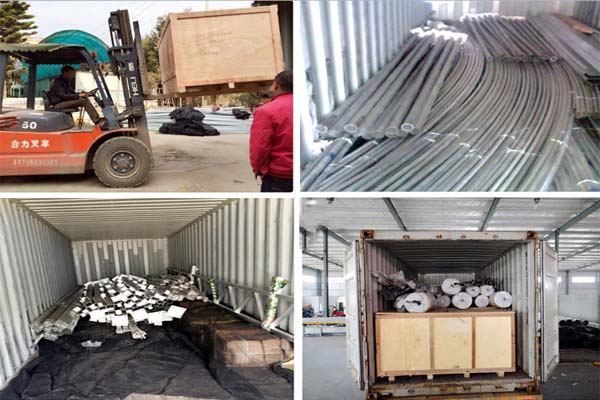
The photograph below is the loading side: a forklift lifting a crated frame section onto the truck, galvanized arch tubes bundled and stacked, the loose components packed into the container, and the covering and fittings crated and stacked inside the container for the voyage.
Factory, Service and How to Place the Order
The frames for this type are made in our own works from hot dip galvanized steel pipe, and the company has been building greenhouses for above 35 years. Where a customer asks for it, our engineers travel to the site to guide the installation, which matters more on a sawtooth roof than on a tunnel: the teeth, the runs of film and the opening frames all have to agree with each other, and that agreement is easier to reach with somebody on the ground.
To quote the covering accurately, send us five things: the span and the length you want, the exposure of the site - open ground, coastal, or sheltered - the film thickness you prefer from 0.12 mm and 0.15 mm, the film job you want the additives to do, and whether the side curtains are to be operated by hand or by motor. Call us on +86 191 5068 3942 or send an enquiry to sales@cngreenhouses.com, and we will confirm the covering, the runs and the accessories together rather than in separate messages. Every year we also welcome customers who come to the factory to see the frame and the covering for themselves before they place an order.
Frequently Asked Questions
Q: Can this house be covered with glass or polycarbonate sheet instead of film?
A: Not as quoted. The covering on this model is polyethylene held with aluminum clips, and that is the covering the frame and the channel are built around. If a rigid covering is what you need, that is a different house in our range, and the frame, the channel and the opening frames all change with it. The choice of roof types is set out on our sawtooth greenhouse range, and the covering products themselves are listed under film greenhouse covering.
A: Not as quoted. The covering on this model is polyethylene held with aluminum clips, and that is the covering the frame and the channel are built around. If a rigid covering is what you need, that is a different house in our range, and the frame, the channel and the opening frames all change with it. The choice of roof types is set out on our sawtooth greenhouse range, and the covering products themselves are listed under film greenhouse covering.
Q: Should I order the 0.12 mm film or the 0.15 mm film?
A: Both are quoted for this house, so the choice is made against your site and your re-cover interval rather than taken as fixed. The 0.15 mm sheet is the one to choose where the wind is strong, where the site is exposed, or where the covering has to survive handling by a team that has not covered a sawtooth roof before, because it tears less at the clip line. The 0.12 mm sheet takes away slightly less light and loads the frame less, which suits a house where light is the tighter of the two constraints. Tell us the exposure and we will recommend one of the two.
A: Both are quoted for this house, so the choice is made against your site and your re-cover interval rather than taken as fixed. The 0.15 mm sheet is the one to choose where the wind is strong, where the site is exposed, or where the covering has to survive handling by a team that has not covered a sawtooth roof before, because it tears less at the clip line. The 0.12 mm sheet takes away slightly less light and loads the frame less, which suits a house where light is the tighter of the two constraints. Tell us the exposure and we will recommend one of the two.
Q: How is the film held - does it get pierced or nailed?
A: Neither. The edge of the film is pushed into a grooved channel in the frame and locked there with an aluminum clip, so the cover is held along a continuous line rather than at a series of holes. The stated purpose of that channel is to keep the covering reinforced against wind and weather, and because nothing is driven through the sheet the same run can be taken up and re-tensioned later by opening the clips, pulling the film a little further into the groove and clipping it down again.
A: Neither. The edge of the film is pushed into a grooved channel in the frame and locked there with an aluminum clip, so the cover is held along a continuous line rather than at a series of holes. The stated purpose of that channel is to keep the covering reinforced against wind and weather, and because nothing is driven through the sheet the same run can be taken up and re-tensioned later by opening the clips, pulling the film a little further into the groove and clipping it down again.
Q: Can the side film be opened for ventilation, and is it manual or electric?
A: Yes, and it is quoted both ways. Ventilation on this house is by sidewall openings covered with insect nets and roll-up curtains, and the curtains are manually or electrically operated. The side film therefore behaves as a curtain rather than as a fixed cover, fixed along its top edge only so that it can be gathered onto its roll, with the insect net held in its own frame behind the curtain.
A: Yes, and it is quoted both ways. Ventilation on this house is by sidewall openings covered with insect nets and roll-up curtains, and the curtains are manually or electrically operated. The side film therefore behaves as a curtain rather than as a fixed cover, fixed along its top edge only so that it can be gathered onto its roll, with the insect net held in its own frame behind the curtain.
Q: Does a film cover keep the house warm enough at night?
A: A film cover is first a wind break that holds still air around the crop, and it is listed as good at keeping warm, so it is the right covering for that job. But the warmth a grower notices comes mostly from being able to close the house - vents shut, side curtains down, doors closed - rather than from the gauge of the sheet, and the difference between 0.12 mm and 0.15 mm is small next to that. Where the night temperature is the real limit on the crop, the cooling and heating system that can be added to this frame is the part that decides the result.
A: A film cover is first a wind break that holds still air around the crop, and it is listed as good at keeping warm, so it is the right covering for that job. But the warmth a grower notices comes mostly from being able to close the house - vents shut, side curtains down, doors closed - rather than from the gauge of the sheet, and the difference between 0.12 mm and 0.15 mm is small next to that. Where the night temperature is the real limit on the crop, the cooling and heating system that can be added to this frame is the part that decides the result.
Q: What is in the package, and how does the covering travel?
A: The package is metal structures, covering system and install accessories, so the frame, the film and the parts that hold the film are shipped together and the clips and the channel arrive with the house. The covering travels as rolls crated inside the container with the frame, and it should be stored upright and out of the sun until the run it belongs to is ready to be covered.
A: The package is metal structures, covering system and install accessories, so the frame, the film and the parts that hold the film are shipped together and the clips and the channel arrive with the house. The covering travels as rolls crated inside the container with the frame, and it should be stored upright and out of the sun until the run it belongs to is ready to be covered.
Q: How much spare film should I keep?
A: Allow for one run of the size used on your house. The width of a run is set by the span and the width of the roll, and ordering the spare width and length with the house keeps it matched to the cover that is on the frame. Film bought later comes as a separate roll and matching it to a cover that has already weathered is never exact.
A: Allow for one run of the size used on your house. The width of a run is set by the span and the width of the roll, and ordering the spare width and length with the house keeps it matched to the cover that is on the frame. Film bought later comes as a separate roll and matching it to a cover that has already weathered is never exact.
Note: If you're interested in the product, please submit your requirements and contacts and then we will contact you in two days. We promise that all your informations won't be leaked to anyone.
 Deutsch
 Español
 Français
 Italiano
 Português
 日本の
 한국어
 العربية
 български
 hrvatski
 česky
 Dansk
 Nederlands
 suomi
 Ελληνικά
 हिन्दी
 norsk
 Polski
 Română
 русский
 Svenska