
- Commercial Greenhouse
- Film Greenhouse
- PC Greenhouse
- Glass Greenhouse
- Tunnel Greenhouse
- Scientific Research Greenhouse
- Vegetable Greenhouse
- Flower Greenhouse
- Multi-span Greenhouse
- Sawtooth Greenhouse
- Greenhouse Equipments
- Greenhouse Accessories
- Hot Dip Galvanized Pipe
- Irrigation System
- Hydroponics System
- Planting Tools
- Planting technology
Tel: +86 191 5068 3942
Fax:
Mobile: +86 191 5068 3942
Contact: Alina
E-mail: sales@cngreenhouses.com
SKYPE:


Boom Irrigation Machine: Water, Power and One Pass
How a greenhouse boom irrigation machine is fed: water and power on one track, the control box on the rail, and what one 15 m pass puts down.
.
TEL:+86 191 5068 3942
- Features


This is our movable boom irrigation machine - the same unit described on the movable sprinkler range, and the machine whose full data sheet sits on the full machine specifications page. This page takes a different cut of the same equipment. It is about the two services that have to follow the machine around the house - water and electric power - and about what a single pass down the house actually does, in time and in litres, once you have decided the size. If you are still choosing between irrigation arrangements, that comparison is elsewhere; here we assume the machine is the right tool and work out how it is supplied and what it delivers.
Two Services on One Track
A machine that travels can not be connected to a tap on the wall. Both what it sprays and what it runs on have to arrive with it, all the way down the house, while it is moving. In this design the inlet water hose and the electric wire are banded together into one run. That bundle travels along the track, passes over a pulley, and is paid out and taken back as the machine advances and retreats, carrying water and power to the machine at the same time rather than in two separate runs.
This is the reason the track in these houses is set high, up near the roof frame rather than beside the beds. Two things are gained: no planting area is lost under the rail, and the same rail that guides the machine is also the route for both services, so there is one line to fix and one line to inspect. For the buyer the practical consequence is that the track is not only a mechanical part. Water pressure, the electric supply and the pulley travel all have to be settled at the drawing stage, and the frame the track is fixed to has to be able to carry them. The inlet rubber pipe itself is quoted as anti-acidic and anti-aging, because on this machine it is exposed and flexing all day.
The Control Box on the Rail
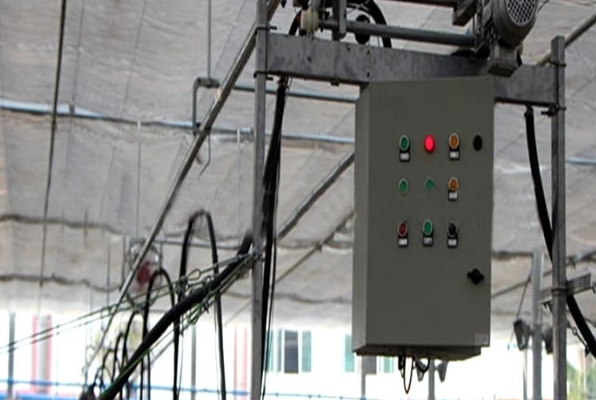
The photograph at the top of this page is the point where the services meet the machine: an anti-water control box carried on the rail, with indicator lamps and selector switches on its face and the wiring loom looping beside it. Everything the operator changes is changed here or from the handset, and the chain behind the front panel runs in four layers. The controller holds the irrigation settings. The frequency converter turns those settings into travel speed, steplessly from 4 m/min to 16.5 m/min. The wireless remote control circuit and its long-range handset, a 100 mW unit with strong anti-interference technology, let one operator run the machine from the aisle instead of walking beside it. The control sensor, a superior electromagnetic type, is what tells the machine where it is on the run.
Read together, those four layers explain why the machine can be left to complete a pass on its own. The operator sets the mode and the speed, the sensor watches the ends of the run, and the frequency converter keeps the travel constant at whatever speed was set - so the pass is repeatable rather than dependent on who is holding the control. Splitting the work this way also makes the machine diagnosable: a machine that stops in the wrong place is a sensor or controller question, while a machine that waters unevenly is a speed or nozzle question. The control box is quoted as anti-water because it hangs under a crop that is being sprayed from below.
Valve and Boom Controlled Separately
On this machine the electromagnetic valve and the spray boom are controlled separately rather than as one block. In practice that means the water can be shut off at the valve independently of what the boom is doing, and the boom can be run over part of the house without the rest of the run being watered. It is the arrangement that makes the machine usable on a house that is not planted evenly - a half-filled house, a section being worked on, or a block of beds that has just been watered.
The valve itself is an imported unit rated 2 W at AC 24 V, and the boom carries the nozzles, which are also imported and of the three-orientation, drip-proof, fast-conversion type. Which of the three flows to fit - 0.28, 1.65 or 2.46 l/min at 3 kgf/cm2 - is a nozzle decision rather than a control decision, and it is set out in full on the machine specifications page. What matters for the feed side here is that the flow you choose is the flow the hose and the valve have to carry, and that the two sides of the boom can be isolated from each other when the house calls for it.
What One Pass Puts Down
Once the feed is settled, the useful question is what a single pass does. Two quoted maximums answer most of it: the spray boom reaches up to 15 m and the working journey runs up to 60 m. Taken together, one full pass covers a strip of up to about 900 m2. Because the machine travels the length of the house on the rail, that strip is continuous - there are no joins along the run for the crop to grow unevenly across.
Time follows from the same two figures and the travel speed. At the slow end, 4 m/min, a 60 m journey takes about 15 minutes; at the fast end, 16.5 m/min, it takes about 3.6 minutes. The difference matters more than it looks, because the nozzle is running for the whole of that time. A single nozzle delivering 0.28 l/min puts down roughly 1.0 to 4.2 litres over one pass depending on which of those two speeds you run; at 1.65 l/min the same pass is roughly 6.0 to 24.8 litres; at 2.46 l/min it is roughly 9.0 to 36.9 litres. These three ranges are worked out from the quoted flow and speed figures rather than being separate specifications, and the water actually landing per square metre still depends on how the nozzles are spaced along the boom and how much the passes overlap.
That is the arithmetic to do before choosing a nozzle and a speed rather than after. A house of young plugs on shallow trays wants short, light, frequent passes, which is a slow travel with a small nozzle; a block of heavier foliage on the floor can take a longer, heavier pass, which is a faster travel or a larger nozzle. Because the speed is stepless between the two ends, the same machine covers both without being changed, and there is a continuous irrigation mode for the runs where the machine should keep working rather than stop at the end.
Water, Power and Mounting Checks
Four checks settle whether the house is ready for the machine. Water: the inlet needs 2 to 5 kgf/cm2, and the nozzles open at 0.7 kgf/cm2, so the supply has to hold pressure at the far end of the run and not only at the tap. Power: the machine runs from a three-phase supply, so the cable that travels with the hose has to be sized for the motor and for the length of the house. Mounting: the unit measures about 900 mm by 900 mm by 385 mm and weighs roughly 70 kg, and it hangs from the roof track, so it takes no floor or bench area and nothing has to be moved to let it pass. Layout: a house longer than 60 m or wider than the 15 m boom cannot be covered by one pass of this machine, and needs a different arrangement rather than a stretched one.
Where the water supply itself is the constraint rather than the machine, the choices are different: drip laterals and emitters put the water at the root instead of over the crop and are covered on the drip laterals and emitters page, and where a whole house is being equipped at once the irrigation, cooling and control equipment are grouped in our 3500 sqm equipment package. All the water and air equipment we supply for houses is collected in the irrigation system range. Irrigation practice for protected cropping is published by bodies such as the USDA, and trade reporting on how commercial houses water and feed their crops appears in HortiDaily.
Why Us
We have built greenhouses and the equipment inside them for above 35 years, in our own factory, and the movable irrigation machines are made and tested there rather than assembled from bought-in units. When a house is quoted, the track, the water line and the electric supply are planned together with the machine, because on this equipment the three cannot be separated - the same rail that carries the machine carries the hose and the cable. If you are extending an existing house or replacing a hand-watering routine, send the length and the width of the house and the crop on the beds, and the pass length, the hose run and the nozzle choice are worked out against them. To have a machine quoted, call +86 191 5068 3942 or write to sales@cngreenhouses.com.
Frequently Asked Questions
Q: How do water and electricity reach the machine while it is moving?
A: The inlet water hose and the electric wire are banded together into one run. The bundle travels on the track, passes over a pulley and is paid out and taken back as the machine advances and retreats, so water and power arrive together instead of as two separate lines. That is also why the track is mounted high up near the roof frame: it saves planting area and it becomes the service route for both.
A: The inlet water hose and the electric wire are banded together into one run. The bundle travels on the track, passes over a pulley and is paid out and taken back as the machine advances and retreats, so water and power arrive together instead of as two separate lines. That is also why the track is mounted high up near the roof frame: it saves planting area and it becomes the service route for both.
Q: What area does one pass cover and how long does it take?
A: With a boom of up to 15 m and a working journey of up to 60 m, one full pass covers about 900 m2. The time depends on the travel speed: at 4 m/min a 60 m journey takes about 15 minutes and at 16.5 m/min about 3.6 minutes. The speed is set steplessly by the frequency converter, so the pass length and the time can be matched to the crop without changing the machine.
A: With a boom of up to 15 m and a working journey of up to 60 m, one full pass covers about 900 m2. The time depends on the travel speed: at 4 m/min a 60 m journey takes about 15 minutes and at 16.5 m/min about 3.6 minutes. The speed is set steplessly by the frequency converter, so the pass length and the time can be matched to the crop without changing the machine.
Q: How much water does a single nozzle put down in one pass?
A: It follows from the flow and the time in the run. A 0.28 l/min nozzle gives roughly 1.0 to 4.2 litres over one pass, a 1.65 l/min nozzle roughly 6.0 to 24.8 litres, and a 2.46 l/min nozzle roughly 9.0 to 36.9 litres, the range coming from the slowest and fastest travel speeds. The water landing per square metre also depends on nozzle spacing along the boom and how much the passes overlap.
A: It follows from the flow and the time in the run. A 0.28 l/min nozzle gives roughly 1.0 to 4.2 litres over one pass, a 1.65 l/min nozzle roughly 6.0 to 24.8 litres, and a 2.46 l/min nozzle roughly 9.0 to 36.9 litres, the range coming from the slowest and fastest travel speeds. The water landing per square metre also depends on nozzle spacing along the boom and how much the passes overlap.
Q: Can the machine water only part of the house?
A: The electromagnetic valve and the spray boom are controlled separately, so the water can be shut off at the valve independently of the boom, and the machine can be run over one block of beds without watering the whole house. That suits a house that is not planted evenly, or where one section is being worked on while the rest is left alone.
A: The electromagnetic valve and the spray boom are controlled separately, so the water can be shut off at the valve independently of the boom, and the machine can be run over one block of beds without watering the whole house. That suits a house that is not planted evenly, or where one section is being worked on while the rest is left alone.
Q: What is inside the control system on the machine?
A: Four layers. The irrigation controller holds the settings, the frequency converter sets travel speed steplessly from 4 to 16.5 m/min, a wireless remote control circuit with a 100 mW long-range handset and strong anti-interference technology lets one operator run the machine from the aisle, and a superior electromagnetic control sensor reads the position of the machine along the run. All of it is carried in an anti-water control box on the rail.
A: Four layers. The irrigation controller holds the settings, the frequency converter sets travel speed steplessly from 4 to 16.5 m/min, a wireless remote control circuit with a 100 mW long-range handset and strong anti-interference technology lets one operator run the machine from the aisle, and a superior electromagnetic control sensor reads the position of the machine along the run. All of it is carried in an anti-water control box on the rail.
Q: What water pressure and mounting space does it need?
A: The inlet water pressure is 2 to 5 kgf/cm2 and the nozzles open at 0.7 kgf/cm2, so the supply must still hold pressure at the far end of the run. The unit is about 900 mm by 900 mm by 385 mm and weighs roughly 70 kg, and it hangs from the roof track, so it takes no floor or bench area. A house longer than 60 m or wider than the 15 m boom needs a different arrangement rather than one machine stretched over it.
A: The inlet water pressure is 2 to 5 kgf/cm2 and the nozzles open at 0.7 kgf/cm2, so the supply must still hold pressure at the far end of the run. The unit is about 900 mm by 900 mm by 385 mm and weighs roughly 70 kg, and it hangs from the roof track, so it takes no floor or bench area. A house longer than 60 m or wider than the 15 m boom needs a different arrangement rather than one machine stretched over it.
Note: If you're interested in the product, please submit your requirements and contacts and then we will contact you in two days. We promise that all your informations won't be leaked to anyone.
 Deutsch
 Español
 Français
 Italiano
 Português
 日本の
日本の
 한국어
한국어
 العربية
 български
 hrvatski
 česky
česky
 Dansk
Dansk
 Nederlands
 suomi
suomi
 Ελληνικά
 हिन्दी
 norsk
norsk
 Polski
 Română
 русский
 Svenska