
- Commercial Greenhouse
- Film Greenhouse
- PC Greenhouse
- Glass Greenhouse
- Tunnel Greenhouse
- Scientific Research Greenhouse
- Vegetable Greenhouse
- Flower Greenhouse
- Multi-span Greenhouse
- Sawtooth Greenhouse
- Greenhouse Equipments
- Greenhouse Accessories
- Hot Dip Galvanized Pipe
- Irrigation System
- Hydroponics System
- Planting Tools
- Planting technology
Tel: +86 191 5068 3942
Fax:
Mobile: +86 191 5068 3942
Contact: Alina
E-mail: sales@cngreenhouses.com
SKYPE:


What Comes With a High Tunnel Sawtooth Greenhouse
What a high tunnel greenhouse order holds: 80x20 m sawtooth frame in hot dip galvanized pipe, plus channel, clips, single layer film, nets and curtains.
.
TEL:+86 191 5068 3942
- Features


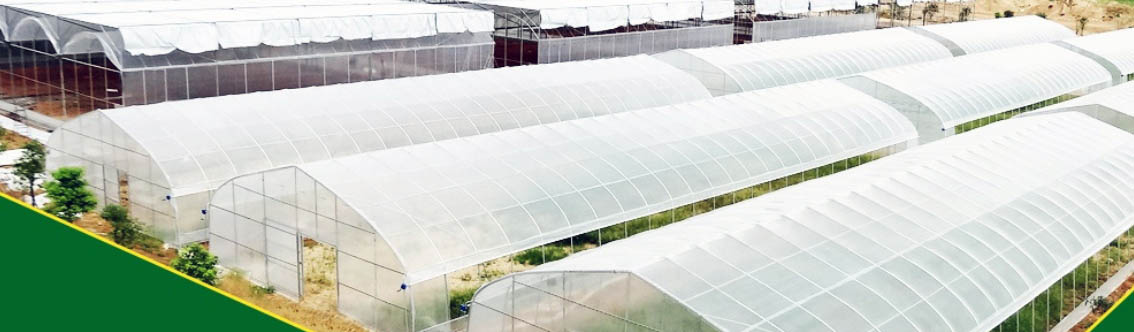
This page answers one question that arrives before any other: what is actually in the order. The house on this sheet is a film covered sawtooth greenhouse, 80 m by 20 m and 1,600 square metres, classed as a middle scale sawtooth house and produced under the Bozong trademark at Ziyang, Sichuan. It is listed for vegetable, fruit, seed nursery and flower work, and it ships to markets worldwide. Rather than repeat the figures that govern span, height and load, or the way the film is chosen and hung, this page walks the parts list: the frame, the channel and the clips, the covering, the opening gear and the fittings, then the systems that can be added and the way the whole order is grouped for shipment. The parameters themselves live on our span, height and frame load page, and the covering in detail on our film choice and fixing page.
The Four Entries on the Sheet That Release the Order
Four entries on the basic sheet have to be settled before a single part is made, because each of them changes a different group of parts. The first is the outline: 80 m by 20 m over 1,600 square metres, which fixes the number of bays and how much pipe is cut. The second is the covering line: film, a single layer, 0.15 mm or 0.12 mm, which fixes what the covering group contains. The third is the type and scale line, sawtooth greenhouse at middle scale, which fixes the roof members and the number of opening gear sets. The fourth is the load line, 0.35 kN/m2 of wind and 0.35 kN/m2 of snow, which fixes the pipe section, the bracing and the anchor detail. The span, available at 6.4 m, 8 m, 9.6 m or 10 m, and the total structure height, from 4.3 m to 6.5 m, sit inside those four and are quoted with them.
Nothing on this page is decided after that. The parts list below is what the four entries above produce, and it is written so that a buyer can read a quotation against it line by line rather than against a photograph.
The Frame: Hot Dip Galvanized Steel Pipe
The load-bearing part of the house is a frame of hot dip galvanized steel pipe, and the reason given on the sheet is blunt: it is used to avoid rust. The pipe carries the columns, the roof members and the purlins of the sawtooth roof, and it carries the 0.35 kN/m2 of wind and 0.35 kN/m2 of snow that the house is checked against. Aluminum has a place on this house, but it is not this one: the aluminum parts belong to the grooved channel and the clips that hold the film, not to the frame that stands the load. Keeping those two materials apart in the quotation is the single most useful thing a buyer can do when reading a parts list, because a supplier who lists the frame as aluminum and the coating as galvanized has not made up their mind which house they are selling.
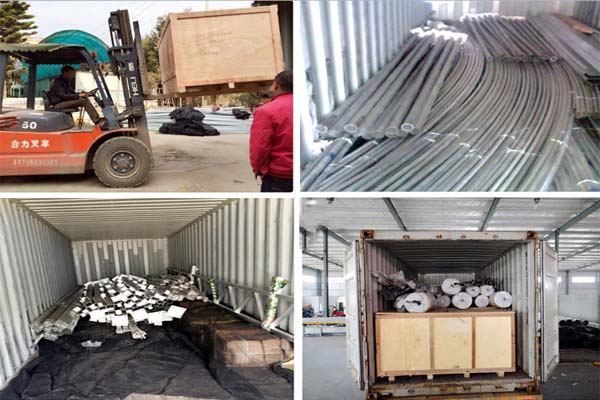
The pipe arrives on site cut to the span and height that were ordered, and the same pipe appears again in the export packing as stacked bundles. On the frame side the sheet offers the house as a simple and effective solution for varied and complex topographic conditions, which is a statement about the pipe frame rather than about the covering: a repeated module that can be stepped to follow ground is a frame property. What the frame cannot absorb is a plot that is out of level within one bay, and that is a site matter rather than a parts matter.
The Grooved Channel and the Aluminum Clips
Two small items do more work than their size suggests, and both belong to the covering group rather than to the frame. The first is the special grooved channel, which is the profile the film edge is run into. The second is the aluminum clip, which is what actually holds the film in that channel. The sheet gives the channel a job beyond grip: the house is designed with the grooved channel frame so that it reinforces the panels against wind and weather. That single line is the reason the channel is not a fitting that can be substituted at the last minute, because a covering held by pressure alone and a covering held by a channel that stiffens the panel are not the same construction.
For a buyer reading a quotation, the check is simple. If the covering group lists film rolls but no channel and no clips, the covering is incomplete, because the sheet states plainly that the house may only be covered by polyethylene held with aluminum clips. The count of clips follows the length of channel, and the length of channel follows the ridge, eave and perimeter lines of an 80 m by 20 m house, so both follow from the outline rather than from a guess at the site.
The Covering as Ordered: One Layer of Polyethylene
The covering line on this sheet reads film, single layer, at 0.15 mm or 0.12 mm, and it is worth saying clearly what that means for the order. It means the house as offered is a polyethylene house, and the parts list contains film rather than any rigid sheet. It also means one skin and not two, so the covering group has one set of rolls, one run of channel and one set of clips per opening rather than a doubled assembly. The sheet adds that the film is good at keeping warm, which is the property behind the warmth the house holds in a cold start, and that the structure is suitable for all climate conditions and adaptable to any type of landscape.
A buyer who has seen the house described elsewhere as a polycarbonate or rigid-sheet covering should raise it at the quotation stage rather than at the packing stage, because the covering group, the channel and the clips are ordered together and a change of covering after the pipe has been cut is a change to more than the film. On the house as this sheet describes it, the covering is polyethylene in a single layer, and the parts list is built on that.
The Opening Gear: Insect Nets, Roll-Up Curtains and Operators
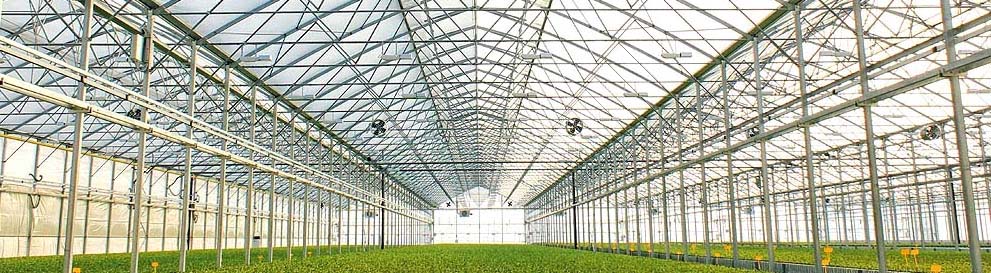
The ventilation on this house is part of the parts list rather than an extra, and it comes in three pieces. The sidewall openings are covered by insect nets, which stay in place and are what keeps the opening usable without letting the crop's pests in. Behind each net is a roll-up curtain, which is what actually opens and closes the house. Both are operated either manually or electrically, and that choice is the one line on the ventilation side that the buyer has to make, because it changes what is packed in the install accessories group. The upright windows along the sawtooth ridge complete the set, and they are what the roof members of each tooth are shaped to carry.
Reading the parts side of this is straightforward once the vent lines are seen as hardware: a house 80 m long has a long run of sidewall opening, and every metre of it needs a net, a curtain and a set of operators or a manual winding point. A quotation that lists only the roof windows and no sidewall gear describes a different house from the one on this sheet, which states the sidewall opening arrangement in full.
The Systems That Can Be Added as Further Groups
Beyond the shell and its opening gear, the order can be extended with systems that are quoted on the customer's request. The list on this sheet is fixed and short: a cooling and heating system, an irrigation system, a ventilation system, a fertilization system, a shading system, and benches. Each one is a further group in the parts list, and each one changes what has to be fixed to the frame and routed underneath it, which is why the add-on list belongs in the same conversation as the frame rather than in a separate one later. A shading system adds a load above the roof line, irrigation and fertilization add pipe runs below the beds, and benches change the internal height the crop occupies.
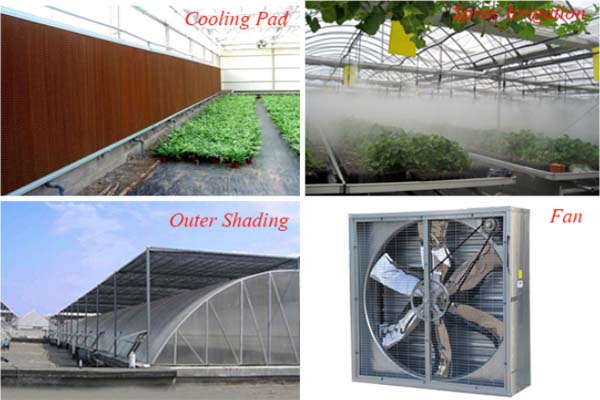
Because they are quoted on request, they are the one part of the order that genuinely varies between two buyers of the same house. That is also why the packing description on this sheet names three groups rather than a long list: the shell, the covering and the accessories travel as three, and the optional systems are added to those groups when they are ordered.
The Coating Figure Behind the Frame Part
One number belongs to the frame part on its own. Read against ISO 9223, a galvanized coating of this kind reaches first maintenance in roughly 13 years in heavy industrial air, class C4, in roughly 30 years in urban conditions, class C3, in roughly 50 years in coastal conditions, class C5, and in 50 years or more without repair in clean suburban air, class C2. The figure that decides which line a project lands on is the coating thickness on the pipe, and the pipe on this house carries a specified average of 70 to 85 micrometres of zinc, read under BS EN ISO 1461 and selected against BS EN ISO 14713-1.
For the parts list the practical reading is that the frame line on a quotation should name the coating and not only the material, because two houses can both say hot dip galvanized steel pipe and still be two different products once the site is coastal rather than inland. The corrosivity class of the site under ISO 9223 is therefore an entry a buyer has to supply, and it is the only entry on this page that comes from the grower rather than from the drawing.
Packing, Capacity and What Arrives Together
The house is packed as an export package and it is grouped so that the site is not left waiting between stages: metal structures, covering system, and install accessories. The value of the grouping is that the pipe, the film with its grooved channel and clips, and the opening gear all travel together on the same order, so a house does not stand bare because the covering is in a second shipment. Production runs at 10,000 square metres a month from Ziyang, Sichuan, against which a 1,600 square metre house is a modest part of one month's output, and the house carries the CE standard, which is the declaration that belongs in the order file rather than on the parts list.
The last entry in the order is the one that is not a part: where it is wanted, our engineers travel to foreign countries to guide the installation, and customers visit the factory for business cooperation. How those three groups are turned into a standing house on site is set out step by step on our installation sequence page, and the way covered structures behave once they are working rather than when they are sold is reported by Hortidaily. Guidance on agricultural buildings and the site conditions they have to be checked against, written for the grower rather than the supplier, is published by the USDA.
Frequently Asked Questions
Q: What does a high tunnel greenhouse order of this size contain?
A: Three shipping groups against a 80 m by 20 m, 1,600 square metre house. Metal structures covers the hot dip galvanized steel pipe frame, the roof and purlin members and the bracing. Covering system covers the polyethylene film in a single layer at 0.15 mm or 0.12 mm, the special grooved channel and the aluminum clips. Install accessories covers the insect nets, the roll-up curtains with their manual or electric operators, and the fittings that hold the assembly together. The add-on systems sit alongside those three when they are ordered.
A: Three shipping groups against a 80 m by 20 m, 1,600 square metre house. Metal structures covers the hot dip galvanized steel pipe frame, the roof and purlin members and the bracing. Covering system covers the polyethylene film in a single layer at 0.15 mm or 0.12 mm, the special grooved channel and the aluminum clips. Install accessories covers the insect nets, the roll-up curtains with their manual or electric operators, and the fittings that hold the assembly together. The add-on systems sit alongside those three when they are ordered.
Q: Is the covering on this house film or a rigid sheet?
A: Film. The covering line reads film in a single layer at 0.15 mm or 0.12 mm, and the sheet states that the house may only be covered by polyethylene held with aluminum clips. That is why the covering group contains one set of rolls, one run of grooved channel and one set of clips rather than a doubled or glazed assembly. If a rigid sheet covering is what you need, it has to be raised at the quotation stage, because the covering group is ordered together with the channel that takes it.
A: Film. The covering line reads film in a single layer at 0.15 mm or 0.12 mm, and the sheet states that the house may only be covered by polyethylene held with aluminum clips. That is why the covering group contains one set of rolls, one run of grooved channel and one set of clips rather than a doubled or glazed assembly. If a rigid sheet covering is what you need, it has to be raised at the quotation stage, because the covering group is ordered together with the channel that takes it.
Q: How is the film held down, and what parts does that need?
A: The film edge is run into a special grooved channel and held there with aluminum clips. The channel is not only an edge grip: the house is designed with the grooved channel frame so that it reinforces the panels against wind and weather. The parts consequence is that a covering group listing film rolls without channel and clips is incomplete, and that the quantity of channel follows the ridge, eave and perimeter lines of the 80 m by 20 m outline.
A: The film edge is run into a special grooved channel and held there with aluminum clips. The channel is not only an edge grip: the house is designed with the grooved channel frame so that it reinforces the panels against wind and weather. The parts consequence is that a covering group listing film rolls without channel and clips is incomplete, and that the quantity of channel follows the ridge, eave and perimeter lines of the 80 m by 20 m outline.
Q: Which parts make up the ventilation side of the order?
A: Three. The sidewall openings are covered by insect nets, which stay in place across the opening. Behind each net is a roll-up curtain, and the curtains are operated manually or electrically, which is the choice that decides what is packed in the install accessories group. The upright windows along the sawtooth ridge complete the set and are carried by the roof members of each tooth. On an 80 m long house the sidewall opening is a long run, so every metre of it needs its net, its curtain and its operating point.
A: Three. The sidewall openings are covered by insect nets, which stay in place across the opening. Behind each net is a roll-up curtain, and the curtains are operated manually or electrically, which is the choice that decides what is packed in the install accessories group. The upright windows along the sawtooth ridge complete the set and are carried by the roof members of each tooth. On an 80 m long house the sidewall opening is a long run, so every metre of it needs its net, its curtain and its operating point.
Q: Can systems such as shading, irrigation or benches be added to the same order?
A: Yes, and they are quoted on request. The list is a cooling and heating system, an irrigation system, a ventilation system, a fertilization system, a shading system and benches. Each one adds parts that have to be fixed to the frame or routed beneath it: shading adds a load above the roof line, irrigation and fertilization add pipe runs below the beds, and benches change the internal height the crop occupies. Because they are optional, they are what makes two orders for the same shell two different orders.
A: Yes, and they are quoted on request. The list is a cooling and heating system, an irrigation system, a ventilation system, a fertilization system, a shading system and benches. Each one adds parts that have to be fixed to the frame or routed beneath it: shading adds a load above the roof line, irrigation and fertilization add pipe runs below the beds, and benches change the internal height the crop occupies. Because they are optional, they are what makes two orders for the same shell two different orders.
Q: How long does the galvanized frame last before maintenance?
A: It follows the air around the site. Read against ISO 9223, a coating of this kind reaches first maintenance in roughly 13 years in heavy industrial air (class C4), roughly 30 years in urban conditions (class C3), roughly 50 years in coastal conditions (class C5), and 50 years or more without repair in clean suburban air (class C2). The pipe on this house carries a specified average of 70 to 85 micrometres of zinc, read under BS EN ISO 1461 and selected against BS EN ISO 14713-1, so the frame line on a quotation should name the coating thickness and the corrosivity class of your site. The full range can be seen on our sawtooth greenhouse range page.
A: It follows the air around the site. Read against ISO 9223, a coating of this kind reaches first maintenance in roughly 13 years in heavy industrial air (class C4), roughly 30 years in urban conditions (class C3), roughly 50 years in coastal conditions (class C5), and 50 years or more without repair in clean suburban air (class C2). The pipe on this house carries a specified average of 70 to 85 micrometres of zinc, read under BS EN ISO 1461 and selected against BS EN ISO 14713-1, so the frame line on a quotation should name the coating thickness and the corrosivity class of your site. The full range can be seen on our sawtooth greenhouse range page.
Contact
To read a quotation against this parts list, call us on +86 191 5068 3942 or write to sales@cngreenhouses.com. Tell us the covering, the outline and the site class you are building in, and we will come back with the frame, the covering group, the opening gear and the accessory group set out separately. Every house is backed by a long-term structural warranty, and each one is built with the grooved channel frame that reinforces the panels against wind and weather.
Note: If you're interested in the product, please submit your requirements and contacts and then we will contact you in two days. We promise that all your informations won't be leaked to anyone.
 Deutsch
 Español
 Français
 Italiano
 Português
 日本の
 한국어
 العربية
 български
 hrvatski
 česky
 Dansk
 Nederlands
 suomi
 Ελληνικά
 हिन्दी
 norsk
 Polski
 Română
 русский
 Svenska