- Commercial Greenhouse
- Film Greenhouse
- PC Greenhouse
- Glass Greenhouse
- Tunnel Greenhouse
- Scientific Research Greenhouse
- Vegetable Greenhouse
- Flower Greenhouse
- Multi-span Greenhouse
- Sawtooth Greenhouse
- Greenhouse Equipments
- Greenhouse Accessories
- Hot Dip Galvanized Pipe
- Irrigation System
- Hydroponics System
- Planting Tools
- Planting technology
Tel: +86 191 5068 3942
Fax:
Mobile: +86 191 5068 3942
Contact: Alina
E-mail: sales@cngreenhouses.com
SKYPE:


Hydroponic Drip System - Components and Daily Operation
A hydroponic drip system feeds each plant from a tank through a pump, pipe and emitter, then returns the drain. See the parts and the EC and pH routine.
.
TEL:+86 191 5068 3942
- Features


Hydroponics, simply defined, is an indoor plants soilless cultivation mode, also known as nutrient solution culture. Its core is that the plant roots are fixed in the engraftment basket and the roots sit in the nutrient solution, which substitutes for nature in providing the plant moisture content, the soil nutrients and the root-zone temperature it needs as growth factors, so the plant grows normally and completes its entire life cycle.
The case for growing out of soil is short: management is lighter, the same house suits different plants, the crop can be planted almost anywhere, and labour, time, fertilizer and pesticide all go down. Production and quality rise and the product grades more evenly, because every growing condition is under control.
A hydroponic drip system is the arrangement that hands that solution to each plant a little at a time. Instead of flooding a bench or a channel, a timed pump pushes solution down a pipe to an emitter at every plant or pot, and what leaves the root zone is caught and returned to the tank. This page follows that single loop from tank to drain, and the routine that keeps it running.
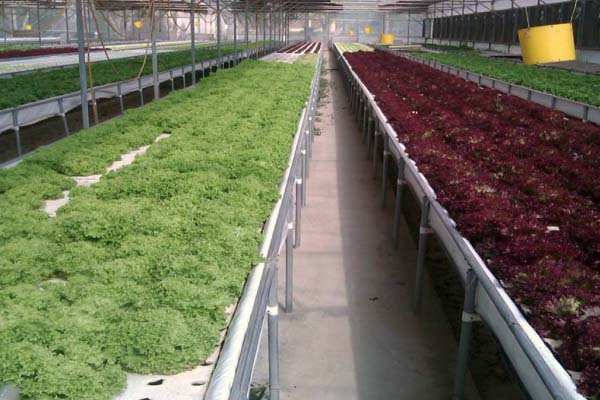
The Loop in Five Parts: Tank, Pump, Pipe, Emitter, Return
A drip loop is five parts, and each has a job that shows up in the crop if it is done badly.
Tank. The reservoir holds the made-up solution. Its volume follows the number of plants and how long the crop may go between remakes, not the size of the house.
Pump. The pump lifts solution out of the tank into the distribution line. It runs on a timer in short events and is idle between them, so it is sized for the event, not for continuous duty.
Pipe. A main line runs down the head of the house and laterals branch from it to each row, bench or pot. These pipes, fittings and drippers are a hardware line of their own, the same parts used in drip irrigation hardware.
Emitter. At the plant end a dripper sets the delivery rate. One emitter per plant or pot makes a row even, because every plant sees the same solution at the same rate and cannot grade itself by position along the pipe.
Return. What drains from the medium or channel is caught in a gutter and returned to the tank, which closes the loop and turns the drain into a sample the grower can read. Where the drain is not reused it leaves the house and the loop becomes drain to waste.
How the Feed Cycle Works
The pump is not switched on and left on. A drip loop is a timed system: the controller runs the pump for a set event several times a day, and between events the medium holds moisture and air at the roots. Each event flushes the medium and brings fresh nutrients, water and oxygen to the root zone, which is why a substrate system fed this way is often used to grow long-term plants.
Volume. The aim is not to wet the surface. Each event should push enough solution through the root zone that a small share runs out of the bottom, carrying away the salts left by the previous event. A run with no drain is not feeding the crop, it is salting it.
Timing. The first event is placed early in the working day, so the crop has the whole light period to take the water up, and the last one early enough that the root zone is not left saturated into the night. A hot day shortens the interval, a dull one lengthens it; a clock that ignores the weather drowns a root zone and then dries it.
Daily Management: EC, pH, Drain and Cleanliness
EC and pH are read daily rather than set once, and the reading that matters is a pair.
Feeding strength. Read the EC of the tank and then of the drain. A drain above the feed means salts are building up in the root zone, so the answer is more run-off or a weaker feed; a drain below the feed means the crop is taking nutrients faster than water, and the feed can be brought up. A drain value on its own says very little.
pH. Hold the solution in the working band for the crop and watch the drift rather than the number. A pH that moves from day to day means the solution, the water or the medium has changed; the drift is the signal to look, not a reason to add more acid.
Top-up. Water leaves the loop through the crop and through evaporation and leaves the salts behind, so a top-up with plain water lowers the EC. A top-up is followed by a remake rather than treated as a refill.
Cleanliness. The opening in a dripper is the smallest part of the loop and the most easily blocked, and a blocked emitter starves one plant while the rest of the row looks well. Filters and lines are flushed on a routine, and tank and gutters kept clear, because the drain that returns also carries debris back.
None of these figures are fixed by the hardware; the band and the interval follow the crop, the medium and the water.
Where the Drip Loop Fits in Commercial Production
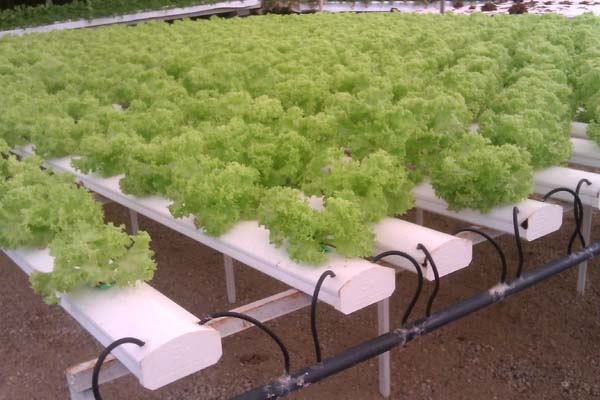
In commercial production the hydroponics systems fall into NFT (Nutrient Film Technique) and substrate systems, and the main difference between them is the growing medium. Drip feeding belongs to the substrate family, where the medium buffers water and air between timed events. In an NFT system the plants are grown in channels and the solution is pumped through them, the roots kept moist by the thin film as it passes by, which suits shorter-term plants and crops such as vegetables and some herbs. The drip loop suits a plant that stands in the house for a long season, and any crop where per-plant control is wanted, since one emitter per pot lets a single poor plant be corrected without disturbing the bed.
The loop still has to be supplied and drained by the house, the work of the greenhouse irrigation and dosing line, and the crop is carried on trays that match the channel or pot spacing, such as the hydroponic bench trays. This equipment sits in the hydroponic growing equipment range, and how the system families compare is set out on a separate page rather than repeated here.
For water and nutrient management in protected cropping, the NGMA, the US greenhouse manufacturers association represents the greenhouse manufacturing industry, and commercial practice is reported by HortWeek. The company has manufactured in its own factory for above 35 years.
To plan a loop for a crop, call +86 191 5068 3942 or write to sales@cngreenhouses.com with the crop, the plant count and the layout of the house.
Frequently Asked Questions
Q: What are the parts of a hydroponic drip system?
A tank, a pump, a distribution pipe with laterals, an emitter at each plant or pot, and a return that carries the drain back to the tank. The pump runs on a timer, so the loop fills and drains in short events.
A tank, a pump, a distribution pipe with laterals, an emitter at each plant or pot, and a return that carries the drain back to the tank. The pump runs on a timer, so the loop fills and drains in short events.
Q: How often should the pump run?
The pump is timed rather than continuous. The number of events and the length of each one are set for the crop, the medium and the weather; the aim of every event is a small share of drain.
The pump is timed rather than continuous. The number of events and the length of each one are set for the crop, the medium and the weather; the aim of every event is a small share of drain.
Q: Should EC and pH be read in the tank or in the drain?
Both, and the value is in the pair. The tank reading is the feed; the drain reading shows what the root zone has done with it. A drain above the feed points to salt build-up, below the feed to fast nutrient uptake.
Both, and the value is in the pair. The tank reading is the feed; the drain reading shows what the root zone has done with it. A drain above the feed points to salt build-up, below the feed to fast nutrient uptake.
Q: What is the commonest cause of poor drip performance?
Blocked emitters and filters. The opening in a dripper is the smallest part of the loop and salt, algae and root debris collect there first, so one plant starves while the rest of the row looks well.
Blocked emitters and filters. The opening in a dripper is the smallest part of the loop and salt, algae and root debris collect there first, so one plant starves while the rest of the row looks well.
Q: Does a drip system need a growing medium?
In commercial production drip feeding is the delivery method of the substrate family, where a medium holds moisture and air between events. The same emitters serve plants held in their own pot, slab or channel.
In commercial production drip feeding is the delivery method of the substrate family, where a medium holds moisture and air between events. The same emitters serve plants held in their own pot, slab or channel.
Q: What is needed to plan a drip loop for a house?
The crop, the number of plants and their spacing, the length of the growing cycle, the quality of the water and the layout of the house, from which the tank volume, the pump, the line sizes and the emitter count can be settled.
The crop, the number of plants and their spacing, the length of the growing cycle, the quality of the water and the layout of the house, from which the tank volume, the pump, the line sizes and the emitter count can be settled.
Note: If you're interested in the product, please submit your requirements and contacts and then we will contact you in two days. We promise that all your informations won't be leaked to anyone.
 Deutsch
 Español
 Français
 Italiano
 Português
 日本の
 한국어
 العربية
 български
 hrvatski
 česky
 Dansk
 Nederlands
 suomi
 Ελληνικά
 हिन्दी
 norsk
 Polski
 Română
 русский
 Svenska