
- Commercial Greenhouse
- Film Greenhouse
- PC Greenhouse
- Glass Greenhouse
- Tunnel Greenhouse
- Scientific Research Greenhouse
- Vegetable Greenhouse
- Flower Greenhouse
- Multi-span Greenhouse
- Sawtooth Greenhouse
- Greenhouse Equipments
- Greenhouse Accessories
- Hot Dip Galvanized Pipe
- Irrigation System
- Hydroponics System
- Planting Tools
- Planting technology
Tel: +86 191 5068 3942
Fax:
Mobile: +86 191 5068 3942
Contact: Alina
E-mail: sales@cngreenhouses.com
SKYPE:


Polycarbonate Roofing: Slope, Loads, Ridge and Sealing
A polycarbonate roofing greenhouse from the roof: sheet slope and the run of the panel, snow and wind loads, ridge and gutter details, sealing.
.
TEL:+86 191 5068 3942
- Features


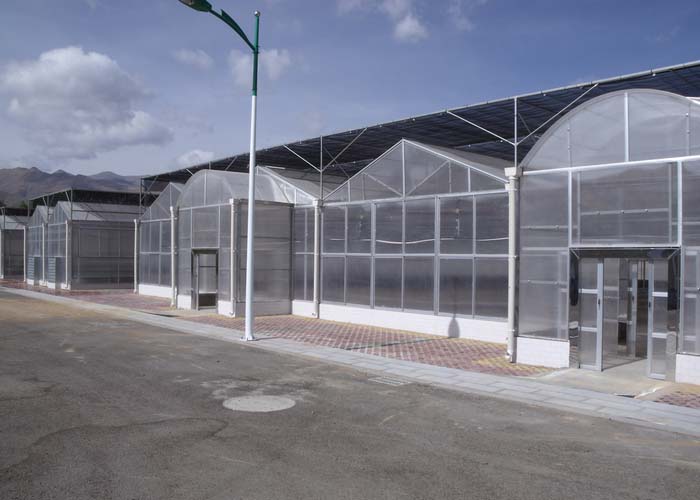
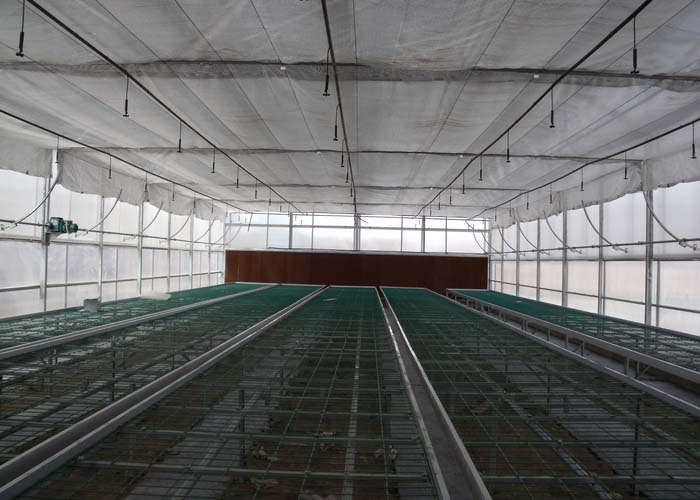
This house is a polycarbonate roof before it is anything else. The covering is polycarbonate hollow sheet at 8 mm or 12 mm, single layer, laid in runs down the roof and held in a grooved channel frame that the specification describes as reinforcing the panels against wind and weather. The house is quoted at 10 m by 30 m, 300 square metres, snow load 0.35 kN/m2 and wind load 0.35 kN/m2, CE marked, made in Ziyang, Sichuan, with a capacity of 10000 square metres a month. It is small scale, bought for scientific research, seed nurseries, flowers and experimental bases rather than for long production runs. Other models built to the same idea are in PC sheet houses built by this factory.
Why a Polycarbonate Roof Behaves Differently
The sheet is hollow: two skins with ribs between them rather than a solid pane. That core gives the covering its thermal performance, and the quotation lists good light transmittance and good heat retention. It also decides how the panel is fixed, because a hollow sheet is stiff along its ribs and flexible across them, so the ribs run down the slope and the purlins follow them.
Impact is where the material separates most clearly from glass. The covering is stated to have 200 times the shock performance of glass and 8 times that of acrylic sheet, and to resist breaking at installation; it is also described as melting without spreading at very high temperature, with good flame retardancy. That is why a PC roof is chosen over glass where hail or falling debris is a risk. What is given up against glass is set out in the comparison between PC sheet and glass covers.
Slope, and the Run of the Sheet
On a polycarbonate roof the slope does two jobs: it carries water off the sheets, and it keeps water from standing on them. Standing water is the enemy of a hollow panel, because a low spot holds water against the surface and any path into the flutes has time to work.
Two things influence the fall. The first is the run of the sheet: the panels are laid as continuous lengths down the slope, so the run of the roof, not the width of the house, fixes how far water travels to the edge. A 10 m by 30 m house gives a long run whichever way the ridge is set. The second is the fixing: panels held in a grooved channel are not pierced at every rib, which lets the sheet sit flat on the purlin instead of being pulled into a dip.
No slope figure appears in the specification for this model, so none is quoted. The fall follows the span, the rainfall and the snow of the site and is settled with the roof design. Roofing panels for a house of this type are described under polycarbonate roof panels.
Snow, Wind and Hail on a Hollow Sheet Roof
This house is quoted for a snow load of 0.35 kN/m2 and a wind load of 0.35 kN/m2, and the two act in different ways. Snow is a load that sits: it rests on the sheets, is carried into the purlins and from the purlins into the frame, so span matters. The spans available here are 6.4, 8, 9.6 and 10 metres, and total structure height runs from 4 to 7.5 metres. Snow left on the roof also refreezes into ice at the gutter line.
Wind pulls as much as it pushes. It is the fixing rather than the sheet that resists uplift: the panel has to be held at enough points, with enough bearing, that a gust cannot lift it out of its channel. The grooved channel frame named in the specification is the answer to that. Hail is the other reason buyers ask for polycarbonate: the 200 times glass figure is the material case, while a real storm depends on stone size and on the thickness and age of the sheet.
The Ridge, the Gutter Line and the Fixing Detail
A PC roof has two lines where the covering is not a flat run of sheet: the ridge, where two slopes meet, and the gutter line, where the roof edge finishes. Both are profile details, and both are where a leak usually starts, because the sheet is not continuous across them.
At the ridge the two runs of sheet are closed against each other. At the gutter line the roof has to stop cleanly and the panel edge has to be closed, because a hollow sheet has open flutes at a cut end and those flutes are the one path water has into the body of the panel. Closing them with the profile supplied for the sheet is what keeps a roof dry at its edges.
The roof edge is carried on the frame, and the structural pipe of this house is hot dip galvanized steel. Galvanizing life is set by the air at the site: under ISO 9223 a site is classed from class C2 in clean country air through C3 and C4 to C5 on a severe coast, and under BS EN ISO 14713-1 the expected coating life runs from about 13 years at C4 and about 30 years at C3 to about 50 years at C5, the mildest class being treated as maintenance free. Pipes and their coating are described under hot dip galvanized pipe for greenhouse frames.
No ridge profile, gutter profile or fixing spacing is fixed in the quotation; all three follow the roof design.
Sealing, Movement and Condensation
Polycarbonate moves. It expands and contracts more with temperature than glass does, and a roof laid in long runs gathers that movement along the run. So the sheet is not locked rigidly at both ends, and the edge seal has to accept the movement rather than be torn by it.
Condensation is the other question the material answers directly: the specification lists better anti-condensation properties than the alternatives, and the reason is the hollow core, where the still air in the flutes separates the cold outer skin from the warmer inner skin.
The panels are held in top quality aluminum frames whose grooved channel reinforces them against wind and weather, and the pipe that carries the structure is hot dip galvanized steel. The sheet is described as having a service life of more than two decades, and the structure carries a 20-year structural warranty. Since the covering weathers first, the roof is where an inspection of a PC house should start.
The house is made in this factory, which has been building greenhouses for above 35 years. Guidance on protected cultivation is published by the UN Food and Agriculture Organization, and trade reporting on covered growing by the Greenhouse Grower trade journal. To have a roof checked against a site, call +86 191 5068 3942 or write to sales@cngreenhouses.com with the span, the loads and the roof drawings.
Frequently Asked Questions
Q: What decides the slope on a polycarbonate roof?
The run of the sheet, because the panels are laid as continuous lengths down the slope, so a long run needs more fall; it also follows the span, the rainfall and the snow of the site. No slope figure is quoted for this model.
The run of the sheet, because the panels are laid as continuous lengths down the slope, so a long run needs more fall; it also follows the span, the rainfall and the snow of the site. No slope figure is quoted for this model.
Q: How does an 8 mm or 12 mm sheet behave against hail?
It is stated to have 200 times the shock performance of glass and 8 times that of acrylic sheet, and to resist breaking at installation. Stone size, sheet thickness and sheet age affect a real storm.
It is stated to have 200 times the shock performance of glass and 8 times that of acrylic sheet, and to resist breaking at installation. Stone size, sheet thickness and sheet age affect a real storm.
Q: What snow and wind loads is this house quoted for?
0.35 kN/m2 snow load and the same wind load. Snow sits on the sheets and is carried through the purlins into the frame, so span matters; wind lifts, so the fixing and the grooved channel resist it.
0.35 kN/m2 snow load and the same wind load. Snow sits on the sheets and is carried through the purlins into the frame, so span matters; wind lifts, so the fixing and the grooved channel resist it.
Q: Where do leaks start on a PC roof?
At the ridge or the gutter line, and at the cut ends of the panels, where a hollow sheet has open flutes. Closing those ends with the profile supplied for the sheet is what keeps water out.
At the ridge or the gutter line, and at the cut ends of the panels, where a hollow sheet has open flutes. Closing those ends with the profile supplied for the sheet is what keeps water out.
Q: Does the sheet move with temperature, and does that affect the fixing?
Yes. Polycarbonate expands and contracts more with temperature than glass, and the movement gathers along a long run, so the sheet is not locked rigidly at both ends and the fixings allow it to move.
Yes. Polycarbonate expands and contracts more with temperature than glass, and the movement gathers along a long run, so the sheet is not locked rigidly at both ends and the fixings allow it to move.
Q: What is this house specified as, and who buys it?
Cover: polycarbonate hollow sheet 8 mm or 12 mm, single layer, working size 10 m by 30 m, 300 square metres, spans of 6.4, 8, 9.6 or 10 metres, height 4 to 7.5 metres, CE marked, packed for export. It is bought for research, seed nurseries, flowers and experimental bases.
Cover: polycarbonate hollow sheet 8 mm or 12 mm, single layer, working size 10 m by 30 m, 300 square metres, spans of 6.4, 8, 9.6 or 10 metres, height 4 to 7.5 metres, CE marked, packed for export. It is bought for research, seed nurseries, flowers and experimental bases.
Note: If you're interested in the product, please submit your requirements and contacts and then we will contact you in two days. We promise that all your informations won't be leaked to anyone.
 Deutsch
 Español
 Français
 Italiano
 Português
 日本の
日本の
 한국어
한국어
 العربية
 български
 hrvatski
 česky
česky
 Dansk
Dansk
 Nederlands
 suomi
suomi
 Ελληνικά
 हिन्दी
 norsk
norsk
 Polski
 Română
 русский
 Svenska