- Commercial Greenhouse
- Film Greenhouse
- PC Greenhouse
- Glass Greenhouse
- Tunnel Greenhouse
- Scientific Research Greenhouse
- Vegetable Greenhouse
- Flower Greenhouse
- Multi-span Greenhouse
- Sawtooth Greenhouse
- Greenhouse Equipments
- Greenhouse Accessories
- Hot Dip Galvanized Pipe
- Irrigation System
- Hydroponics System
- Planting Tools
- Planting technology
Tel: +86 191 5068 3942
Fax:
Mobile: +86 191 5068 3942
Contact: Alina
E-mail: sales@cngreenhouses.com
SKYPE:


Polycarbonate Greenhouse Covering: Reading the Numbers
How to read a polycarbonate greenhouse covering specification: wall count, thickness, weight on the frame, the UV face and the service life behind it.
.
TEL:+86 191 5068 3942
- Features


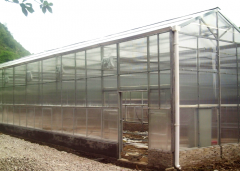
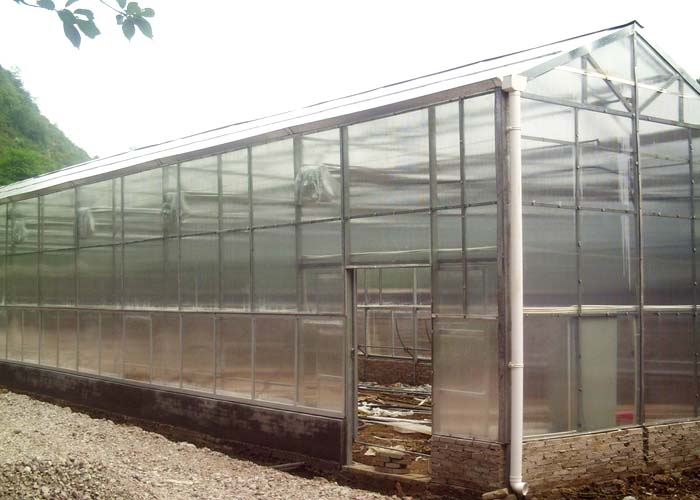
A covering quotation arrives as a list of numbers: a wall count, a sheet thickness, a weight, a transmittance figure and a service life. None of them can be read on its own, and the same sheet can be the right answer on one site and the wrong one on the next. This page is about reading those numbers for polycarbonate board, the rigid covering called PC board, which has been used in greenhouse construction since the 1970s in Europe. PC board is normally supplied as a double or triple hollow transparent plate, or as a single corrugated plate.
Read the Wall Count First
The first number in a PC sheet description is how many walls it has, and it is the one that changes the house most. A double or triple hollow sheet is not one skin but several, joined by ribs, and the air sealed in the channels between them is what insulates. Every additional pair of walls adds another layer that heat has to cross, which is why a triple sheet holds a house warmer at night than a double one of the same thickness, and why good insulation is the property PC board is chosen for in the first place.
The wall count is also a structural decision. The ribs that join the walls give the sheet its stiffness across the span, so the same profile that insulates also carries the wind and the snow between supports. A short span in a mild climate can be closed with two walls; a house that has to hold temperature through a cold winter is worth reading at three. The difference between the two constructions is set out on the twin wall polycarbonate sheet house.
Then Thickness, Because the Frame Carries It
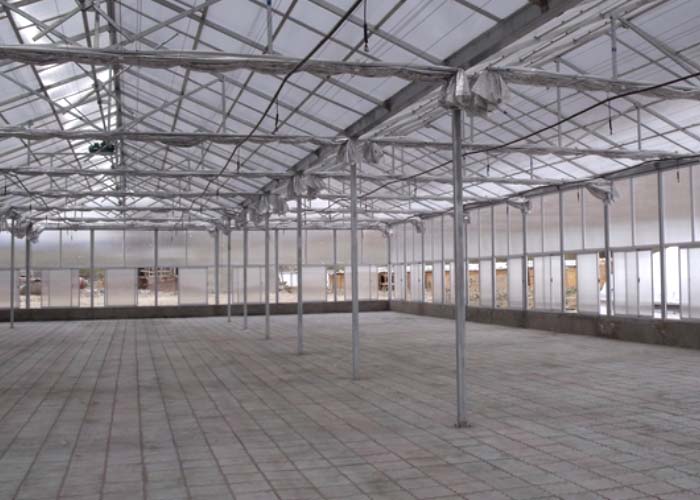
Thickness is read second, and it is never read alone. A thicker sheet of the same construction is stiffer and spans further between purlins, which reduces the number of supports the frame needs, but it also weighs more per square metre, and that weight is carried by the purlins, the gutter and the columns. This is why the sheet specification and the frame drawing have to be settled together: a sheet chosen for its insulation without reference to its weight is how a gutter ends up overloaded. The thicknesses these houses are built with are listed on the polycarbonate roof panels page.
Two properties of the sheet itself belong to the same reading. Impact strength is quoted high, which is what a hail-prone or windy site should be looking at, and sealing is quoted as good, which is a property of how the sheet is fixed rather than of the sheet alone: rigid panels sit in aluminium profiles with gaskets, they do not sag between fixings, and the joints stay closed. The PC sheets and panels used on these houses are described with the fittings they need.
The UV Face, and Where the Service Life Comes From
A PC sheet carries its protection on one face, and that face is fitted outwards. The life of the covering is decided by that layer far more than by the thickness, because it is the surface that takes the sun. Read a service life claim by asking which face is protected, whether the fixing instruction keeps that face outside, and what the covering guarantee includes; a sheet turned the wrong way during installation is a sheet that will finish its life early whatever number was quoted with it.
For reference, the numbers the page gives for the other rigid cover are about 90 percent light transmittance, optimum UV resistance and barrier, and a wear life of up to 25 years, with a low coefficient of thermal expansion, easy supply at a lower price, and a service period longer than a PC sheet: the PC sun panel is described here as using up its material in about 10 years. Those figures are worth having beside a PC sheet quotation, because they say what the PC sheet is being asked to beat on life and what it does not need to match on first cost.
Choosing by Climate First, Budget Last
Put the site before the price list. Summer light sets the transmittance the crop needs and the shading the house must be able to add; hail and gust exposure set how much impact resistance is worth paying for; the winter the house has to work through sets the wall count; snow and wind load set the thickness and the frame under it. The board itself has no regional restriction: it is described as usable across greenhouse classes and adaptable to any landscape, so the site is the variable, not the sheet.
Budget is the last line of the reading, and it should be read after the life figures. The one point the original description concedes is price: PC board costs more than the lighter covers, and the whole of that difference has to be set against the replacement cycle it avoids. The polycarbonate greenhouse range shows what a house built on that reading looks like, and the commercial greenhouse range puts it beside the other covering types.
Who Builds the House
The company has above 35 years of professional greenhouse production behind it and has grown into a conservatory company with some influence in the trade. The range covers all types of greenhouses and their supporting facilities, from design and construction through to machine research: multi-span film houses, glass houses, single-span film houses, PC board houses, garden and flower houses, lighting board houses, houses for vegetables on hot galvanized pipe, and a variety of hydroponic greenhouses. The high roof and large span types built for eco-restaurant work are also part of it, with large bays, a clean appearance and a bright interior.
Every year the company ships its greenhouses to customers around the world, and many customers visit the factory for business cooperation. A professional engineer department prepares the drawings, and on request engineers are sent to foreign countries to guide the installation. Standards and market reporting behind this kind of building are published by the United States Department of Agriculture and by Hortidaily. To have a covering and a frame read together for your site, call +86 191 5068 3942 or write to sales@cngreenhouses.com with the ground plan, the climate and the crop.
Frequently Asked Questions
Q: Which number should be read first on a PC covering sheet?
The wall count. Double or triple hollow is the construction that decides how well the house holds heat, and it also supplies the ribs that give the sheet its stiffness across the span. Thickness is read after it, never alone.
The wall count. Double or triple hollow is the construction that decides how well the house holds heat, and it also supplies the ribs that give the sheet its stiffness across the span. Thickness is read after it, never alone.
Q: Why does sheet weight matter to the frame?
Because a heavier sheet is carried by the purlins, gutter and columns. A thicker sheet spans further between supports but adds weight, so the sheet specification and the frame drawing have to be settled at the same time.
Because a heavier sheet is carried by the purlins, gutter and columns. A thicker sheet spans further between supports but adds weight, so the sheet specification and the frame drawing have to be settled at the same time.
Q: What decides the service life of a polycarbonate cover?
The protected face. The sheet carries its UV layer on one side and that side is fitted outwards. What matters when a life is quoted is which face is protected, whether the fixing keeps it outside, and what the covering guarantee includes.
The protected face. The sheet carries its UV layer on one side and that side is fitted outwards. What matters when a life is quoted is which face is protected, whether the fixing keeps it outside, and what the covering guarantee includes.
Q: Is a PC sheet suitable for any climate?
The board is described as usable across greenhouse classes with no regional restriction and as adaptable to any landscape. In practice the climate decides the wall count and the frame decides the thickness, so the site is what is read, not the sheet.
The board is described as usable across greenhouse classes with no regional restriction and as adaptable to any landscape. In practice the climate decides the wall count and the frame decides the thickness, so the site is what is read, not the sheet.
Q: How does PC board compare with glass on the numbers?
Glass is given about 90 percent light transmittance, optimum UV resistance and barrier, a wear life of up to 25 years and a lower supply price, while the PC sun panel is described as using up its material in about 10 years. Read the two sets of figures against the replacement cycle rather than against each other.
Glass is given about 90 percent light transmittance, optimum UV resistance and barrier, a wear life of up to 25 years and a lower supply price, while the PC sun panel is described as using up its material in about 10 years. Read the two sets of figures against the replacement cycle rather than against each other.
Q: What experience stands behind the houses?
The company has above 35 years of professional greenhouse production, builds the whole range from multi-span film to glass and PC board houses, ships worldwide, and can send engineers abroad to guide installation.
The company has above 35 years of professional greenhouse production, builds the whole range from multi-span film to glass and PC board houses, ships worldwide, and can send engineers abroad to guide installation.
Note: If you're interested in the product, please submit your requirements and contacts and then we will contact you in two days. We promise that all your informations won't be leaked to anyone.
 Deutsch
 Español
 Français
 Italiano
 Português
 日本の
日本の
 한국어
한국어
 العربية
 български
 hrvatski
 česky
česky
 Dansk
Dansk
 Nederlands
 suomi
suomi
 Ελληνικά
 हिन्दी
 norsk
norsk
 Polski
 Română
 русский
 Svenska