- Commercial Greenhouse
- Film Greenhouse
- PC Greenhouse
- Glass Greenhouse
- Tunnel Greenhouse
- Scientific Research Greenhouse
- Vegetable Greenhouse
- Flower Greenhouse
- Multi-span Greenhouse
- Sawtooth Greenhouse
- Greenhouse Equipments
- Greenhouse Accessories
- Hot Dip Galvanized Pipe
- Irrigation System
- Hydroponics System
- Planting Tools
- Planting technology
Tel: +86 191 5068 3942
Fax:
Mobile: +86 191 5068 3942
Contact: Alina
E-mail: sales@cngreenhouses.com
SKYPE:


Flower Greenhouse Climate: Light, Temperature, Air
How light, the day-night temperature gap, and air with humidity decide stem length, bud colour and bloom quality in a film flower greenhouse.
.
TEL:+86 191 5068 3942
- Features


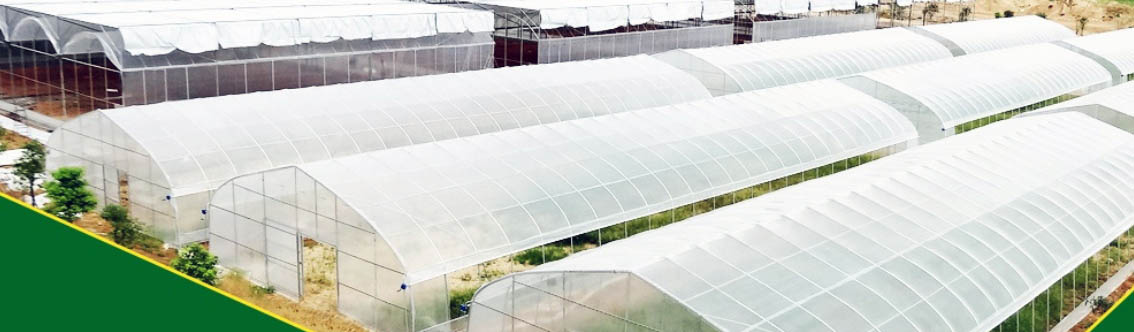
A flower crop does not buy a greenhouse, it buys a climate. What decides whether a stem is long, straight and well coloured, or short, blind and soft, is what happens inside the house over the whole day and night: how much light reaches the leaves, how far the temperature falls after sunset, and how much water vapour is left hanging in the air. This film house is also known as an agricultural plastic poly film flower greenhouse, and its job is to hold those three variables steady enough for a flower crop to be sold.
How a Flower Crop Reads the House
Leafy crops forgive a bad week; a flower crop usually does not, because the part that is sold is the flower itself. Three levers decide the outcome inside a film house. Light sets how much the plant can build and whether a bud is initiated at all. Temperature, and in particular the gap between the day value and the night value, sets how that growth is shaped - long or compact, thin or filled out. Air and moisture set whether the quality survives to harvest, because flowers are the part of the plant that suffers first when the house stays wet and still.
All three levers are worked from the same short list of parts: the covering film, the vent and its drive, and whatever heating, cooling, irrigation, fertilization, shading or benches are added around the shell. Nothing inside the house changes the crop more than the cover and the air exchange do.

Light: Flower Initiation and Bloom Colour
The first job of the cover is to let light in, and the reason the covering is specified as a clear film with UV protection rather than as any plastic sheet is that light transmission is the one property a flower grower cannot add on later. What a flower crop uses is the total light it receives across the day, not the brightest moment at noon, so a house that loses a share of the light all day loses stem strength and bud colour across the whole crop rather than in a few plants.
The failure mode to watch is the blind shoot - a stem that grows but never forms a flower bud. It appears first where light is lowest, which in a film house means along the sides, under the structure members and in the shaded half of the bay during a dull winter. Colour is the second symptom: coloured cultivars that are grown too dark open paler than the variety should, and no amount of feeding corrects it afterwards. Both are managed before planting, by choosing the covering and by using the shade net that is listed among the systems that can be added to this house. The same shading is what protects a summer crop from scorch and from flower colour being bleached out.
Day length is the third part of the light story, and it is a crop requirement rather than a house setting. Some flower crops begin to form buds only when the nights lengthen past a certain point, others begin under long days, and a third group ignores day length altogether. The house has to be able to close down the light when a short-day crop needs it, and to open up and shade sensibly when a long-day or day-neutral crop is growing. That is why the shading system sits on the light lever while the vents sit on the air lever, and why the two are chosen together rather than separately.
Day and Night Temperature: The Difference Does the Work
Asking for one temperature for a flower house hides the thing that matters. What shapes a flowering crop is the pair of values and the gap between them. The night figure decides how much of what the day built is kept: in warm nights the plant respires hard and spends the day gain, which is how soft, pale, thin-walled flowers are produced even in a bright house. The day-to-night difference decides stem length. A warm day followed by a markedly cooler night stretches the stem, which is what a cut flower crop wants, while an even difference - or a night as warm as the day - keeps a plant short and full, which is what a potted crop wants. The two directions are the same lever pulled opposite ways.
This is where the covering layer becomes a crop decision. A single layer of film is the base case, and a double layer traps an air cushion between the two sheets, which is what gives the house its insulation: it prevents heat loss and cold air intrusion and keeps energy consumption low. In practice that means the night temperature in a double layer house falls less far after sunset, so the gap between day and night is smaller and more controllable, and the crop is not exposed to the sharp early-morning fall that a single sheet allows. Cooling and heating are on the list of systems that can be added to this house, so the night figure itself can be held rather than left to the weather.
Air and Moisture: Where Flower Quality Is Lost
A closed film house traps the water the crop transpires. When the vents are shut, the air is still and the inside surface of the film is cold, that vapour has nowhere to go but onto the nearest cool surface, and on a flower crop the nearest cool surface is often a petal or a leaf. Condensation on a petal is not a yield problem, it is a quality problem: it opens the door to petal rot, and a flower with petal rot is rejected at the packhouse instead of being sold as a second. This is the single most common way a film house loses money on flowers, and it is managed with air, not with chemicals.
Air movement does two jobs at once. It strips the still layer of damp air that sits against the leaf, which lets the plant transpire and take up water properly through the day, and it evens out the temperature inside the bay so the cold corners where condensation forms do not exist. Ventilation then replaces the damp air with drier outside air. On this house the vents are manually or electrically operated, and on a single-span arch house the opening area runs along the sides of the bay and at the ends, so the runs of the house matter as much as the vent itself: a long run of single-span houses ventilates differently from one wide bay.
The covering layer helps here too. A double layer keeps the inner sheet warmer, so the air inside is further from the point where it has to give up its water, and the house dries out more slowly overnight. The habit that goes with it is to vent in the late afternoon, before the temperature falls, and to keep a little air moving through the night rather than closing the house tight with the crop still wet.
Cut Flowers and Potted Flowers in the Same House
The same shell serves both markets, but the three levers are aimed at different targets, and a house that is run for one will not quietly deliver the other.
| Lever | Cut flower crop | Potted flower crop |
| Light | Wants stem length and saturated bud colour. Blind shoots, where no bud forms, are the main loss, and they start in the lowest-light parts of the bay. | Wants a compact, evenly filled plant. Uneven light across the pot is what makes a plant lean, so the plant is turned or the bay is chosen for even light. |
| Day and night temperature | A warm day over a cooler night stretches the stem, and cool nights keep the plant from spending the day gain. | An even difference, or a night warmer than the day, holds the plant short and dense. Those same conditions would ruin a cut flower stem. |
| Air and moisture | Petals must be dry at harvest and stay dry at night. Petal rot at the bud stage is the loss to avoid, and no selection can correct it after the fact. | Leaf quality carries the sale. Small pots dry fast and wet foliage invites leaf spotting, so air movement and even irrigation matter more than the peak humidity figure. |
What This Particular House Gives You
The shell that carries those three levers is a single-span house with a hot dip galvanized steel pipe frame and an arch roof, covered by clear polyethylene held with aluminium clips in a special grooved channel frame that reinforces the panels against wind and weather. It takes a single or a double layer of film. Covering material thickness is quoted at 0.15 mm or 0.12 mm and the standard clear greenhouse film is 6 mil, and film can be supplied cut to the length of the house so the cover follows the run instead of being pieced together.
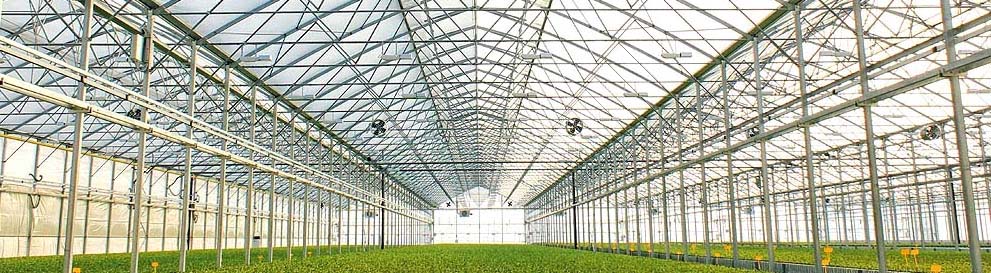
Houses in this range are built on spans of 6.4 m, 8 m, 9.6 m and 10 m with a total structure height of 4.3 m to 6.5 m, and the reference layout for this model is 64 m by 40 m, an area of 2,560 square metres, described as middle scale. Materials are plastic and mesh, the design wind load is 0.35 kN/m2, and the export market is global. Vents are manually or electrically operated. Alongside the shell, cooling and heating, irrigation, ventilation, fertilization, shading and benches can be added depending on the requirement, which is how the same frame is aimed at a temperature lever, an air lever or a light lever for different crops. The house leaves the factory as three groups: metal structures, covering system and install accessories.
The rest of the film houses built on this frame are listed in the film houses built for flower crops, and flower-specific production practice and year-round cropping are covered in the flower greenhouse section, including a longer piece on greenhouse flower production.
Why Us ?
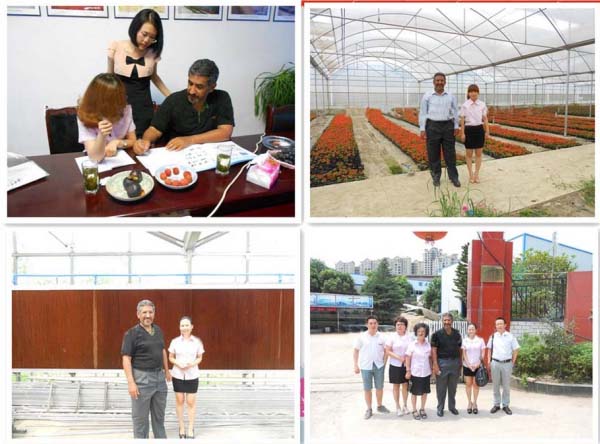
We are the manufacturer specializing in greenhouses with above 35 years, and our greenhouses are exported worldwide. A professional engineer department stands behind every drawing, and if a customer requests it our engineers travel to the buyer country to guide the installation. Every year many customers visit the factory for business cooperation, and the photos below come from those visits - an order being signed at the office, the frame being walked through on site, and the visiting group at the works.
Frequently Asked Questions:
Q: How much light does a flower crop need inside a film house?
A: What a flower crop uses is the total light it receives across the day, so the useful question is not the brightest reading at noon but how much light the cover lets through from morning to evening. The covering is specified as clear film with UV protection so that transmission is protected, and shading covers the summer end of the range. Too little light shows up first as blind shoots and weak stems at the sides of the bay.
A: What a flower crop uses is the total light it receives across the day, so the useful question is not the brightest reading at noon but how much light the cover lets through from morning to evening. The covering is specified as clear film with UV protection so that transmission is protected, and shading covers the summer end of the range. Too little light shows up first as blind shoots and weak stems at the sides of the bay.
Q: Why does the difference between day and night temperature matter for flower stems?
A: It is the lever that sets stem length. A warm day over a cooler night stretches the stem, which a cut flower crop needs, while an even difference, or nights as warm as the day, keeps a plant short and full, which is what potted crops need. Warm nights also push respiration up, so the plant spends what the day built and flower quality goes soft and pale.
A: It is the lever that sets stem length. A warm day over a cooler night stretches the stem, which a cut flower crop needs, while an even difference, or nights as warm as the day, keeps a plant short and full, which is what potted crops need. Warm nights also push respiration up, so the plant spends what the day built and flower quality goes soft and pale.
Q: How do ventilation and humidity affect flower quality?
A: A closed film house holds the water the crop transpires. With the vents shut and the air still, that vapour condenses on the coldest surface available, which on a flower crop is often a petal or a leaf, and wet petals are how petal rot starts. Air movement also strips the damp layer against the leaf so the plant can transpire and move water and calcium through the day.
A: A closed film house holds the water the crop transpires. With the vents shut and the air still, that vapour condenses on the coldest surface available, which on a flower crop is often a petal or a leaf, and wet petals are how petal rot starts. Air movement also strips the damp layer against the leaf so the plant can transpire and move water and calcium through the day.
Q: Does a double layer of film change the climate for flowers?
A: Yes, because the air cushion between the two sheets is what insulates the house. It prevents heat loss and cold air intrusion and holds energy consumption low, so the night temperature falls less far after sunset, the day-to-night gap stays under control, and the inner sheet stays warm enough that the air does not have to give up its water as readily.
A: Yes, because the air cushion between the two sheets is what insulates the house. It prevents heat loss and cold air intrusion and holds energy consumption low, so the night temperature falls less far after sunset, the day-to-night gap stays under control, and the inner sheet stays warm enough that the air does not have to give up its water as readily.
Q: What are the parameters of this film house?
A: Single span with an arch roof on a hot dip galvanized steel pipe frame. Spans of 6.4 m, 8 m, 9.6 m and 10 m; total structure height 4.3 m to 6.5 m; single or double film layer; covering material thickness 0.15 mm or 0.12 mm, standard clear film 6 mil; wind load 0.35 kN/m2; reference layout 64 m by 40 m, an area of 2,560 square metres.
A: Single span with an arch roof on a hot dip galvanized steel pipe frame. Spans of 6.4 m, 8 m, 9.6 m and 10 m; total structure height 4.3 m to 6.5 m; single or double film layer; covering material thickness 0.15 mm or 0.12 mm, standard clear film 6 mil; wind load 0.35 kN/m2; reference layout 64 m by 40 m, an area of 2,560 square metres.
Q: Can one house be run for cut flowers and for potted flowers?
A: The shell is the same, but the three levers are aimed differently: cut flower crops want a positive day-to-night difference and dry petals, potted crops want an even or reversed difference and leaf quality. Cooling and heating, irrigation, ventilation, fertilization, shading and benches can be added to suit whichever of the two you grow, and the house is packed as metal structures, covering system and install accessories.
A: The shell is the same, but the three levers are aimed differently: cut flower crops want a positive day-to-night difference and dry petals, potted crops want an even or reversed difference and leaf quality. Cooling and heating, irrigation, ventilation, fertilization, shading and benches can be added to suit whichever of the two you grow, and the house is packed as metal structures, covering system and install accessories.
A flower house is planned from the crop backwards, so tell us what you are growing, what quality the market pays for, and the span and run you have in mind. Reference material on crop production and protected cultivation is published by the USDA, and what commercial flower and vegetable growers are doing with these houses is reported by HortiDaily.
If you need to ask a question and get some help to find the best greenhouse for you, then just call us on +86 191 5068 3942 or send E-mail to sales@cngreenhouses.com
Note: If you're interested in the product, please submit your requirements and contacts and then we will contact you in two days. We promise that all your informations won't be leaked to anyone.
 Deutsch
 Español
 Français
 Italiano
 Português
 日本の
 한국어
 العربية
 български
 hrvatski
 česky
 Dansk
 Nederlands
 suomi
 Ελληνικά
 हिन्दी
 norsk
 Polski
 Română
 русский
 Svenska