
- Commercial Greenhouse
- Film Greenhouse
- PC Greenhouse
- Glass Greenhouse
- Tunnel Greenhouse
- Scientific Research Greenhouse
- Vegetable Greenhouse
- Flower Greenhouse
- Multi-span Greenhouse
- Sawtooth Greenhouse
- Greenhouse Equipments
- Greenhouse Accessories
- Hot Dip Galvanized Pipe
- Irrigation System
- Hydroponics System
- Planting Tools
- Planting technology
Tel: +86 191 5068 3942
Fax:
Mobile: +86 191 5068 3942
Contact: Alina
E-mail: sales@cngreenhouses.com
SKYPE:


Reinforced PE Greenhouse Cover for Windy and Exposed Sites
PE greenhouse cover built for wind and tear load: multi-layer reinforced sheeting on a 64x40 m house, and the channel, clips and corners that carry it.
.
TEL:+86 191 5068 3942
- Features


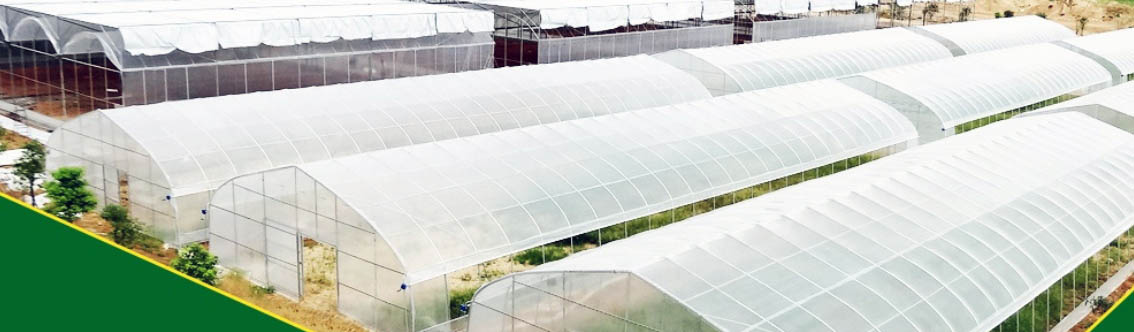
This page is about the part of a covering that has nothing to do with light: how the sheet is built so that it holds together under load, and where on a film house that load actually lands. The covering written about here is sold as reinforced greenhouse plastic sheeting, described on our own sheet as a multi-layer reinforced design with anti-tear reinforcement that stands up to heavy rain, strong winds and ultraviolet through the year, and as weatherproofing that outlasts regular sheeting. The house it is written around is a commercial single span film greenhouse at 64 m by 40 m, 2,560 square metres, carrying standard clear greenhouse film at 6 mil, about 0.15 mm, in a single or double layer on a hot dip galvanized steel pipe frame with an arch roof and a design wind load of 0.35 kN/m2. What follows stays with the load path through that assembly: what a reinforced construction is, why tearing is not the same problem as stretching, which points on a covered house take the force, and what has to be reinforced so the strength that is in the sheet is not thrown away at a fixing.
| Size | 64 m x 40 m |
| Area | 2,560 square metres |
| Type and scale | Film greenhouse, middle scale, single span |
| Cover | Standard clear greenhouse film, 6 mil (about 0.15 mm), reinforced |
| Cover construction | Multi-layer reinforced design with anti-tear reinforcement |
| Cover properties | Durable and weatherproof, high light transmittance, anti-fog and anti-dripping, anti-aging |
| Cover fixing | Polyethylene held with aluminum clips on a specially engineered grooved channel frame |
| Layer | Single or double |
| Covering material thickness | 0.15 mm or 0.12 mm |
| Frame | Hot dip galvanized steel pipe, arch roof |
| Span | 6.4 m, 8 m, 9.6 m or 10 m |
| Total structure height | 4.3 m to 6.5 m |
| Wind load | 0.35 kN/m2 |
| Application | Vegetable, fruit, flower, seed nursery |

What a Multi-Layer Reinforced Sheet Is
A greenhouse cover is not one homogeneous sheet of plastic. Agricultural film is made by blowing or casting polyethylene through a die, and a modern line can feed more than one melt into that die at the same time, so the finished sheet is a stack of layers bonded to each other rather than a single material through its thickness. That is what multi-layer means in this context, and it is why the same nominal thickness can be made to do different jobs: an outer layer can be loaded with ultraviolet stabilizers, an inner layer with anti-fog additives that keep the film from beading with condensation on the face that looks down at the crop, and the material in between can be chosen for mechanical behaviour rather than for surface performance.
Reinforcement is a second and separate idea, and it is the one the product name refers to. Where a film is described as having anti-tear reinforcement, the construction is built so that a tear which starts cannot travel easily through the sheet. There are different ways to achieve that, and they sit on a scale. At one end, the layers themselves are formulated so that the material around a crack tip deforms and blunts the crack rather than letting it run. Further up, a reinforcing element is introduced into the build, which can be a stronger layer bonded inside the sheet or a distinct reinforcing grid or scrim embedded between two layers of film. A scrim does the job the way a woven fabric does: the tear reaches the thread and stops, because the load is picked up by material that was not cut at the same time.
The practical difference between those approaches shows up in the specification rather than in a photograph. A sheet with a reinforcement element in it resists a tear that has already begun, and it also resists the small cut that starts one, which is why reinforced sheeting tends to be used around openings, along edges and at fixing points rather than instead of a plain film across the middle of the roof. A sheet without one relies on the properties of the layers alone. Both constructions are sold as greenhouse film, and the sheet on this page is described as a multi-layer reinforced design with anti-tear reinforcement, so what follows is about where that reinforcement has to be matched by the way the house holds the film.
Why Tearing Is Not the Same Problem as Stretching
Two properties are routinely confused when a covering is being chosen, and the confusion is what makes a house fail in a way the specification did not predict. The first is tensile strength, which is how much pull a strip of film takes before it breaks when the load is spread evenly across the strip. The second is tear resistance, which is how much force is needed to keep a cut or a nick travelling once it exists. They are measured differently and they do not move together.
What decides which one matters is geometry. A stretch of film in the middle of a roof panel with no cut in it and no fixing in it is loaded across its whole width, and it behaves as a tensile member: the load is shared and a strong film carries a great deal. The same film once it has been cut, drilled, or pinched and perforated at a fixing point no longer has an even load path. The stress concentrates at the tip of the cut, and if the material cannot blunt it, the cut opens and runs. That is why a covering can be perfectly adequate by its tensile figure and still be the covering that splits along the clip line in its third season, and it is why the point where a load is applied matters as much as the strength of the sheet.
Reinforcement changes the second number rather than the first, and the change it makes is directional. A tear that meets a reinforcing element has to either break that element or go around it, and going around it takes a longer path than going through, which is energy the wind has to supply. For the grower the consequence is simple: where a sheet is reinforced, the place a tear will start moves from wherever the wind can find a nick to wherever that nick is nearest a fixing or an edge, because those are the places where a cut and a load meet.
Where the Load Actually Lands on a Covered House
Wind does not push on a greenhouse evenly, and neither does the covering's own weight once the house is shut. Force arrives at a set of zones, and each of them has to be reinforced for a different reason. Working through them is how a house is checked before a season, and it is also how a specification is written, because a reinforcement in the middle of a panel does nothing about a load that is concentrated eight metres away at a corner.
| Point of load | Why the force arrives there | What has to be reinforced |
| The clip line in the channel | Every square metre of sheet is held by this one line, so the whole roof load passes through it | The sheet at the line and the fixing itself, plus the tension that keeps the sheet from working against the clip |
| Corners and end walls | Pressure and suction peak where two faces meet and the flow is split | The sheet on both faces, the corner post behind it, and the restraint that stops the corner lifting |
| Arch crown on the windward side | The curved surface presents the largest area to the wind and has the longest unsupported span between clips | Tension across the arch, and the intermediate arch bars that shorten the unsupported span |
| Roll-up curtain edge and net line | A free edge that is opened and closed takes the wind while it is loose | The edge of the curtain film, where a hem or a reinforced strip is doing the work |
| Door and vent openings | A cut in the sheet is the start of every tear, and openings are cut on purpose | The film around the opening, and the frame member that carries the load across it |
The last row is the one most often missed. Every door, every louvre and every vent is a deliberate cut in a material whose whole job is to be continuous, and the reinforcement that has to be arranged around an opening is not the same as the reinforcement in the sheet that arrives on the roll. Where a run of covering has to be restrained with a rope line, the same logic applies to each point the line passes through: an unrestrained fixing point in a loaded sheet is a tear waiting for a windy week, so anything the line bears on has to be able to take the force and spread it.
How Wind Is Carried by This House
The design wind load listed for this model is 0.35 kN/m2, and what that figure describes is a pressure rather than a force: it is the load the structure is designed to accept on each square metre of exposed surface. Turning it into a force is arithmetic, and the answer is why reinforcement is not a detail on a house of this size. Two thousand five hundred and sixty square metres of surface, if the whole of it were loaded at the design pressure at once, would be a load measured in hundreds of kilonewtons, and it is the frame and the covering together that have to carry it to the ground.
What makes a covered house harder to reason about than a solid wall is that the covering is held on all four sides and loaded from both faces. Wind arriving at the windward wall and the windward half of the arch pushes inward, while the flow separating over the ridge leaves a region of suction on the leeward half that pulls the sheet outwards. The two do not cancel; they add to the same lift on parts of the house. On an arch roof the transition between push and pull sits near the crown, which is exactly where the sheet has the longest unsupported run, so the crown of an arch is a place to plan rather than a place to hope.
There is also a fatigue component that a single design pressure figure does not show. A sheet that is not tensioned to the profile will lift and settle on every gust and every change of wind direction, and a reinforced sheet is not exempt from that movement. What the reinforcement does is stop the movement from turning into a tear once the film has been softened by a season or two in the sun; what it cannot do is stop the movement itself. Tensioning the covering, and re-checking it after the first months when the film has taken its set, is what keeps the load on the reinforcement rather than on the fixing.
The Fixing Line Is Part of the Reinforcement
This house integrates a specially engineered grooved channel frame, and the covering may only be covered by polyethylene held with aluminum clips. The channel and clip are not merely a way of attaching the film; on a loaded house they are the member through which almost every force passes, and they set the pattern of where a covering will eventually fail if the details around them are wrong.
A clip fixing concentrates load at intervals along the edge of the sheet, so the film between two clips is carrying a share of the roof load over a short span, and the film at each clip is being pinched as well as pulled. That is the arrangement that makes the tension in the sheet so important, because a slack covering arrives at the clip line with a slack edge, folds and frets against the metal, and the fretting is a nick. A covering that is run and tensioned properly arrives at the same clip line with the sheet flat against the channel, and the load is taken as a straight pull rather than as a rub. The order in which the covering is run, seated and checked on this model is set out on our film greenhouse installation page, and the parts that make up the fixing line, together with the anchors that take the restraint to the ground, are listed on our film greenhouse parts page.

The Structure the Cover Is Stretched Over
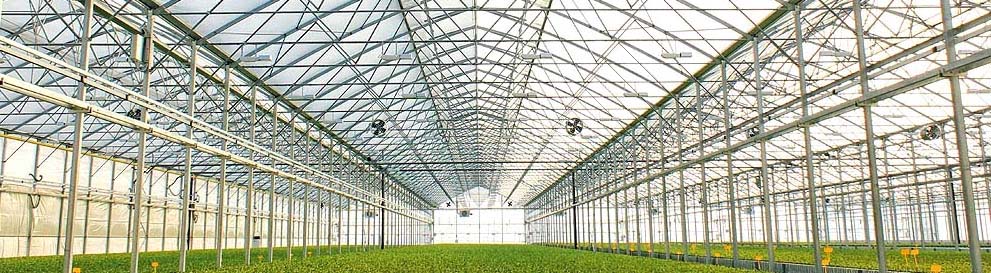
A film is only as strong as the frame it is pulled onto, and this house is built on hot dip galvanized steel pipe, with the reason given on the sheet being a plain one: the pipe is used to avoid rust. The model runs to a span of 6.4 m, 8 m, 9.6 m or 10 m, with a total structure height of 4.3 m to 6.5 m, an arch roof, and a covering material thickness of 0.15 mm or 0.12 mm; the advantages listed include effective prevention of heat loss and cold air intrusion, good insulation properties, low energy consumption, and a structure that is suitable for all climate conditions and adaptable to any type of landscape. How the frame is dimensioned for span, load and the galvanized coating that keeps it serviceable is the subject of our film greenhouse steel structure page.
The frame and the film are also on two separate clocks, and separating them is useful when a house is being planned. Corrosion is not a load question, and the coating on a galvanized frame is judged against the corrosivity of the air at the site rather than against the wind: under ISO 9223 a standard galvanized coating reaches first maintenance at about 13 years in heavy industrial air (class C4), about 30 years in urban conditions (class C3), about 50 years in coastal conditions (class C5), and 50 years or more without repair in clean suburban air (class C2). This house carries a specified average coating of 70 to 85 micrometres of zinc under BS EN ISO 1461, assessed against BS EN ISO 14713-1, and every cut and drilled point made during the build is treated afterwards so the coating line is not broken. Naming the corrosivity class and that coating thickness is what turns the four figures into a number for a particular site, and keeping that number apart from the wind load keeps both figures honest.
Where Openings and Systems Change the Load
Systems are added to the order depending on the customer request, and several of them change what the covering has to carry rather than only what the crop gets. Ventilation is the clearest case: this model is ventilated by sidewall openings covered by insect nets and roll-up curtains, manually or electrically operated, and a house that is opened through the day has a covering that is being handled, rolled and re-tensioned at the openings rather than left alone. A cooling and heating system adds ducting, pipework and sometimes a wet pad wall, each of which is an opening or a penetration in the envelope. A ventilation system adds fans in the end wall. A shading system adds a second layer of material above the covering, which shelters the film and also has to be anchored against the same wind.
| Ventilation system | Opens the envelope, adds free edges and a net line to be restrained |
| Cooling and heating system | Adds penetrations and a wet surface, with the humidity that comes with it |
| Shading system | A second membrane above the cover, anchored against the same wind |
| Irrigation system | Pipework and fittings inside the house, planned so the cover is not cut for them |
| Fertilization system | Injection equipment and tanks, placed for access without breaching the covering |
| Benches | Internal fittings that also have to be cleared when the film is renewed |


Crops, Sites and Small Houses
The house is used for vegetables, fruit, flowers and seed nursery work, and the crops that make the argument for a reinforced sheet are the ones that are grown to a canopy and sold by weight or grade. A fruiting vegetable crop such as peppers, tomatoes or cucumbers fills the house with green material and holds it there for months, which means the covering is under its working load for the whole season rather than for a few weeks; a covering that fails in the middle of that is not a repair, it is a lost crop under an open roof. Nursery and flower work carries the same risk with tighter margins, because a torn panel lets the environment the crop was planned around escape in an afternoon.
The same construction is the reason the sheet suits smaller houses as well, and our own sheet describes it for home gardens, small farms and urban growing spaces. On a small house with a short span, the load per clip is lower but the exposure per square metre of covering is often higher, because a small house on a suburban plot is surrounded by buildings, hedges and fences that break the wind up into gusts and eddies instead of letting it pass. That is a load case a reinforced cover handles better than a plain film, and it is why the small-house buyer is not getting a lesser version of the specification. How commercial growers choose covering for their own sites, and what they see in a season, is reported by Greenhouse Grower, and the wider technical picture for covered crop production, including work on structures and covering materials, is published by the FAO.

Packing, Warranty and Support
The house travels in three groups: metal structures, covering system and install accessories. The covering system carries the film, and the clips and channel that take the load off it come with the group that installs them, so the reinforcement in the sheet and the strength of the fixing line are ordered together rather than being brought together on site from two sources. For a house of this size the covering is normally ordered cut to length for its bays, with a spare length held against a damaged panel, because the load path through a roof is only as good as its weakest panel.
The structure is backed by a long-term structural warranty, and the company behind it has been manufacturing greenhouses for above 35 years. We ship to customers all over the world every year. We have a professional engineer department, and if a customer requests it we can send our engineers to foreign countries to guide the installation. Many customers visit our factory each year for business cooperation, and the question most of them bring about a cover is the one this page answers: whether the sheet will hold through the wind their site produces, and where it will give first if it does not.

If you need to ask a question and get some help to find the best greenhouse for you, call us on +86 191 5068 3942 or send an e-mail to sales@cngreenhouses.com. Tell us the wind the site produces, the span the house will run to and the openings the crop needs, and the covering construction, the fixing line and the restraint can be put together as one assembly instead of three separate choices. The rest of the polyethylene covered range is on our film greenhouse range page.

Frequently Asked Questions
Q: What does multi-layer reinforced mean on this sheeting?
It describes two things at once. Multi-layer means the film is produced with more than one melt fed to the die, so the finished sheet is a stack of bonded layers rather than one material through its thickness; that is what allows an outer layer to carry the ultraviolet stabilizers and an inner layer to carry the anti-fog additives. Reinforced means the construction is built so that a tear, once it has started, meets resistance instead of running: the sheet on this page is described as a multi-layer reinforced design with anti-tear reinforcement, and it is sold as durable, weatherproof, high in light transmittance and anti-aging.
It describes two things at once. Multi-layer means the film is produced with more than one melt fed to the die, so the finished sheet is a stack of bonded layers rather than one material through its thickness; that is what allows an outer layer to carry the ultraviolet stabilizers and an inner layer to carry the anti-fog additives. Reinforced means the construction is built so that a tear, once it has started, meets resistance instead of running: the sheet on this page is described as a multi-layer reinforced design with anti-tear reinforcement, and it is sold as durable, weatherproof, high in light transmittance and anti-aging.
Q: Where does the load actually land on a film house?
At a set of zones rather than evenly. The clip line in the channel takes the whole roof load, because every square metre of sheet is held by it. Corners and end walls take peak pressure and suction where two faces meet. The arch crown on the windward side presents the largest area and has the longest unsupported run between fixings. Roll-up curtain edges and net lines are free edges being opened and closed. And every door, louvre and vent is a deliberate cut in a material whose job is to be continuous, which is where a tear most often begins.
At a set of zones rather than evenly. The clip line in the channel takes the whole roof load, because every square metre of sheet is held by it. Corners and end walls take peak pressure and suction where two faces meet. The arch crown on the windward side presents the largest area and has the longest unsupported run between fixings. Roll-up curtain edges and net lines are free edges being opened and closed. And every door, louvre and vent is a deliberate cut in a material whose job is to be continuous, which is where a tear most often begins.
Q: Why does a tear start at an edge or a clip line instead of in the middle of a panel?
Because a cut changes how the load is shared. A film in the middle of a panel with no nick in it is loaded across its whole width and behaves as a tensile member, so the load is spread. Once the film has been cut, drilled, or pinched at a fixing point, the stress concentrates at the tip of that cut, and if the material cannot blunt it the cut opens and travels. Reinforcement in the sheet works on that second number, forcing a tear to break the reinforcing element or go around it, which costs the wind more energy than going straight through.
Because a cut changes how the load is shared. A film in the middle of a panel with no nick in it is loaded across its whole width and behaves as a tensile member, so the load is spread. Once the film has been cut, drilled, or pinched at a fixing point, the stress concentrates at the tip of that cut, and if the material cannot blunt it the cut opens and travels. Reinforcement in the sheet works on that second number, forcing a tear to break the reinforcing element or go around it, which costs the wind more energy than going straight through.
Q: How does this house take the wind it is designed for?
The design wind load listed for this model is 0.35 kN/m2, which is a pressure per square metre of exposed surface rather than a total force. Because the covering is held on all four sides and loaded from both faces, wind pushes inward on the windward wall and the windward half of the arch while suction pulls the sheet outward on the leeward half, so the two add to the lift on parts of the house rather than cancelling. On an arch roof the changeover sits near the crown, which is where the unsupported run is longest, so the crown is a place to plan.
The design wind load listed for this model is 0.35 kN/m2, which is a pressure per square metre of exposed surface rather than a total force. Because the covering is held on all four sides and loaded from both faces, wind pushes inward on the windward wall and the windward half of the arch while suction pulls the sheet outward on the leeward half, so the two add to the lift on parts of the house rather than cancelling. On an arch roof the changeover sits near the crown, which is where the unsupported run is longest, so the crown is a place to plan.
Q: What has to be reinforced around openings?
More than most buyers expect. Every door, louvre and vent is a cut, and the film around it needs reinforcement that the sheet on the roll cannot supply by itself. This model is ventilated by sidewall openings covered by insect nets and roll-up curtains, manually or electrically operated, and each open edge has to be held so it cannot work loose in the wind. The same rule applies wherever a run of covering is restrained by a rope line: every point the line passes through has to take the force and spread it, because a bare fixing point in a loaded sheet is where a tear will start.
More than most buyers expect. Every door, louvre and vent is a cut, and the film around it needs reinforcement that the sheet on the roll cannot supply by itself. This model is ventilated by sidewall openings covered by insect nets and roll-up curtains, manually or electrically operated, and each open edge has to be held so it cannot work loose in the wind. The same rule applies wherever a run of covering is restrained by a rope line: every point the line passes through has to take the force and spread it, because a bare fixing point in a loaded sheet is where a tear will start.
Q: Can reinforcement in the sheet make up for a loose cover or a poor fixing?
No, and that is the main reason a reinforced sheet sometimes disappoints. Wind loading on a slack covering is not static: the film lifts and settles on every gust, and that movement, not the pressure figure, is what wears a covering out at the fixing line. This house holds the film on a specially engineered grooved channel frame, and the covering may only be covered by polyethylene held with aluminum clips, so the sheet arrives at the fixing as a straight pull only if it is tensioned to the profile and re-checked after it has taken its set. What reinforcement does is stop a soft, sun-exposed film from turning that movement into a tear; what it cannot do is remove the movement.
No, and that is the main reason a reinforced sheet sometimes disappoints. Wind loading on a slack covering is not static: the film lifts and settles on every gust, and that movement, not the pressure figure, is what wears a covering out at the fixing line. This house holds the film on a specially engineered grooved channel frame, and the covering may only be covered by polyethylene held with aluminum clips, so the sheet arrives at the fixing as a straight pull only if it is tensioned to the profile and re-checked after it has taken its set. What reinforcement does is stop a soft, sun-exposed film from turning that movement into a tear; what it cannot do is remove the movement.
Note: If you're interested in the product, please submit your requirements and contacts and then we will contact you in two days. We promise that all your informations won't be leaked to anyone.
 Deutsch
 Español
 Français
 Italiano
 Português
 日本の
 한국어
 العربية
 български
 hrvatski
 česky
 Dansk
 Nederlands
 suomi
 Ελληνικά
 हिन्दी
 norsk
 Polski
 Română
 русский
 Svenska