- Commercial Greenhouse
- Film Greenhouse
- PC Greenhouse
- Glass Greenhouse
- Tunnel Greenhouse
- Scientific Research Greenhouse
- Vegetable Greenhouse
- Flower Greenhouse
- Multi-span Greenhouse
- Sawtooth Greenhouse
- Greenhouse Equipments
- Greenhouse Accessories
- Hot Dip Galvanized Pipe
- Irrigation System
- Hydroponics System
- Planting Tools
- Planting technology
Tel: +86 191 5068 3942
Fax:
Mobile: +86 191 5068 3942
Contact: Alina
E-mail: sales@cngreenhouses.com
SKYPE:


- Features


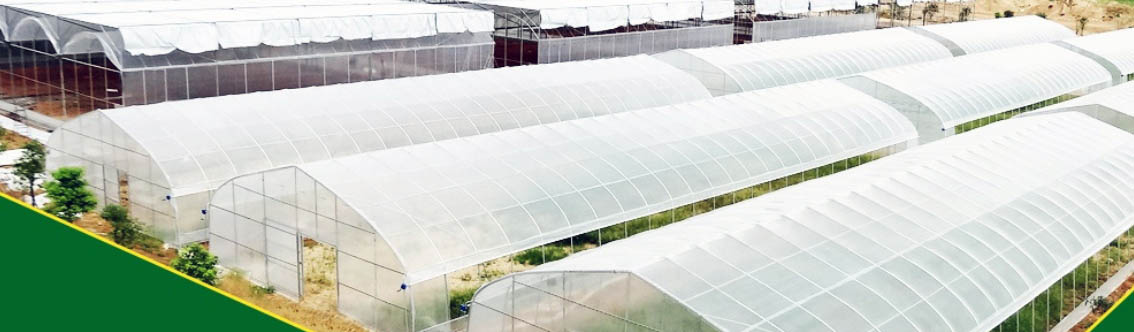
An ecological agriculture park rarely opens all at once. The photo above shows the block that normally goes up first: a long multi-span production greenhouse with side-wall louvre vents, ridge openings and a paved service path already in place. This page deals with the part that decides whether such a park stays affordable — the order in which it is built and the rhythm in which money is released, from the first phase to the later extension.
Why an ecological park is delivered in phases
Building the whole park in one push ties up the budget before a single crop is sold, leaving the owner carrying running costs with no income. Phasing splits the park into blocks that can each open and operate on their own. The test for a phase boundary is simple: once that phase is finished, can it run by itself? It must already have water, power, drainage, road access and a working greenhouse. Without those, it is not a phase, only a fragment.
Phase one: what has to be built first
The first block built is normally the producing block — the multi-span greenhouse that can start growing and shipping earliest. Everything that makes it usable is built with it: site levelling and vertical drainage, the internal road spine, the main water supply line, the power intake, and an area for handling growing medium and inputs.
Two are easy to under-build and expensive to redo:
- Underground services — supply mains, drainage and spare ducts should follow the routing the finished park will need, so a later block can be connected without digging the yard open again.
- The road spine — its alignment and turning space should suit the vehicles the park will eventually run, not only the first block's traffic.
For the structure, hot-dip galvanised steel is the usual choice for a park that will be extended over several years, because the coating protects members that sit through repeated wet seasons; corrosion categories follow ISO 9223 and BS EN ISO 14713-1, class C2 to C5, selected for the local atmosphere. A producing block should be laid out so a second block can be added onto its gable end without disturbing what is already running.
Phase two and beyond: what follows, and in what order
Later phases turn the site into more than a farm. The order that generally works is support first, showcase second:
- Blocks that lower the running cost of phase one come first — seedling raising, substrate handling, grading and packing space, cold storage.
- Blocks that depend on phase one being in production come later — demonstration houses, visiting routes and display planting.
The photo already hints at that second layer forming: the flower border and lamp posts along the service path are not production assets — they belong to the phase in which the park starts receiving visitors. For what a greenhouse does inside the park — production, demonstration or teaching — see our notes on the roles a greenhouse plays inside an ecological park. This page stays with build order and investment.
Rolling investment, staged payback and how funds are prioritised
The purpose of phasing is that income from a finished block partly carries the next one. That changes what payback means: ask whether each phase can cover its own running cost and still contribute to the next, instead of waiting for the whole park to break even.
When funds are limited, spending is normally ranked in this order:
- Crop safety — structure, drainage, load capacity, dependable power. A failure here costs a whole season.
- Capacity — covering, ventilation openings, irrigation and water storage. These set how much the park can actually produce.
- Efficiency — automation, internal transport, control sensors. Worthwhile, but they can be added to a block that is already running.
- Image — landscape planting, lighting and visitor facilities. These only pay off once there is something to visit.
A working reserve should be kept inside every phase, so a change found on site is absorbed without stopping work. Where a park is built over several years, the frame's anti-corrosion class, the covering and the vent type should stay consistent from phase to phase; mixing specifications midway makes an extension behave like a different greenhouse.
Expansion interfaces, and keeping works apart
Extensions become difficult only when the first phase was not designed for them. These are the interfaces worth fixing during the first build:
- Structural grid and foundations — the new block repeats the existing bay spacing so columns, gutters and gable frames line up.
- A closable gable — the end wall is detailed so it can be opened later and joined, rather than cut on site.
- Spare ducts and capacity — drainage, irrigation and power routes are run with the finished park in mind, with capacity reserved at the intake and the distribution board.
- Levels and discharge — new ground is set to the same level and drainage outlet, so adding a block never backs water up into its neighbour.
While a later phase is being built the earlier greenhouses must keep producing, and the two operations have to stay out of each other's way:
- Construction traffic follows a temporary route away from the working crop area, with the site edge screened.
- Water and power for the new block come from the reserved connection points, so the running block is never switched off.
- Dust-heavy and noisy work is scheduled for the part of the day when vents can stay closed, protecting the crop and biological control.
- Each phase has one identified handover point for foundations, covering and commissioning.
To have a build sequence reviewed before the first block is ordered, write to sales@cngreenhouses.com or call +86 191 5068 3942. With above 35 years in greenhouse engineering, we also keep other park and project references on file; the structure behind most producing blocks is described under multi-span greenhouse construction, and a typical multi-span delivery sequence is covered in our multi-span project notes.
Industry coverage of how growers plan and fund new protected-cropping capacity is published by HortWeek, while guidance on protected cultivation in agricultural development programmes is published by FAO.
Frequently Asked Questions about phasing an ecological agriculture park
Q1: How do you decide what to build first in an ecological agriculture park?
Build the block that can start producing earliest, together with the services it needs to run alone. Anything that only supports visitors or image is postponed until production is under way.
Q2: Should the underground services really be sized for the whole park in phase one?
Yes, for routing and capacity. Cuts, ducts, the road spine and the power intake are the items that are expensive to reopen once greenhouses and yards are finished, so they are set out for the final layout even when only one block is installed.
Q3: How does rolling investment work when each phase funds the next?
Each completed phase is expected to carry its own running cost and contribute towards the following one. The question to ask per phase is whether that phase stands on its own, rather than whether the entire park has broken even.
Q4: How do you stop a later phase from disturbing greenhouses already in production?
Give the new phase its own temporary access route, its own connections at the reserved points, and a working pattern that keeps dust and noise away from the crop while vents can still be closed. The running block should never have to shut down for the extension.
Q5: Which greenhouse type is normally used for the producing block?
Multi-span houses are the common choice, because bays can be repeated as the park grows and the ventilated side walls and ridge openings seen in the photo above suit year-round production.
Q6: What should stay the same from one phase to the next?
Frame anti-corrosion class, covering material, vent type, bay spacing and drainage levels. Keeping these consistent is what makes a later block read as part of the same park and allows the same maintenance routine throughout.
 Deutsch
 Español
 Français
 Italiano
 Português
 日本の
 한국어
 العربية
 български
 hrvatski
 česky
 Dansk
 Nederlands
 suomi
 Ελληνικά
 हिन्दी
 norsk
 Polski
 Română
 русский
 Svenska