- Commercial Greenhouse
- Film Greenhouse
- PC Greenhouse
- Glass Greenhouse
- Tunnel Greenhouse
- Scientific Research Greenhouse
- Vegetable Greenhouse
- Flower Greenhouse
- Multi-span Greenhouse
- Sawtooth Greenhouse
- Greenhouse Equipments
- Greenhouse Accessories
- Hot Dip Galvanized Pipe
- Irrigation System
- Hydroponics System
- Planting Tools
- Planting technology
Tel: +86 191 5068 3942
Fax:
Mobile: +86 191 5068 3942
Contact: Alina
E-mail: sales@cngreenhouses.com
SKYPE:


- Features


This Project Display page looks at a vegetable seedling base from the operating side: how capacity is planned, how batches are laid out against orders, and how the three growing zones and internal flow keep the raising programme on schedule. It is written for growers who need to know whether the base can deliver its seedlings on time.
Capacity Is Decided Before the Building
The economics of a seedling base come from the rhythm of selling seedlings, not from the amount of ground covered. The starting point is a target output: how many seedlings per batch the market will take, multiplied by how many batches the base can deliver in a year. Only then does it make sense to work backwards to raising area, bench count and zone proportions.
Area is the result of that calculation, never its starting point. Two bases with identical footprints can hold very different real capacity, because bench levels, aisle width and the share of floor given to germination or hardening all change how much of the plan is productive. This layout thinking is discussed on our multi-span greenhouse for vegetable seedling bases page.
Bench Turnover and Batch Scheduling
Bench turnover rate is the number of complete raising batches one bench finishes in a given period. In planning terms it is available working days divided by the days a single batch occupies the bench. That occupied time is longer than the growing time alone: it includes clearing the previous batch, sanitising, filling trays, germination, raising, hardening and moving the plants out. Teams that count only growing days usually overestimate capacity.
There are two honest ways to lift turnover. One is to shorten the occupied days of each batch, for example by tightening germination and hardening so seedlings reach saleable size sooner. The other is to remove the dead gap between batches, so sanitising and tray filling overlap with the outgoing batch. What must not be sacrificed is uniformity; squeezing batch length until ages blur creates rejection at delivery, and the saving disappears.
Batch layout works backwards from the order calendar. Fix delivery windows first, then count back through hardening and raising to a sowing date for each batch. Spreading those dates keeps the hardening area from being hit by every batch in the same week. Where orders concentrate before the main planting season, it is better to design many small, continuous batches than one large one: a rolling series smooths the delivery curve and keeps labour steady. Related work is shown in our PC sheet greenhouse projects.
Three Functional Zones and Their Division of Labour
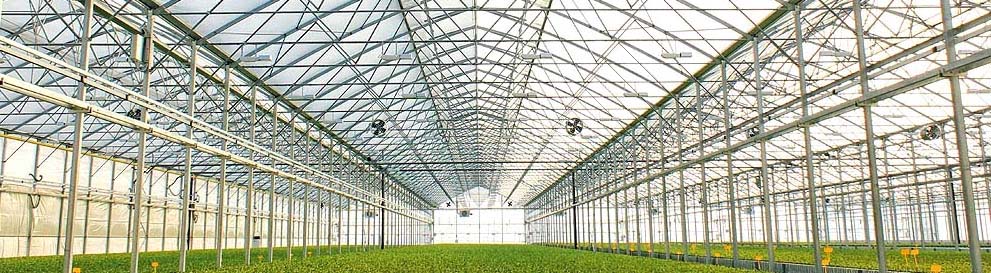
Germination, raising and hardening are not three names for the same room. The germination zone needs stable high humidity and warmth with low or filtered light. It occupies the smallest area but sits closest to the sowing and tray-filling stations, because its whole value is a short, fast turnaround.
The raising zone is the largest and sets the true capacity of the base. It is best split into small blocks by batch and by seedling age, so every block holds one age group with one environment, which lets water, nutrition and hardening be applied uniformly rather than averaged across mixed ages.
The hardening zone sits next to dispatch. Its job is gradual exposure to the outside climate, so ventilation and a step-by-step drop in humidity matter more than heat retention. Because hardening is measured in days, it must be adjacent to the loading area to cut handling and stress on the final move. The share of area given to each zone shifts with crop and season and should not be frozen; the working rule is simply that raising is the largest, germination the smallest, and hardening is anchored to dispatch.
Internal Logistics Flow
The internal flow should run one way and never double back: sowing and tray filling, germination, raising, hardening, grading and packing, then loading. A single direction keeps the crop moving forward and avoids the crossing of clean and used material that causes disease problems. Each batch travels the same fixed route from germination to the gate, which removes time wasted hunting for trays.
Aisles, door openings and the height of the loading platform are part of this flow and must be sized with it, not added afterwards. Where benches build the route, the bench type itself is a separate equipment decision; see our multi-layer rolling growing bench page for that side of the question, and our PC board seedling workshop project for a completed working example.
Area-to-Capacity Conversion and Seasonal Scheduling
Converting area into capacity follows a simple logic, though actual figures vary by crop and order book: effective raising area equals total area minus aisles, working space and buffer zones; annual output is then effective bench area multiplied by trays per square metre, by turnovers per year, by survival rate. The point of the formula is not a headline number but a way to see which factor is limiting. If turnover is the bottleneck, more benches will not help; if area is the bottleneck, shortening batches will not help either.
Seasonal scheduling follows the same logic. In the peak season the base protects capacity by maximising productive area and shortening time in hardening; in the quiet season it consolidates the zones into fewer blocks so running costs drop, and uses the spare time for equipment servicing, tray and substrate preparation, and staff training. Scheduling is also where movable benches earn their place, letting one footprint follow demand through the year.
For industry guidance on how commercial growing facilities are specified and built, see the National Greenhouse Manufacturers Association; for current market and production news, see HortWeek horticulture coverage.
To discuss a seedling base project with our engineering team, write to sales@cngreenhouses.com or call +86 191 5068 3942. With above 35 years in greenhouse manufacturing, we help clients move from a target output to a workable layout.
Frequently Asked Questions
Q1: How is seedling base capacity planned before construction?
Start from a target output of seedlings per batch and the number of batches per year, then work backwards to raising area, bench count and zone proportions. Treat area as the outcome, not the input.
Q2: How do you calculate growing bench turnover rate?
Divide available working days by the days a batch occupies the bench, counting clearing, sanitising, tray filling, germination, raising, hardening and dispatch, not just the growing period.
Q3: How should batches be scheduled against order peaks?
Fix delivery windows first, count back to sowing dates, and use many small continuous batches instead of one large one, so hardening and labour are not overloaded in the same week.
Q4: What separates the germination, raising and hardening zones?
Germination needs stable warmth and humidity in the smallest area near sowing; raising is the largest block, split by age; hardening is measured in days and sits next to dispatch.
Q5: Which way should internal logistics flow inside the base?
One direction only: sowing, germination, raising, hardening, grading and loading, with no doubling back, so a batch follows the same route every time.
Q6: Can a base be expanded as orders grow?
Often yes. Capacity depends on bench density and batch turnover as much as on floor area, so the same site can absorb higher density before a second building is needed.
 Deutsch
 Español
 Français
 Italiano
 Português
 日本の
 한국어
 العربية
 български
 hrvatski
 česky
 Dansk
 Nederlands
 suomi
 Ελληνικά
 हिन्दी
 norsk
 Polski
 Română
 русский
 Svenska