

- Commercial Greenhouse
- Film Greenhouse
- PC Greenhouse
- Glass Greenhouse
- Tunnel Greenhouse
- Scientific Research Greenhouse
- Vegetable Greenhouse
- Flower Greenhouse
- Multi-span Greenhouse
- Sawtooth Greenhouse
- Greenhouse Equipments
- Greenhouse Accessories
- Hot Dip Galvanized Pipe
- Irrigation System
- Hydroponics System
- Planting Tools
- Planting technology
Tel: +86 191 5068 3942
Fax:
Mobile: +86 191 5068 3942
Contact: Alina
E-mail: sales@cngreenhouses.com
SKYPE:


- Features


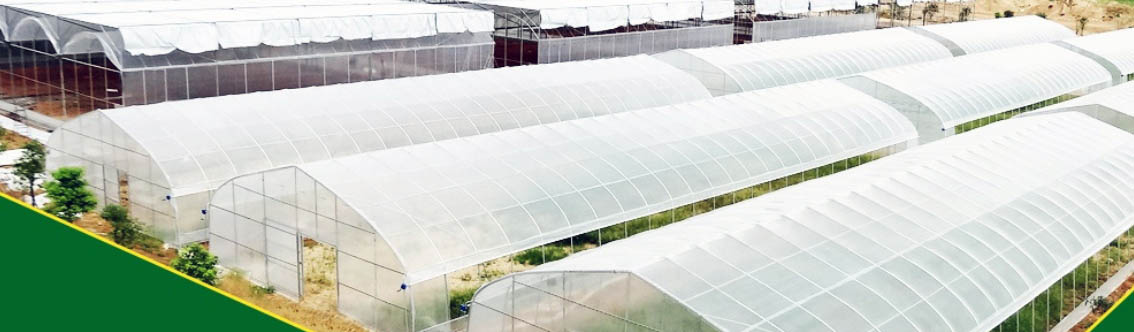
A PC board greenhouse built as a seedling workshop differs from a general growing house. The picture above shows the finished shell: rigid panels on a gable and ridge frame, a masonry base wall lifting the cover clear of ground splash, and a paved apron along the working side. This page covers why hollow polycarbonate board suits seedling production, how the workshop is zoned, how the panels are sealed, and how the covering is maintained. Other builds are listed in the greenhouse project gallery.
Why Hollow PC Board Suits a Seedling Workshop
Seedlings are the most climate-sensitive stage of the crop cycle, and the covering decides how much of that the equipment has to absorb. A hollow polycarbonate board is a multi-wall panel with sealed air cells between its skins. Those cells slow heat loss, so the workshop holds a steadier night temperature than it would under single film. The board also scatters light instead of passing it straight through, softening direct sun and spreading light evenly across the benches. Condensation behaves differently too: single film lets water fall in drops, while a hollow board holds moisture on or lets it run down, so seedlings are wetted from above far less often - an advantage where damping-off is the main risk. The trade-off is transmission: rigid board passes less light than clear glass, so summer shading and low-light supplementary lighting have to be planned in. The polycarbonate versus glass comparison sets out that balance.
Zoning and Bench Layout in the Seedling Workshop
A seedling workshop works best divided by climate, not by bench count. Germination takes the warmest, most humid zone, where heat and moisture can be pushed up without stressing older plants. Growing-on takes the largest zone, a little cooler with more air movement. Hardening, the last stage before planting out, wants the coolest, best-ventilated area, usually near the doors where temperature can be dropped and outside air brought in. A separate working zone for trays, substrate and irrigation keeps that traffic out of the growing area. Benches follow those zones: fixed or movable, aligned with the ridge, with aisles wide enough for trays and trolleys, and eave height that clears the bench, the seedlings at full height and any lighting above them. Keeping each zone in contiguous bays lets one ventilation and heating strategy serve it. The PC greenhouse range shows the covering options these benches sit under.
Climate Control Points for a Seedling Workshop
Temperature is the first control. The board insulation cuts night heat loss, and pipe heating under the benches warms the roots and trays, but those gains are lost if cold air reaches the plants through doors and gaps, so a lobby or screen at the main entrance pays for itself. Humidity is the second. Every surface has a dew point; if the inner face of the board drops below it, moisture condenses there. A little heat and moving air hold the surface above the dew point, and venting at midday carries moisture out rather than letting it settle overnight; overhead irrigation late in the day works against this. Air movement is the simplest control to run: horizontal fans even out temperature and humidity across the benches and dry the leaves. Light is the last piece - summer shading to stop scorching, supplementary lighting to carry the winter, and a clean covering so light is not lost at the surface. Screened ridge and side vents remove heat and moisture, though the screen reduces airflow and is allowed for in the opening area. Trade guidance from the National Greenhouse Manufacturers Association and industry reporting in HortWeek treat these as one system.
PC Panel Installation and Sealing
Panel work decides how the covering performs, because most failures start at an edge. Boards are set into aluminium glazing profiles with rubber (EPDM) gaskets, and they need room to move: polycarbonate expands and contracts with temperature more than the frame does, so panels are not clamped so tightly that the expansion has nowhere to go. The open ends of the hollow channels are closed with a tape or matching profile, which keeps dust, insects and algae out of the cells and controls condensation inside them; without it the cells turn green or black and light transmission falls. Panels go in the right way round, UV face to the weather, with the fall arranged so water runs off rather than standing at a joint. Ridge, eave, gable and frame penetrations are sealed with the matching closures, and the bottom edge is left able to drain. The frame is steel and aluminium; where steel is used, corrosion protection is specified against ISO 9223 and BS EN ISO 14713-1 at class C2 to C5 for the site, with cut ends and drilled holes treated on site. Panel type and thickness are set out in the PC hollow panel range.
Routine Maintenance of the Covering
Maintenance is mostly about keeping light coming through and water out. Cleaning the outer face with water and a soft brush restores transmission that dust, pollen and algae take away; abrasive pads, solvents and ammonia-based cleaners damage the surface and are avoided. Gaskets, closures and sealant are checked on a walk-round and renewed when they harden or pull away. Fixings and clamps are checked for tightness, and gutters and downpipes kept clear so water never stands against the base. Where the end tape has failed, dirt and algae inside the channels are cleaned out before it is replaced. After snow, build-up is cleared without striking the panels, and a small stock of spares keeps the workshop running when one is damaged. How covering properties change over a service life is discussed in the polycarbonate covering guide.
Bozong Greenhouse has manufactured commercial greenhouse structures for above 35 years. For a seedling workshop project, send the site conditions and the growing plan to sales@cngreenhouses.com or call +86 191 5068 3942.
Frequently Asked Questions
Q: Why is hollow PC board chosen over single film for a seedling workshop?
It separates the plants from the outside air better: the sealed air cells slow night heat loss, the surface scatters light instead of passing it straight through, and condensation stays on or runs down the board rather than falling in drops on the seedlings. Film is quicker to renew, but the steadier climate is usually worth it.
Q: How should a PC board seedling workshop be divided into zones?
By climate, not by bench count: germination in the warmest, most humid zone; growing-on in the largest, slightly cooler zone with more air movement; hardening near the doors where temperature can be dropped; and a working zone for trays, substrate and irrigation.
Q: How do you keep condensation from dripping onto young seedlings?
Run a little heat and keep air moving so the inner face stays above the dew point, vent at midday to carry moisture out, and avoid overhead irrigation late in the day. A hollow board also holds moisture on or lets it run down the surface instead of forming drops.
Q: Why do the open ends of hollow PC panels need sealing?
The tape or profile keeps dust, insects and algae out of the air channels and controls condensation inside them; without it the cells grow dirty or algae and light transmission falls. The bottom edge is still left able to drain.
Q: What is the light trade-off when a nursery uses PC board?
Rigid board passes less light than clear glass, so the workshop leans on summer shading and supplementary lighting to manage what it gets. The board scatters what does pass through, which suits young plants better than hard, uneven light.
Q: What maintenance does a PC board covering need?
Clean the outer face with water and a soft brush, check gaskets, closures and fixings on a walk-round, keep gutters clear, clean the channels if the end tape fails, and clear snow without striking the panels.
 Deutsch
 Español
 Français
 Italiano
 Português
 日本の
 한국어
 العربية
 български
 hrvatski
 česky
 Dansk
 Nederlands
 suomi
 Ελληνικά
 हिन्दी
 norsk
 Polski
 Română
 русский
 Svenska