- Commercial Greenhouse
- Film Greenhouse
- PC Greenhouse
- Glass Greenhouse
- Tunnel Greenhouse
- Scientific Research Greenhouse
- Vegetable Greenhouse
- Flower Greenhouse
- Multi-span Greenhouse
- Sawtooth Greenhouse
- Greenhouse Equipments
- Greenhouse Accessories
- Hot Dip Galvanized Pipe
- Irrigation System
- Hydroponics System
- Planting Tools
- Planting technology
Tel: +86 191 5068 3942
Fax:
Mobile: +86 191 5068 3942
Contact: Alina
E-mail: sales@cngreenhouses.com
SKYPE:

News Show
Greenhouse Humidity Requirements and Dew Point Control
Humidity is the greenhouse variable that is easiest to feel and hardest to hold. Temperature you can see on a dial and act on with a heater; moisture in the air moves the other way as the house cools, and the number that looked comfortable at noon can be doing damage by midnight. This page deals with that side of a greenhouse - what relative humidity actually is, where the safe band sits, how the moulds and mildews use it, and the practical kit and habits that keep it in range. It sits in the same Planting technology library as our crop, ventilation and heating articles, and it is written for the grower who wants to hold a number rather than hope for one.
Humidity Is a Measured Quantity, Not a Feeling
Every plant has small open pores in its leaves, called stomata, through which gases such as oxygen and carbon dioxide pass in and out. Water vapour leaves through the same pores, and because a plant rarely uses all the water its roots take up, the surplus is given off as vapour. That vapour in the air is what we call humidity, and relative humidity is the term that expresses it as a percentage: the quantity of water vapour actually present, measured against the most the air could hold at its current temperature. A hygrometer is the instrument that reads it.
The part of that sentence worth re-reading is at its current temperature. Warm air can hold far more moisture than cool air, so the same quantity of water vapour in the same house reads as a modest percentage at midday and a high one after dark. Relative humidity is not a fixed property of your greenhouse - it is a number that follows the thermometer, and understanding that before you try to control it saves a lot of wasted effort.
Why the Same Air Reads 50 Per Cent by Day and 90 by Night
Through the day the house is warm and the crop is transpiring, and warm air soaks the vapour up. Shade the sun, let the temperature fall, and two things happen at the same time: the crop keeps giving off vapour, and the air's capacity to hold it shrinks. The percentage therefore climbs even though nothing has been added. Keep cooling and the air reaches the point at which it can hold no more - the dew point - and every surface cooler than that point collects a film of water. After dark the coldest surfaces in a greenhouse are the glazing and the leaves nearest it, which is why condensation appears on the cover and dew forms on the crop at the same hour. This is the reason the first two hours after the sun goes off matter more than the middle of the day, and it is part of the wider picture of how a greenhouse behaves as a system, set out in our companion page on how a greenhouse works.
The University of Massachusetts Amherst extension describes the sequence plainly in its guidance on Botrytis in greenhouse crops: in the evening, as warm air cools, relative humidity rises until water vapour begins to form a film of moisture on surfaces. That film, more than the percentage alone, is what fungal spores need in order to germinate.
The Band Most Plants Grow Best In, and What Sits Outside It
Most greenhouse plants grow best between 45 and 60 per cent relative humidity, and that band is worth treating as the operating target rather than a rough guide. Below it the crop transpires faster than the roots can replace the water, and leaf edges and flower buds are the first to suffer. Above it, the house stops drying itself out. The line the original guidance on this page drew was 80 per cent: humidity above that level encourages mould on the plants and rot in any timber in the structure - frames, shelving, benches - and mould is a disease risk as well as a nuisance.
The specific thresholds published by extension services sit a little higher again, and they are worth knowing because they tell you how much margin you actually have. The Connecticut Agricultural Experiment Station, in its fact sheet on powdery and downy mildews in greenhouse crops, advises venting and heating to hold relative humidity below about 93 per cent. At 85 per cent and above, with a film of moisture present, the spores of Botrytis - gray mould - are able to germinate, and infection follows if the wetness lasts long enough.
Read as a ladder, the numbers are easy to hold in mind: 45 to 60 per cent is where you want to sit, 80 per cent is where trouble starts in a general sense, 85 per cent plus a wet leaf is the band in which gray mould infects, and 93 per cent is the ceiling the extension guidance tells you not to ride above.
The Moulds Do Not All Want the Same Thing
Treating every mould as one enemy leads to one response - dry the house out - and that is wrong in one important case, because powdery mildew does not want a wet leaf at all. The three that a protected crop runs into most often divide like this:
Gray mould (Botrytis). The University of Massachusetts Amherst extension gives the conditions for spore germination and infection as a film of moisture held for 8 to 12 hours, a relative humidity of 85 per cent or greater, and temperatures between 55 and 75 degrees F (about 13 to 24 degrees C). Note that the moisture has to last - a brief spike is not enough, which is why a long damp night is more dangerous than a wet hour.
Downy mildew. This one needs leaf wetness and high humidity above 85 per cent, and it is an oomycete rather than a true fungus, which is why it behaves like a water mould. The Connecticut Agricultural Experiment Station singles out leaf wetness early in the day as the condition that is critical to its development, and puts water management at the centre of controlling it.
Powdery mildew - the exception. Penn State Extension describes powdery mildew as favoured by a warm (60 to 80 degrees F), dry climate: it does not require free water for germination and infection, but it does need high relative humidity around the plant in order to spread. It is most severe in crowded, shady and poorly ventilated spots and is slowed by temperatures above 90 degrees F. A house that reads a comfortable 55 per cent at head height can therefore still be a powdery mildew house if the air is not moving, while the same house can be a gray mould house by midnight once the film forms. Air movement and the night hours do as much of the work here as the percentage does.
Drying the Air: Heat and Vent Together, in Short Bursts
A house that is running too humid is far more common than one that is too dry, and the remedies are not exotic - but the order in which you use them matters.
Move the air first. The original guidance on this page leads with circulation: install a fan and increase the movement of air through the crop. Horizontal air movement dries the leaf surface and evens out the temperature across the house, which is what stops a cold corner condensing while the middle reads perfectly fine.
Then change when you water. Water earlier in the day so the surfaces have daylight left to dry in, because the moulds do their work at night. Water only when the plants actually need it rather than on a routine.
Ventilate, and put the heat on while you do it. The University of Massachusetts Amherst guidance gives the most direct method for a humid evening: turn on the heat and open the vents at the same time. Warm air holds more moisture, so the incoming outside air drops sharply in relative humidity as it is warmed, and the moist inside air is carried out through the vents. Their figure for how long this needs to run is short - the air exchange takes only 5 or 10 minutes - and on some evenings the cycle has to be repeated several times before the house is closed down for the night. It can be put on a timer so it happens on the nights you are not there.
Recover the heat if you can. An air-to-air heat exchanger passes the warm moist inside air against cool dry outside air, so the house gets fresh air without throwing all of its heat out with the moisture. On a house that is heated as well as ventilated, this is the piece that keeps the two systems from fighting, which is why the control logic and the greenhouse ventilation system are best planned together rather than bought as separate items.
Water in the Root Zone Is a Separate Problem
Air humidity and root-zone moisture are managed differently, and confusing the two is one of the commonest mistakes in a greenhouse. Within soil there are small air pores that the roots depend on for the gases they need. Water fills those pores when the soil is wet. A plant watered every day whether it needs it or not can end up with its roots sitting in waterlogged soil with no air around them at all, and a suffocating root system shows itself in exactly the same way a drought does - the plant wilts. The instinctive response to a wilting plant is another watering, and that makes the problem worse rather than better.
Because a greenhouse is an enclosed volume it traps a fair share of the moisture it receives, so a house generally needs less watering than an open garden bed of the same area, not more. The rule the original guidance on this page gives is the one to keep: always check the soil before you water, and water when it is dry rather than by the calendar. If you want the watering itself to be repeatable, a drip irrigation system puts the water at the root zone instead of over the leaves, which brings the next point with it.
How You Apply the Water Changes the Humidity
Watering method and air humidity are the same conversation, because water that lands on the leaves has to be dried off again, and every extra hour of wet foliage is another hour of infection risk. That is why moving from overhead watering to drip, soaker hose or a flood floor is the standard recommendation for downy mildew control - the Connecticut Agricultural Experiment Station lists it among the essential water-management measures, and Penn State Extension gives the same advice for both mildews.
The other number that is easy to get wrong is the temperature of the water itself. Greenhouse plants, like people, do not enjoy being watered with cold water. The guidance on this page puts the ideal water temperature at 65 to 80 degrees F (about 18 to 27 degrees C), and anything above 80 degrees F is too hot. Let a can or a tank come up towards house temperature instead of pouring straight from a cold tap, and avoid drawing from an unshaded outdoor tank that has been standing in full sun at midday.
When the Air Is Too Dry
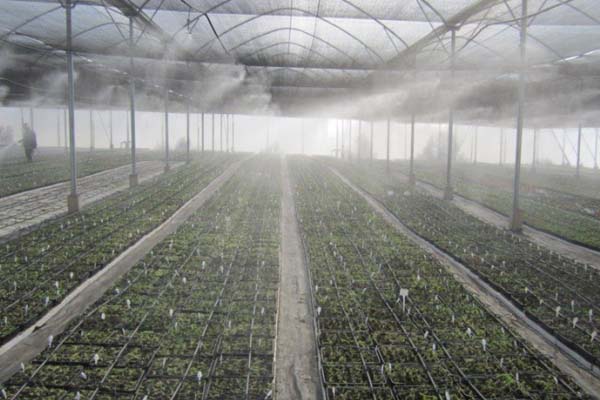
A dry house is the easier of the two problems and it is the rarer one, because the enclosed volume holds on to the moisture the crop gives off. If the air is genuinely too dry, watering more often is the first and simplest answer, and a greenhouse humidifier will lift the level directly. Overhead misting does the same job over a bench or a propagation area - the misting line in the photograph at the top of this page is exactly that tool - but it must be run early enough that the foliage is dry before dark, because the film it leaves behind is the very thing the moulds are waiting for.
What to Measure and Where to Measure It
A single hygrometer at head height will not tell the whole story, because the number that matters is the one at the canopy and in the coldest corner of the house. Cold spots condense first. The lower tier of a dense canopy usually runs damper than the aisle beside it. A house can read 55 per cent down the middle and be sitting under a drip at one end. Measure where the crop is, at more than one point, and at the hour the risk is highest - the first couple of hours after the vents close for the night.
Hold 45 to 60 per cent through the day and stay clear of the 85 per cent line at night, and remember that the measures which get you there are airflow, early watering and short heat-and-vent cycles - not a larger appliance bolted on at the end.
Why Us
Bozong Greenhouse has above 35 years of professional greenhouse production behind it. From a small workshop the company has grown into a professional conservatory manufacturer with a real presence in the market, and we supply complete houses rather than frames alone. Humidity control is one of the systems we quote as part of the same package as the structure: misting and humidification, ventilation and air circulation, heating and screening, and the sensor and control gear that ties them together, so a house is specified as one climate rather than a set of parts bought season by season.
To specify a humidity and ventilation package we need the house dimensions and volume, the crop and the humidity band you want to hold, and your local climate together with whether the house is heated. Send those and we can put the airflow, vent area, misting line and controls together with the frame and cover for the same house. The components sit inside our greenhouse equipment catalogue, so the climate side can be ordered in the same pass as the structure.
Guidance on protected cropping and greenhouse practice is published by the FAO, and commercial greenhouse practice is reported every month by Greenhouse Grower.
Frequently Asked Questions:
Q: What relative humidity should a greenhouse be held at?
A: Most greenhouse plants grow best between 45 and 60 per cent relative humidity, and that is the band to aim for by day. Above 80 per cent mould becomes a general risk, at 85 per cent and above with a wet leaf the spores of gray mould can germinate, and the extension guidance is to keep the house below about 93 per cent. Stay clear of the top of that ladder at night, when relative humidity climbs on its own.
A: Most greenhouse plants grow best between 45 and 60 per cent relative humidity, and that is the band to aim for by day. Above 80 per cent mould becomes a general risk, at 85 per cent and above with a wet leaf the spores of gray mould can germinate, and the extension guidance is to keep the house below about 93 per cent. Stay clear of the top of that ladder at night, when relative humidity climbs on its own.
Q: Why is my greenhouse humidity higher at night than in the day?
A: Because warm air holds more moisture than cool air. As the house cools after sunset the crop keeps giving off vapour while the air's capacity to hold it shrinks, so the percentage rises with no new moisture added. Cool it far enough and the air reaches its dew point, at which point any surface cooler than that collects a film of water - which is why condensation and dew appear after dark.
A: Because warm air holds more moisture than cool air. As the house cools after sunset the crop keeps giving off vapour while the air's capacity to hold it shrinks, so the percentage rises with no new moisture added. Cool it far enough and the air reaches its dew point, at which point any surface cooler than that collects a film of water - which is why condensation and dew appear after dark.
Q: At what humidity does gray mould become a problem?
A: The University of Massachusetts Amherst extension gives the conditions for Botrytis spore germination and infection as a film of moisture held for 8 to 12 hours, a relative humidity of 85 per cent or greater, and temperatures between 55 and 75 degrees F. Duration matters as much as the peak, so a long damp night is far more dangerous than a brief wet spell.
A: The University of Massachusetts Amherst extension gives the conditions for Botrytis spore germination and infection as a film of moisture held for 8 to 12 hours, a relative humidity of 85 per cent or greater, and temperatures between 55 and 75 degrees F. Duration matters as much as the peak, so a long damp night is far more dangerous than a brief wet spell.
Q: What water temperature is best for greenhouse plants?
A: The guidance on this page puts the ideal water temperature at 65 to 80 degrees F (about 18 to 27 degrees C), and anything above 80 degrees F is too hot. Plants dislike being watered with cold water, so let a can or a tank come up towards house temperature rather than drawing straight from a cold tap or an outdoor tank standing in full sun.
A: The guidance on this page puts the ideal water temperature at 65 to 80 degrees F (about 18 to 27 degrees C), and anything above 80 degrees F is too hot. Plants dislike being watered with cold water, so let a can or a tank come up towards house temperature rather than drawing straight from a cold tap or an outdoor tank standing in full sun.
Q: Is overhead watering or drip irrigation better in a greenhouse?
A: For disease control, drip, soaker hose or a flood floor is the safer choice, because it puts water at the root zone instead of onto the leaves. Water on foliage has to dry off again, and every extra hour of wet leaf is another hour of infection risk - which is why the Connecticut Agricultural Experiment Station and Penn State Extension both list the change away from overhead watering as a core downy mildew measure.
A: For disease control, drip, soaker hose or a flood floor is the safer choice, because it puts water at the root zone instead of onto the leaves. Water on foliage has to dry off again, and every extra hour of wet leaf is another hour of infection risk - which is why the Connecticut Agricultural Experiment Station and Penn State Extension both list the change away from overhead watering as a core downy mildew measure.
Q: What do you need from me to specify a humidity and ventilation package?
A: The house dimensions and volume, the crop and the humidity band you want to hold, and your local climate together with whether the house is heated. With those we can size the airflow and vent area, recommend misting or humidification where it is needed, and quote the controls with the frame and cover for the same house.
A: The house dimensions and volume, the crop and the humidity band you want to hold, and your local climate together with whether the house is heated. With those we can size the airflow and vent area, recommend misting or humidification where it is needed, and quote the controls with the frame and cover for the same house.
If you need to ask a question and get some help to find the best greenhouse for you, then just call us on +86 191 5068 3942 or send E-mail to sales@cngreenhouses.com
 Deutsch
 Español
 Français
 Italiano
 Português
 日本の
日本の
 한국어
한국어
 العربية
 български
 hrvatski
 česky
česky
 Dansk
Dansk
 Nederlands
 suomi
suomi
 Ελληνικά
 हिन्दी
 norsk
norsk
 Polski
 Română
 русский
 Svenska