- Commercial Greenhouse
- Film Greenhouse
- PC Greenhouse
- Glass Greenhouse
- Tunnel Greenhouse
- Scientific Research Greenhouse
- Vegetable Greenhouse
- Flower Greenhouse
- Multi-span Greenhouse
- Sawtooth Greenhouse
- Greenhouse Equipments
- Greenhouse Accessories
- Hot Dip Galvanized Pipe
- Irrigation System
- Hydroponics System
- Planting Tools
- Planting technology
Tel: +86 191 5068 3942
Fax:
Mobile: +86 191 5068 3942
Contact: Alina
E-mail: sales@cngreenhouses.com
SKYPE:

News Show
Mobile Robots in Greenhouse Cultivation: Tasks and Limits
Greenhouses are translucent glass or plastic constructions built to hurry plant growth along, and the atmosphere that suits the crop suits its pests just as well. That single fact is why protected cropping has always leaned on sprayed chemicals, and why the people who apply them inside a closed house in summer are among the most exposed workers in agriculture. Robotics is the answer the industry keeps returning to, and this page is about what mobile machines are actually being asked to do in a greenhouse, how they find their way around one, how the house has to be laid out for them, and where the technology still stops. It sits in the same Planting technology library as our other cultivation articles.
The Robot Argument Starts With the Wage Bill
The applications of instrumental robotics spread every day, and they spread fastest where replacing a human operator carries a real return. Greenhouse production is one of those places, because the labour bill is not a minor line in it. Public cost figures put hired labour at roughly 30 to 40 per cent of the cost of production in protected crops, and the exact share depends on the market you are in:
| Source | Labour share of production cost |
|---|---|
| Teagasc, Ireland (protected crops, 2025) | about 41 per cent |
| RaboResearch, Dutch fruiting vegetable greenhouses | roughly 30 per cent of cost price |
| USDA-NASS, US nursery, greenhouse and floriculture | about 40 per cent of production expenses |
Read together, those numbers explain the order in which automation arrives. The RaboResearch global greenhouse update notes that automation and robotics companies concentrate on harvesting and sorting precisely because those tasks come round daily or weekly through the whole cultivation cycle, so the hours they consume are the ones worth buying back. The page you are reading was itself written around the same reasoning: replacing human operators only pays if the duty is frequent enough, or hazardous enough, to justify the machine.
The Jobs a Greenhouse Robot Is Being Asked to Take Over
Automation in protected cropping is not one job but a short list of them, and they differ enormously in how hard they are to mechanise. Spraying, environmental monitoring and control, harvest support, plant inspection and artificial pollination are the operations most often named as candidates. Put them in the order a machine would meet them, and the list looks like this:
- monitoring the growing health state of the crop;
- picking up samples of leaves from plants suspected to be sick;
- carrying those samples back to the laboratory;
- spraying only the plants that have been identified as sick;
- monitoring the harmful chemical residues left in the house;
- working out the safe re-entry time after each spraying operation.
Two things are worth noticing about that list. The first is that only one of the six is a handling job with a heavy payload - the rest are sensing, moving small samples, and carrying information. The second is that the list is a loop: the same machine that spots a problem can be sent to spot-treat it and can then tell the grower when it is safe to walk back in. That loop is where the value sits, because it is what converts a whole-house blanket spray into a targeted one.
The reason the loop is worth building is on the other side of the same argument. Rather than any single task being impossible for a person, it is the combination that is expensive: heavy chemicals distributed plentifully at fixed intervals across the whole house, an interior that becomes toxic while the spray settles, and long re-entry delays that lock the crew out of the crop they are being paid to manage.
Spraying Is the One Task Nobody Should Do by Hand
The strongest case for a mobile machine in a greenhouse is not productivity, it is exposure. Operators working a knapsack sprayer inside a protected house are exposed to the spray in exactly the conditions that make chemical uptake worst - high temperature, still air and poor ventilation - and the problem is worse the taller and denser the crop is. That is why the health and safety argument and the economic one point the same way here, and why a machine that sprays only the plants that need it is worth more than its labour saving alone. Fewer litres applied, less residue left behind, and no operator standing in the cloud.
The residue consequence is worth spelling out. If the house is sprayed unevenly, the amount of active ingredient left on the crop and in the air is uneven too, and the safe re-entry interval has to be set from the worst part of the house rather than the average. A machine that treats individual plants and records where it treated them gives you a house you can reason about, which is the part that human spraying has never been able to offer.
How a Mobile Robot Finds Its Way Around a Greenhouse
Navigation is the part of greenhouse robotics that decides what the house has to look like, so it is worth knowing the three families of solution. They are not competitors so much as answers to different layouts.
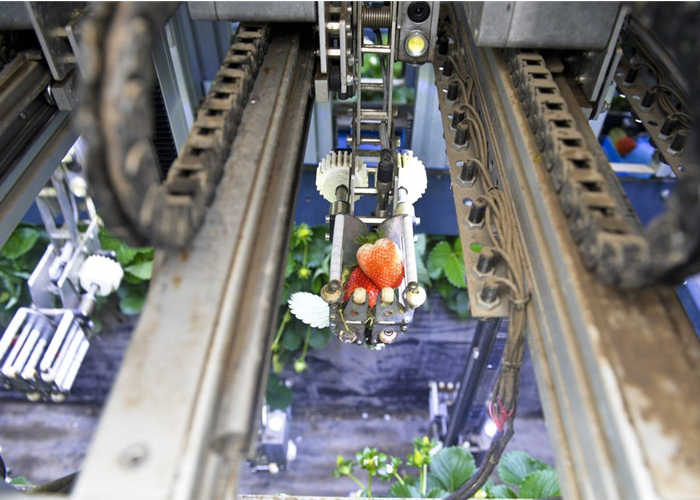
Overhead rail and gantry. The machine hangs from, or runs on, a track fixed to the structure. One of the harvesting projects described in the original work behind this page uses exactly this arrangement - a semi-autonomous machine for crop harvesting supported by twin tracks suspended from the ceiling. The attraction is that the path is fixed and therefore precise, the machine never has to negotiate an obstacle, and the power and data can be delivered along the rail. The cost is that the track has to be built into the house, and the machine can only go where the track goes.
Guided floor paths. The machine drives itself along a defined route on the floor - a buried wire, a painted or magnetic guide strip - with the route laid out to match the aisles. It costs less to install than an overhead gantry and it keeps the machine out of the crop canopy, but it inherits the same limitation: the route is only as good as the day it was laid, and re-arranging the house means re-arranging the guide.
Free-roaming with onboard sensing. The most flexible answer, and the hardest. The machine carries its own perception and localises itself against what it sees, so it can work in a house that was not built for it. The projects described in the original source lean this way - one aims to navigate autonomously in different kinds of greenhouse, and the AGROBOT concept for greenhouse tomato cultivation pairs a mobile platform with a stereoscopic vision system and a six degrees of freedom arm. Where the work is done by tele-operation rather than full autonomy, the same sensing is used to give the remote operator a usable view: a video camera combined with sonar data is one described arrangement, so the person supervising can still see what the machine is doing. That shared-control mode, where an operator supervises or takes over, is a practical middle step rather than a failure to reach full autonomy.
Whichever family a machine belongs to, the control layer behind it is the same problem, and it is already familiar in houses that run automatic climate equipment - the subject of our page on multifunction automatic control.
The House Has to Be Laid Out for the Machine
Plant distribution inside a greenhouse is normally an alternation of double rows of plants and narrow corridors for human operation and walkway, an arrangement refined over decades around the width of a person and a barrow. A robot changes the specification. It needs a consistent aisle it can follow, a bench height and reach it can work at, and either a rail it can hang from or a surface it can trust its wheels on. A house that is being planned with automation in mind is therefore a different design brief from one that is not, and those decisions are best made on paper.
The bench is where that lands most often, because the machine's reach, the working height and the aisle width are all set by the bench system and the gutter spacing rather than by the robot itself; the options in our growing bench range are where that part of the layout is settled. The original work behind this page also describes a modular, easy-to-assemble greenhouse proposed for a controlled environment that could be built to a machine's needs rather than adapted to them afterwards, which is the same idea taken to its logical end.
The layout argument is also why automation arrives faster in tall, wide, modern houses than in low, narrow ones. Structure and machines are the same purchase decision, which is why the canopy arrangement and the glazed areas of a house are best settled together, as they are in our commercial glass greenhouse range.
Reading a Sick Plant From the Crop Itself
One of the main tasks a greenhouse robot is given is to decide whether a plant is healthy, and that is harder than it sounds. Every pathogenic agent that infests a plant changes its appearance in a different way, and the changes range from obvious rot to spotting that is nearly undetectable by the human eye. A vision system and its algorithms therefore have to be built and tuned around the particular symptoms of the particular crop, because no single rule set recognises all of them.
There is a promising shortcut. Work described in the original source, carried out in the USA, introduced a method for judging plant health from the light the plant reflects when it is illuminated at a chosen wavelength. That approach should simplify the control system considerably, because it turns a shape-recognition problem into a measurement - but the same source is explicit that it is not applicable across different kinds of cultivation. A spectral method tuned to one crop is not a general-purpose plant doctor, and that limitation, more than the machine vision itself, is what keeps inspection robots crop-specific.
The prize for solving it is the same loop described earlier: individual diagnosis and removal of disease instead of a generalised spray of poisonous material across the whole house. That is a food-safety argument and a cost argument at once, and it is why the EU's Sixth Framework Programme gave such strong attention to food-related activities, looking for effective procedures and eco-compatible treatments rather than more chemistry.
Where Automation Stops Today
It is worth being blunt about the limits, because they are what decide whether a robot belongs in a particular house rather than in a brochure.
One crop, one machine. A robot tuned to tomato plants in a given aisle geometry has no idea what to do with a pot plant on a different bench. The original source is clear that the affordable route depends on equipment being task-driven and low-cost, which means narrow and specific, not general.
Harvesting is the hardest task, not the easiest. Delicate handling and selectivity are what make mechanised harvesting impractical for many crops, and that is why, on the RaboResearch reading quoted at the top of this page, the practical automation market still centres on the tasks around harvest - sorting, moving, counting - rather than the picking itself.
Most systems still keep a human in the loop. Tele-operation, where a person supervises and can take over, is the working compromise in several of the projects described in the original source. That is honest engineering rather than a shortfall: it means the machine does the repetitive and hazardous part while a person supplies judgement.
And the machine has a whole life to pay for. The original approach evaluates the machine across design, service, maintenance and dismantling, and balances the mechanical, control, sensing and informatics sides against each other rather than optimising one of them. Digital mock-ups and simulation campaigns were used to test whether the device would fit and whether tasks could be carried out safely and reliably before any steel was cut, which is the right order for a machine that has to justify itself over years rather than seasons.
One honest gap in the record: the original page names no payback period, no robot price and no hourly labour figure, so none is invented here. The evidence it does give is directional - replacing operators pays where the duty is frequent or harmful, and the labour share of protected-crop production cost is the number that sets the size of the prize.
Why Us
Bozong Greenhouse has above 35 years of professional greenhouse production behind it. From a small workshop the company has grown into a professional conservatory manufacturer with a real presence in the market, and we supply complete houses rather than frames alone. Because a robot is really a layout decision wearing a machine's clothes, the useful conversation for an automated house starts with the structure: span, height, bench and gutter spacing, aisle width, and whether the house will hang a rail or drive a floor path. Those are the choices we can build in from the start, and the systems that go with them - self-propelled equipment, control gear, irrigation and ventilation - are quoted in the same package.
To work out whether a house should be planned around a mobile machine, we need the crop, the house dimensions and span, how the plants will be laid out, and which operations you want to take off the crew. Send those and we can design the structure and the working geometry together rather than selling a frame that has to be adapted later. The components sit inside our greenhouse equipment catalogue.
Agricultural labour and mechanisation data for the United States is published by the USDA, and developments in protected cropping technology, including automation, are reported daily by HortiDaily.
Frequently Asked Questions:
Q: What jobs can a mobile robot actually do in a greenhouse today?
A: The workable list is sensing and light handling rather than heavy picking: monitoring the growing health state of the crop, taking leaf samples from plants suspected to be sick, carrying those samples back to the lab, spraying only the plants that are sick, monitoring chemical residues in the house, and working out the safe re-entry time after spraying. Environmental monitoring, harvest support, plant inspection and artificial pollination are the other operations most often named as candidates.
A: The workable list is sensing and light handling rather than heavy picking: monitoring the growing health state of the crop, taking leaf samples from plants suspected to be sick, carrying those samples back to the lab, spraying only the plants that are sick, monitoring chemical residues in the house, and working out the safe re-entry time after spraying. Environmental monitoring, harvest support, plant inspection and artificial pollination are the other operations most often named as candidates.
Q: How do greenhouse robots navigate - rails, guide wires or free roaming?
A: All three are in use. Overhead rail and gantry machines run on a track built into the structure, which is precise and simple but fixes where the machine can go; one harvesting project uses twin tracks suspended from the ceiling. Guided floor paths cost less to install but inherit the same route limitation. Free-roaming machines carry their own perception so they can work in a house that was not built for them, which is the most flexible and the hardest - the original work describes a machine intended to navigate autonomously in different greenhouses, and an AGROBOT concept with stereoscopic vision and a six degrees of freedom arm.
A: All three are in use. Overhead rail and gantry machines run on a track built into the structure, which is precise and simple but fixes where the machine can go; one harvesting project uses twin tracks suspended from the ceiling. Guided floor paths cost less to install but inherit the same route limitation. Free-roaming machines carry their own perception so they can work in a house that was not built for them, which is the most flexible and the hardest - the original work describes a machine intended to navigate autonomously in different greenhouses, and an AGROBOT concept with stereoscopic vision and a six degrees of freedom arm.
Q: Does a greenhouse have to be built differently for a robot?
A: In practice, yes. A normal house is laid out as alternating double rows of plants with narrow corridors sized around a person and a barrow. A machine needs a consistent aisle it can follow, a bench height and reach it can work at, and either a rail above or a trustworthy floor. Bench and gutter spacing set the machine's working envelope, so those decisions belong at design stage alongside the structure.
A: In practice, yes. A normal house is laid out as alternating double rows of plants with narrow corridors sized around a person and a barrow. A machine needs a consistent aisle it can follow, a bench height and reach it can work at, and either a rail above or a trustworthy floor. Bench and gutter spacing set the machine's working envelope, so those decisions belong at design stage alongside the structure.
Q: Why is spraying the first task to automate?
A: Because the exposure, not the labour saving, is the strongest argument. Knapsack spraying inside a protected house puts the operator in the worst conditions for chemical uptake - high temperature, still air and poor ventilation - and the taller and denser the crop, the worse it gets. Treating individual plants also applies less chemical and leaves less residue, which makes the safe re-entry interval easier to manage.
A: Because the exposure, not the labour saving, is the strongest argument. Knapsack spraying inside a protected house puts the operator in the worst conditions for chemical uptake - high temperature, still air and poor ventilation - and the taller and denser the crop, the worse it gets. Treating individual plants also applies less chemical and leaves less residue, which makes the safe re-entry interval easier to manage.
Q: Can a robot detect plant disease as well as a grower?
A: Not generally, and the reason is crop-specificity rather than eyesight. Symptoms differ by pathogen, from obvious rot to spotting that is nearly undetectable by eye, so vision algorithms have to be tuned per crop. A USA method that judges health from the light a plant reflects at a chosen wavelength simplifies the control system but is explicitly not applicable across different kinds of cultivation.
A: Not generally, and the reason is crop-specificity rather than eyesight. Symptoms differ by pathogen, from obvious rot to spotting that is nearly undetectable by eye, so vision algorithms have to be tuned per crop. A USA method that judges health from the light a plant reflects at a chosen wavelength simplifies the control system but is explicitly not applicable across different kinds of cultivation.
Q: Is greenhouse automation worth the investment?
A: It depends on the frequency and the hazard of the task. Labour is roughly 30 to 40 per cent of production cost in protected crops, so the hours a machine removes are worth real money, and the tasks that pay first are the ones that recur daily or weekly and the ones that expose a worker to chemicals. The original page behind this article gives no payback period or machine price, and none is invented here - the labour share is the honest starting figure.
A: It depends on the frequency and the hazard of the task. Labour is roughly 30 to 40 per cent of production cost in protected crops, so the hours a machine removes are worth real money, and the tasks that pay first are the ones that recur daily or weekly and the ones that expose a worker to chemicals. The original page behind this article gives no payback period or machine price, and none is invented here - the labour share is the honest starting figure.
If you need to ask a question and get some help to find the best greenhouse for you, then just call us on +86 191 5068 3942 or send E-mail to sales@cngreenhouses.com
 Deutsch
 Español
 Français
 Italiano
 Português
 日本の
 한국어
 العربية
 български
 hrvatski
 česky
 Dansk
 Nederlands
 suomi
 Ελληνικά
 हिन्दी
 norsk
 Polski
 Română
 русский
 Svenska